Table of Contents
Summary:
"Black crusty skin on dogs is also known as Alopecia X and psuedo-Cushings.The cause is unknown but is believed to be either hormonal or hereditary. In intact canine males, neutering has often been recommended, although there is only a 40% rate of success. There are several treatment options available, although it can't be determined which treatment will be effective for each dog."
Overview of Black Crust Skin Disease
There are other names for the Black Crusty Skin Disease, such as: alopecia X (alopecia is another name for hair loss) and pseudo-Cushing’s Syndrome. Canine black skin disease is suspected to be an inherited disorder, but that is not known for certain. It can be a difficult disorder to diagnose and treat.
Symptoms of Black Skin Disease in Dogs
Symptoms of dog black skin disease include severe hair loss and darkening of the skin (hyperpigmentation). Dog black skin disease often begins with loss of hair.
Some breeds are more susceptible to the condition than others, including the Alaskan Malamute, Poodle, Chow Chow, and Pomeranian. Male dogs are more susceptible than females.
Diagnosis
Many, though not all, dogs with canine black skin disease have abnormally low levels of growth hormone. This can be determined with blood tests. If this is the case with your dog, it will help to determine the course of treatment.
If there is black skin on your dog and growth hormone levels are normal, other causes must be investigated, as it can occur even when growth hormone levels are normal.
Thyroid problems and tumors on the adrenal gland (Cushing’s disease) can cause similar symptoms. Your vet will need to do blood tests to rule out these causes of black crust skin dog disorders. However, if these things are ruled out, your dog may be diagnosed with canine black skin disease even if his growth hormone levels are normal.
Treatment of Black Skin Disease
Of course, the treatment of black crusty skin dog disorders depends on the cause of the disease. If it is canine black skin disease and growth hormone levels are low, treatment with growth hormone is indicated. Treatment with growth hormone can lead to diabetes, however, so careful monitoring of blood sugar is necessary.
In some cases, black crusty skin dog disease seems to be related not to growth hormone but to sex hormones, and getting your dog neutered or spayed will help solve the problem. It’s a good idea to neuter your pet anyway, so this is a good thing to try before resorting to medications.
If your dog has been neutered or spayed and the level of growth hormones are normal, the condition is more of a cosmetic problem than a health concern. Vets often recommend leaving it alone. It isusually not itchy and will not bother your dog. Even with several treatment options available as noted below, not all dogs will respond to treatment.
Prescription treatments may include:
- Mitotane
- Trilostane - normally given at a dose rate of 3-4mg/kg per day for several months
- Ketoconazole
- Prednisolone - not recommended by many clinicians
- Growth hormone - can be expensive
- Testosterone
- Melatonin - administered normally at an initial dose of 3-6mg twice daily (bodyweight can be a factor). Based on clinical progression over several weeks to months
- Alpha-tocopheryl
If blood tests find that the problem is related to thyroid problems or Cushing’s disease then treatment for those conditions are, of course, needed. A natural remedy such as Cushex may provide some support, as it contains ingredients associated with improving adrenal gland health and function. Also, you can try giving your dog melatonin, found at health food stores, which may help hair to regrow. Give a 3 mg tablet daily. Be aware, however, that this may have a sedating effect on your dog.
Ask Our Vet A Question or Share Your Story
Have A Question about Your Dog's Skin Condition? Our Team Will Answer It for Free!
Do you have a question or comment? Share it!
Our editors will pick 1 question to answer each week. Please include your dog's age, breed, medical history, medications and if possible, a picture of the condition.
We will do our best to get back to you quickly (it depends on how many questions we receive each day). If you do require an immediate response we suggest using this online dog veterinary service that is available now.
Other Reader Dog Skin Related Questions and Vet Suggestions
Click below to see contributions from other visitors to this page...
Testing for Dog Hair Loss 
I have a 10 year old black male who 2 months ago had this black crusty, scab growth under his fur. It started to fall out and irritate him and he picked …
Canine Black Skin Disease Treatment
My German Shepphard's skin is black and her hair has fallen out. Do you think it is Black Skin Disease? I take her to vets and they give her antibiotics …
Black Skin Disease Not rated yet
Reader Question: How Does A Canine Get Black Skin Disease?
I have a 14 year old yellow female lab that within the last 8 weeks has developed black …
Dog Black Skin Disease and Euthanization Not rated yet
Reader Question: Why Do Vets Want to Euthanize Our Dog for Black Skin Disease?
Our dog has this horrible disorder... We've tried several different …
Causes of Black Patches on Dog Skin Not rated yet
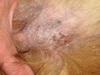
Could this possibly be some form of black crusty skin dog disorder?
Editor Suggestions Regarding Causes and Treatment of Black Patches on Dog Skin …
Dog Skin Infection Returns After Using Antibiotics Not rated yet
Reader Question Followed by Advice From Our Veterinarian: Cause of Dog Skin Infection Returning After Antibiotic Treatment
We have a 4-year-old male …
West Highland White Terrier With Itchy Skin Not rated yet
my dog itches practically all the time he has cuts over his body from where he has been itching and his hair off his chest is falling out all the time …
Dog Hair Loss and Skin Changes Not rated yet
I have a seven year old female Am Staff that has started losing dog hair on her sides and tail. About a year ago I noticed her skin turning very dark, …
Reference
Unusual Endocrine Dermatoses in the Dog and Cat
Rory Breathnach MVB, PhD, MRCVS
University Veterinary Hospital, University College Dublin
Belfield, Dublin, Ireland


