Summary:
"Prostate cancer (prostate carcinoma or PCa) is not common in dogs and is usually diagnosed during the later stages of the disease after it has started to spread. Usually the condition is seen in older dogs at an average 10 years of age. A veterinarian can find signs of the disease during a rectal exam, by taking x-rays, and by performing certain tests. There are no known cures, with some studies showing that surgery used in combination with radiation could extend a dogs life for a limited time as detailed below. Some supportive care may be available using natural remedies, although note this is not a cure."
Overview
Canine prostate cancer is found primarily in older male dogs that have been castrated, although it can be found in dogs that are intact. The disease is not more common in any particular breed.
Most cases of canine prostate cancer are carcinomas (cancerous tumors that spread to other parts of the body) and are referred to as adenocarcinomas. Most cancers are highly malignant and spread to the sublumbar lymph nodes, lungs and skeletal system, particularly the lumbar vertebrae, pelvis and femur.
Symptoms of Canine Prostate Cancer
Common symptoms of canine prostate cancer include:
- Straining when defecating - dyschezia
- Urination problems
-- Blood in urine - haematuria
-- Straining when urinating, drop by drop urination - stranguria - Systemic signs such as:
-- Weight loss
-- Anorexia
-- Occasional signs of hind limb lameness
-- Neurological (nervous system problems, trouble reacting to environment, etc.)
Detection of Prostate Cancer
When a veterinarian examines the prostate for any cancer or malignancies it will feel firm, irregular, and cause some pain. It will also be immovable within the pelvis. Canine prostate cancer is one of the few cancers that affect dogs that have been castrated. In fact, many believe that castrated dogs have a higher incidence of the disease.
Helpful tests to confirm a cancer in dog prostate include
x-rays (retrograde positive contrast urethrocystography), biopsy via
fine needle aspirates, cytology, and histology. On x-rays the
dog prostate will look
enlarged.
Unfortunately, canine prostate cancer is usually diagnosed late in the disease's progression. After diagnosis, most dogs only live 30 days. Human treatment options such as antiandrogens are not effective since the cancer is not dependent on hormones. Also unlike humans, tests that screen for prostate cancer are also not reliable such as human PSA tests. Canine prostates need to be tested for CPSE.
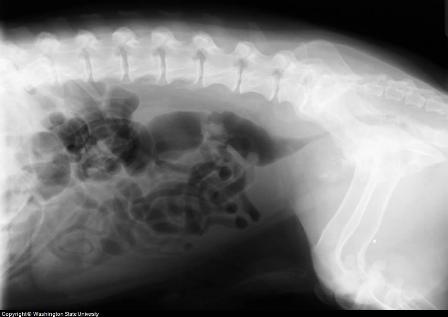
X-Ray Basset Hound Prostatic Adenocarcinoma
Source: Washington State University College of Veterinary Medicine
Treatment of Prostate Cancer In Dogs
Canine prostate cancer (PCA) is usually not treated since in most cases the cancer has spread and there is usually a poor prognosis. Among dogs that are not treated, studies are limited in terms of life expectancy. One study resulted in the majority of dogs being euthanised (put to rest) while 12 out of 72 dogs in the study lived for 30 days.
Removing the prostate gland with surgery, a procedure called prostatectomy, is not usually recommended. Dogs that do undergo the operation have a high incidence of urinary incontinence.
There are new techniques being investigated that can result in longer survival times, although studies are limited. In one approach, surgery is used to place a retained urethral catheter in three dogs with PCa and stranguria (difficulty urinating) which resulted in the dogs survival for 3 to 5 months after surgery (Mann et al., 1992). Another study of 3 male dogs with prostatic neoplasia (prostatic transitional cell carcinoma in 2 cases and undifferentiated carcinoma in one case) were treated with transurethral resection using an electrosurgical loop (combined with intraoperative radiation therapy in 2 of those 3 dogs) (Liptak et al., 2004). Survival times were 32, 74, and 264 days.
Radiation therapy (intraoperative orthovoltage radiation) in combination therapy with surgery was used in a study of 10 dogs (Turrel, 1987). The mean survival time was 114 days. In another study external beam radiation therapy was combined with administration of ketoconazole. Two dogs treated with this technique were reported to survive for 12 weeks and 4 months, respectively (Bell et al., 1991).
Natural Remedies such as C-Caps Formula may provide some level of supportive care by reducing the severity of symptoms, strengthening healthy cells and restoring some energy and vitality.
Ask Our Vet A Question or Share Your Story
Have A Question For Our Veterinarian About Cancer in Dogs?
Do you have a question or story about canine cancer? Share it! Our editors will try their best to answer your question for free.
Please include information such as age, breed, sex, medical history, medications, diagnosis, cancer stage,has it spread and anything you believe that will help us answer your question.
We will do our best to get back to you quickly (depends on how many questions we receive each day). If you do require an immediate response we suggest using this online dog veterinary service that is available now.
References
Prostate Disease
P. E. Holt
University of Bristol, Department of Clinical veterinary Science,
Langford House
Langford, Bristol, UK.
Prostatic neoplasia, is there room for surgery?
Jolle Kirpensteijn DVM, PhD, Dipl ACVS, Dipl ECVS, Utrecht, NL
Henry l’Eplattenier, Faculty of Veterinary Medicine, Utrecht
University, Utrecht, NL


