Table of Contents
Overview & Anatomy | Types of Eye Tumors | Symptoms & Diagnosis | Treatment | Q & A
Summary:
"Most canine eye tumors, or ocular tumors, are benign, which means that they are not cancerous or dangerous to the health of your dog. Benign tumors can be left alone if they are not causing any discomfort or interfering with eye function.
Malignant or cancerous tumors can originate in the eye or spread from neoplasms (growths) in other areas of the body.
Diagnosis is made after examining a small tumor sample under a microscope. Tumors behind the eye or malignant tumors (cancerous and fast growing) can be problematic and require surgical removal or other treatments such as laser therapy or cryotherapy (freezing)."
Overview
Canine eye tumors often appear as spots or discolorations on the eye. These are not necessarily tumors, but can be. Tumors can be in the eye, on the surface of the eye, behind the eye, or on the eyelid.
Canine eyelid tumors are usually not cancerous and do not spread to other parts of the dog. Most tumors are located on the anterior (front) of the uvea (middle part of the dog eye containing the choroid, ciliary body and iris.
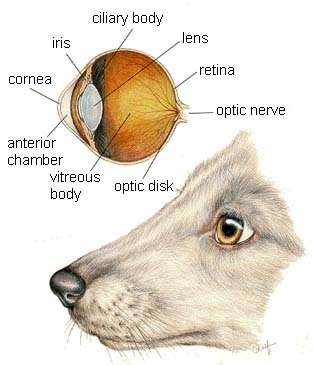
Source: Hill's Pet Nutrition, Atlas of Veterinary Clinical Anatomy
Types of Canine Eye Tumors
- Iris Melanoma:
This is the most common type of dog eye tumor. The condition
starts with a change in the pigmentation or color of the iris (the
round colored part of the eye). It can take from years to just a few
months to form. As the tumor grows in size it can restrict the ability
of the iris to function (let's light into the eye), causing it to
change shape (a condition called dyscoria).
An iris melanoma can trigger secondary glaucoma. This type of tumor or neoplasia can spread to a dog's lungs, spleen and liver, where tests often first determine the presence of cancer. A type of iris melanoma, focal iris melanoma, can be treated with a procedure called laser coagulation. - Orbital
Neoplasia (the cavity that holds the eye): This type of
neoplasia or tumor occurs in the tissues that line the cavity that
holds the eye (most common type is a osteosarcoma). The neoplasia can
spread from nearby locations such as the dog's nasal cavity or sinuses.
Symptoms of canine orbital neoplasia include swollen eyelids, a buildup
of the tissue behind the eye (exophthalmos).
Other types include squamous cell carcinoma (starts on the eyelid), orbital adenocarcinoma (spreads from the dog's nasal cavity) and a epibulbar melanoma (mass on eye sclera often seen in German Shepherds). Treatment depends on the specific type, location and size of the tumor. - Cilary Body
Neoplasia: This type of dog eye tumor appears as a reddish
pink mass in the eye pupil, towards the rear of the iris.
Cilary body neoplasia can trigger glaucoma. If this
dog eye condition can be diagnosed early, it can be corrected with
surgery. Signs include a swollen conjunctiva (membrane that lines the eyelids and
that
covers the dog eyeball), a prominent third eyelid, a dilated
pupil, or if the dog retina is detached.
- Uveal Canine
Lymphoma (canine ocular lymphoma): This is a common type
of tumor that is the result of a neoplasia or cancer that has spread
from another area of the dog's body. The condition appears
as a pinkish white mass on the front of the uvea. As the tumor
grows it can trigger canine glaucoma. The cornea can also
appear blue/white in color. Tumor cells can spread to other areas of
the eye including the retina and vitreous.
- Ocular
Metastases: This type of cancer occurs in the uvea and
choroid. The presence of this type of tumor may indicate
cancer (adenocarcinoma) in a dog's mammary glands, cancer in the
uterus, the presence of a squamous cell carcinoma, or a
hemangiosarcoma. This type of tumor is commonly found in the
part of the eye referred to as the ciliary body.
- Posterior
Segment Neoplasia: This is a one of the rare canine eye
tumors where a tumor forms in the part of the eye called the posterior
(rear) segment. They are sometimes a type of dog eye tumor
called astrocytoma. Symptoms include a brown mass beneath the retina.
- Limbal
Melanoma: This type of melanoma appears as a brown mass
the appears on the limbus (the part of the eye between the white sclera
and the colored iris). The eye tumor can reach from the
limbus to the sclera (white part of the eye). Treatment is possible
with procedures such as cryotherapy (freezing), sclerectomy (removal of
a portion of the sclera), or a keratectomy (removal of part
of the cornea).
- Canine eyelid
neoplasia: The most common type of dog eyelid tumor or
neoplasia is referred to as a sebaceous gland adenoma. Other
types are papiloma and melanoma. Most tumors are benign. Dog
eyelid tumors are treated with surgery.
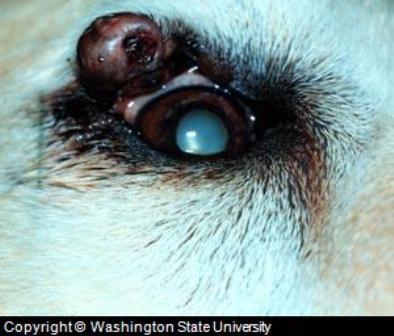
Source: Washington State University
Symptoms of Canine Eye Tumors
Redness, itching or tearing of the eye can mean your dog has an eye tumor. Changes in eye pigmentation can also indicate the presence of a primary or secondary (spread from another part of the body) dog eye tumor.
Diagnosis of Eye Tumors in Dogs
To make a diagnosis of the canine eye tumors mentioned, your veterinarian will want to take a small sample of the tumor for testing in a lab. The dog should undergo a complete physical examination.
If the tumor is inside the eye a veterinarian has a special scope
(opthalmoscope) that can look into a dilated eye (done with drops). If
the tumor is behind the eye, there is a special tool (fine-needle
aspirate) that will allow your veterinarian to take a sample (biopsy).
Other methods include ultrasound, x-rays, MRI, CT scan and
blood tests.
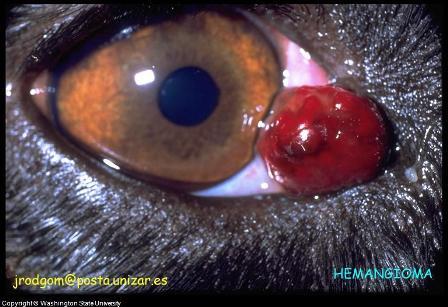
Source: Washington State University
Treatment of Canine Eye Tumors
Not every eye tumor requires treatment. If your veterinarian believes it is small, and with monitoring it is not growing, it can be left alone without treatment. Other options include removing the tumor or in more drastic cases removal of the entire eye. If your dog needs its eye removed, most dogs adapt well and heal completely.
Tumors behind the eye can be a problem. They tend to grow quickly so removal of the eye is often called for. Radiation after the eye is removed is often prescribed in case any cancer cells were not surgically removed. Other methods for treating canine eye tumors includes laser ablation, hyperthermia, cryosurgery, chemotherapy and radiation.
Ask Our Vet A Question or Share Your Story
Have a Dog Eye Related Question For Our Editors or A Story to Tell About This Topic?
Do you have a dog eye related question for our Veterinarian or a helpful story to share? We'll answer it for free! Please include information such as age, sex, breed, medical history, symptoms, diet, changes in behavior and medications.
We will do our best to get back to you quickly (depends on how many questions we receive each day). If you do require an immediate response we suggest using this online dog veterinary service that is available now.
Other Dog Eye Related Reader Questions and Answers from our Vet
Click below to see contributions from other visitors to this page...

Lump on Dog Eye and Dog Eye Inflammation 
Samantha, my 13 month old Labrador retriever has an inflamed eye that weeps and the other eye has a lump near the tear duct.
I took her to the vet and …
Fast Growing Dog Eye Tumor Not rated yet
This tumor has doubled in size in just a few weeks. It also has a bloody discharge but from nowhere obvious. We clean with a warm wet cloth em several …
References
Canine Ocular Tumours
Ingrid Allgoewer
European College of Veterinary Ophthalmologists
Animal Eye Practise
Nutrition and Cancer: New Keys for Cure and Control 2003!
Gregory K. Ogilvie, DVM, DACVIM (Internal Medicine & Oncology)
Colorado State University
Ft. Collins, CO, USA
Prostatic Disease in the Dog
Peter E. Holt, BVMS, PhD, ILTM, DECVS, CBiol, FIBiol, FRCVS
Professor of Veterinary Surgery, University of Bristol,
Department of Clinical Veterinary Science
Langford, Bristol, UK
Lymphoma
Antony Moore, BVSC, Diplomate ACVIM
Director, Veterinary Oncology Consultants
379 Lake Innes Drive
Wauchope NSW 2446, Australia
Canine Brain Tumors: Improvements in Diagnosis and Treatment
R Chun
School of Veterinary Medicine
University of Wisconsin-Madison
Neoplasia of the Nervous System (spinal tumors)
S. Long
School of Veterinary Medicine
University of Pennsylvania
Current Therapy for Canine Oral Tumors
M. Kessler
Tierklinik Hofheim, Germany
Dog Owner’s Home Veterinary Handbook
James M. Giffin
Liisa D. Carlson DVM
Hound Health Handbook
Betsy Brevitz, DVM
Ophthalmic Neoplasia
Michael H. Brown, DVM, MS, Diplomate ACVO
Veterinary Ophthammology Services


