Table of Contents
Summary:
"Dog glaucoma is one of the most common causes of blindness in dogs. It is a condition where fluid builds up in the eye causing an increase in pressure. It can be inherited or caused by eye inflammation or trauma. Treatment options include medication or surgery. New surgical procedures involve the use of surgical implants. Severe or acute glaucoma requires immediate treatment to avoid vision loss."
Overview
Glaucoma is a condition where the fluid pressure in the eye is higher than normal. It results in loss of vision and can be painful for your dog. The condition is progressive meaning it gets worse over time.
Glaucoma in dogs is caused by pressure from a build of fluid where the iris meets the cornea. When the fluid doesn't drain normally, pressure builds. The condition is either inherited (primary glaucoma) or a result of another disease (secondary).
Secondary glaucoma can be caused by:
- Inflammation in the eye
- Eye injury
- Eye tumor
- Dislocated lens
If the glaucoma is severe (acute) then emergency treatment is needed to relieve the pressure. Not doing so can result in vision loss.
Canine glaucoma is difficult to diagnose. A device is used to measure the pressure. Accurate readings are influenced by the breed, time of day, restraints and age. For this reason several readings are often taken.
Breeds Susceptible to Glaucoma
There are over 40 breeds where glaucoma can be inherited (called primary glaucoma).
These include:
- Jack (Parsons) Russell Terriers
- Akita
- Alaskan Malamute
- Basset Hound
- Maltese
- Beagle
- Border Collie
- Boston Terrier
- Bouvier des Flandres
- Brittany Spaniel
- Cairn Terrier
- Cardigan Welsh Corgi
- Chihuahua
- Chinese Shar Pei
- American Cocker Spaniel
- Chow Chow
- Dachshund
- Dalmatian
- Dandie Dinmont Terrier
- English Cocker Spaniel
- English Springer Spaniel
- German Shepherd
- Giant Schnauzer
- Greyhound
- Irish Setter
- Italian Greyhound
- Lakeland Terrier
- Miniature Pinscher
- Miniature Schnauzer
- Norfolk Terrier
- Norwegian Elkhound
- Norwich Terrier
- Poodle (Toy/Miniature)
- Samoyed
- Scottish Terrier
- Sealyham Terrier
- Shih Tzu
- Siberian Husky
- Skye Terrier
- Smooth Fox Terrier
- Tibetan Terrier
- Welsh Springer Spaniel
- Welsh Terrier
- West Highland White Terrier
- Wire Fox Terrier
Symptoms of Dog Glaucoma
Canine glaucoma symptoms include:
- Redness
- Cloudy eyes
- Tearing
- Vision loss
- Elevated third eyelid
- Poor appetite
- Enlarged eyeball
- Tiredness or lethargy
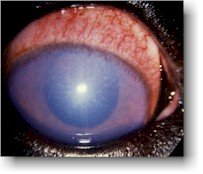
Treatment of Dog Glaucoma
Glaucoma in dogs is difficult to treat. Treatment includes oral and topical medications. Surgical options include laser surgery and cryosurgery to help drainage or insert a drainage device.
If treatment is not an emergency, the medications will be tried first to see if the eye pressure (IOP) can be brought into normal range. Your veterinarian will need to monitor your dog's eye condition every 2 weeks for the first month. If eye pressure cannot be controlled then surgery may be needed.
There is a new surgical approach called TR-ClariFEYE, which is a 30 minute procedure involving an implant which is inserted into the eye. The device can help to control pressure in the dog's eye and can lead a reduced need for topical eye treatment.
If you dog is in pain then the eye may need to be removed (called enucleation) or replaced with silicone. Even with surgery and medications, irreversible blindness may still occur.
Sources
Canine Glaucoma. Recent Advances in its Diagnosis and Treatment
Daniel Herrera, MV, PhD
Diplomate of the Latin American College of Veterinary Ophthalmologists
University of Buenos Aires, Argentina
Glaucoma: What Can I Do Before I Send It?
C.M.H. Colitz
Animal Eye Specialty Clinic, West Palm Beach, FL, USA


