Summary:
"Canine or animal Distemper (canine distemper virus or CDV) is a deadly disease that cannot be cured with medication. The virus is a morbillivirus in the Paramyxovirdae family. There is no direct treatment with focus on supportive care.
The disease results in proteins that can enter membranes of infected cells making them susceptible to immune system attack. The virus is spread via aerosol droplet secretions from the nasal or oral cavities of infected animals or contact with bodily fluids such as urine. It can also be transmitted by a pregnant bitch to her pups via transplacental travel. In adults the spread of the disease is moderated by immune system strength.
Puppies younger than 4 months of age are susceptible to the disease since they have not yet been vaccinated, a process that can start as early as 6 weeks of age followed by boosters. A puppy can contract the disease before receiving the complete set of vaccinations. For this reason use caution if taking a puppy to an obedience class or groomer.
A dog that recovers from distemper is then immune from for the rest of his life. A large number of dogs (25% to 75%) are susceptible to the virus, but can fight off the disease without showing any clinical signs. Dogs that show clinical signs have an immune system that is not capable of fighting it off. Vaccination is a critical preventative.
The virus can be removed from the dog's environment with any disinfectant cleaner that has a detergent activity."
Overview
Animal distemper is a paramyxovirus, very similar to the virus that causes measles in humans. In dogs, it affects a wide range of organs, including the skin, brain, eyes, intestinal, and respiratory tracts. It occurs in dogs and other wild carnivores.
Dogs that receive the vaccine should be protected from the virus unless the vaccine did not take hold as is sometimes the case in puppies, who need to be several months old (4 to 6) since antibodies in their system from their mother can prevent the vaccine from taking hold.
Contrary to rumors, there is no evidence the CDV can cause multiple sclerosis or infection in humans.
Symptoms
Symptoms for Canine Distemper affects all major systems of the body, including the respiratory, digestive, and central nervous systems. Your dog can show severe symptoms to no symptoms at all.
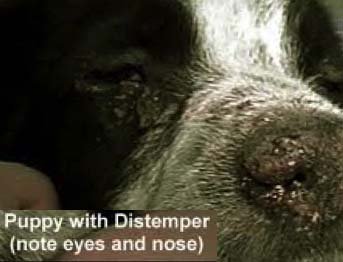
During the first 3 - 6 days after infection probably will show no symptoms. Immediately after you could see discharge from the knows and eyes, depression and anorexia. Gastrointestinal and/or respiratory signs may follow with some type of bacterial infection.
Generally, are in the eyes, nose, respiratory system and the gastrointestinal system. Specific symptoms include:
- Reddened eyes, discharge from the eyes
- Blindness may occur
- Cough
- Runny nose
- Fever
- Vomiting
- Diarrhea
- Loss of appetite, weight loss
- Loss of energy
- Muscle tremors
- Paralysis
- Seizures
- Thickened foot pads
- Thickened pad on the nose
Symptoms may be mild or severe. In mild cases, it may not be easily recognized as distemper.
Diagnosis
Distemper diagnosis is difficult. The veterinarian will attempt to
detect the virus by testing bodily fluids such as blood or urine. In
vaccinated dogs tests are less useful since they may indicate a
incorrect results.
Blood tests that can help to diagnose the disease but they are not always effective. For instance, finding that white blood cells are very low suggests a diagnosis of distemper, but it can indicate other illnesses as well. Vets also look for evidence that white blood cells have produced special antibodies to fight distemper. However, if a dog has been vaccinated in the past, these antibodies will often be present, whether or not the dog actually has distemper. There are other blood tests that actually look for the virus itself, but these often show false negatives as the virus "hides" inside the cells and does not show up in the blood.
Another test for the disease is a cerebral spinal fluid test (CFS). This involves taking a sample of spinal fluid and examining it. It is a costly and somewhat dangerous test, however. And it will not always be accurate.
Hopefully, one of the tests for distemper will be accurate and give you a diagnosis. Otherwise, your vet may have to simply make a diagnosis based on your dog's symptoms.
Distemper can be confused with other infections such as:
- leptospirosis
- canine infectious hepatitis
- rabies
- infectious respiratory disease complex
- Rocky Mountain spotted fever
Treatment
Unfortunately, there is no cure for distemper in adult dogs or for puppy distemper. That's why it is so important to get your dog vaccinated against the disease. Your dog should be vaccinated every year.
If your dog gets distemper, a veterinarian will focus on supportive care to address any symptoms. The Vet will treat him with antibiotics for any secondary bacterial infections. He many need IV fluids and nutritional supplements. Anti-seizure medications can be given is he has developed seizures as a symptom of his condition. He should be kept away from other animals, as distemper is highly contagious. Antiviral medications are not typically used.
If vomiting is present, oral drugs, food and water are discontinued.
If symptoms are sever, a dog may require hospitalization and should be isolated from other animals.
Dogs that recover from the virus are immune from CDV (canine distemper virus) for life. Any neurological signs such as seizures indicates the possibility of a poor prognosis for recovery.
Cost of Care
Distemper can cost up to $500 to treat depending on the severity of the disease.
Prognosis
The prognosis in dogs is guarded.
Prevention and Vaccination
Vaccination can start at 6 to 8 weeks of age with boosters every 2 to 4 weeks until age 16 weeks.
Guidelines suggest revaccination every 2 to 3 years depending on the vaccine used. No vaccine is 100% effective.
Have a Canine Distemper Related Question For Our Editors or A Story to Tell About This Topic?
Do you have a dog distemper related question for our editors or a helpful story to share? Please include information such as age, sex, breed, medical history, symptoms, diet, changes in behavior and medications.
We will do our best to get back to you quickly (depends on how many questions we receive each day). If you do require an immediate response we suggest using this online dog veterinary service that is available now.
For Additional Reading
American Veterinary Medical Association
Sources
Distemper
Foster, Race DVM, and Smith, Marty DVM
Canine Distemper: Current Status
Appel, M. and Summers, B.
Clinical Signs and Diagnosis of
Distemper Encephalitis
Alejandro Luján Feliu-Pascual
DVM MRCVS Diplomate ECVN


