Table of Contents
Overview | How to Apply | Symptoms | Treatment & Glaucoma | Natural Remedies & Support
Summary:
"Eye drops for dogs requires care in how they are administered. Different drops are recommended based on the underlying cause of the condition. Homeopathic drops or treatments might also help a condition."
Overview
Eye infections in dogs can be caused by a number of things. Commonly they are caused by viral or bacterial infections, but they can also be caused by parasites, by foreign bodies in the eye, and by allergies.
Eye drops for dogs are commonly used for treatment of eye infections and diseases. A single eye drop lasts in effectiveness from 2 to 20 minutes; frequent treatment is needed to maintain drug levels. Typically, this requires treatment at least every 1-4 hours.
One drop is all that is needed when treating an eye. Droppers deliver a drop size of 25 to 75 microl, while the Canine eye “holds” 25 to 30 microl. Therefore, if you or the pet’s owner gives 2 or more drops, then spillover will occur causing waste of medication and increased systemic absorption.
If your veterinarian wants a higher concentration of drug in the eye, then increase the frequency of administration of the drug (however, wait at least 5 minutes between drops). Your veterinarian will either prescribe a higher concentration of the drug (e.g., 0.5% timolol instead of 0.25% timolol), or alter the eye or drug to improve ocular penetration (e.g., remove corneal epithelium, increase the pH of the drug).
Eye drops for dogs are easy to use and there are many drugs available in solution or suspension form. They work for a wide range of canine eye diseases and problems including perforations.
Ointments stay in the eye longer than drops so are usually applied less often.
How to Apply Canine Eye Drops or Ointment
While you might be concerned that giving your dog eye drops is difficult, with a little practice it will quickly become second nature. Start with some eyewash on a cotton ball and clean the inner corner of the eye. Use a new cotton ball for each eye. If you are applying ointment or drops, do not touch the tip of the container to the eye or your fingers. It's important that the tip remain sterile.
Most veterinarians will instruct you to either put a dot or 1/4 inch of ointment in the eye, or 2 drops of liquid.
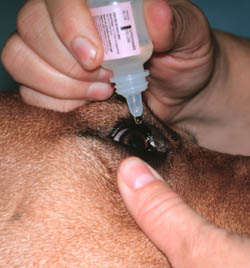
Ointment or Eye Drops for Dogs: Instructions
- Hold or muzzle your dog to keep the head steady if your dog tends to squirm.
- See the instructions on the bottle for dosage. Shake if necessary.
- Use one hand to hold the bottle between thumb and index and place the other under your dog’s jaw to support the head.
- Tilt the head back and, to prevent blinking, use your free fingers to hold the eyelids open.
- Hold the bottle close to the eye but DON’T touch the eye’s surface. Keep the bottle about 2 inches from the eye.
- Squeeze the drops onto the eyeball, then release the head.
- Your dog will blink, spreading the medication over the eye’s surface. If using ointment and it sticks to the tube, use the top of the eyelid you are holding open to push the ointment off the tube. You can also pull down the lower lid, forming a pocket for the ointment. As long as you get the ointment in the eye it will melt and spread.
Immediately put the cap on the ointment or drops. If you are working with someone they can help block your dog's front paws with their forearm.
When Eye Drops for a Dog are Needed: Symptoms
There are several types of eye infections in dogs including:
- Conjunctivitis (pink eye) - The type of eye infection most often seen. Common symptoms are redness, mucus discharge.
- Keratoconjunctivitis sicca - Dry eyes. Could cause ulcers in the eye.
- Uveitis - Dog eye symptoms include redness, light sensitivity (photophobia), blurred vision, and pain.
See your veterinarian if your dog is in pain, redness persists, or if your dog is having vision problems.
Eye Drops for Dog if Conjunctivitis
If your dog doesn't seem sick, isn't squinting or rubbing the eyes and the only symptom is red eyes, then your dog probably has conjunctivitis caused by irritants or allergies. Try flushing the eye with a plain saline eyewash form the drugstore. Squirt large amounts of solution in each eye and gently wipe with a clean tissue.
Use the saline 2x - 3x per day for up to two days. If the redness disappears and does not return, the problem is solved. If redness quickly comes back then make an appointment with your veterinarian.
Vet Diagnosis
Your vet will examine your dog’s eyes with an ophthalmoscope, a
lighted magnifying instrument for examining the eyes. He or she may take a
swab of any discharge from your dog’s eyes to be examined under
a microscope, and based on findings may prescribe ointment or eye drops for your dog.
Treatment Using Eye Drops for Dogs
Over the counter human products such as Visine should not be used as it is not made for dogs and at best will only provide temporary short-term relief. It will not treat the underlying cause of the redness.
Glaucoma Eye Drops for Dogs
There are many kinds of eye treatments for glaucoma depending on the type. Most are designed to reduce pressure in the eye.
- Miotic:
-- Pilocarpine
-- Humorsol (Demecarium bromide) - ß -blocker:
-- Timoptic (Timolol maleate)
-- Metipranolol - Carbonic Anhydrase Inhibitor (CAI) diuretic:
-- Daranide (dichlorphenamide)
-- Neptazane (methazolamide)
-- Dorzolamide
-- Diamox (acetazolamide) - Osmotic diuretic:
-- Mannitol
-- Glycerine or glycerol - Prostaglandin analog:
-- Xalatan (latanoprost) - Cholinesterase inhibitor:
-- Demecarium bromi
Natural Treatment for Red or Swollen Dog Eyes
Natural remedies contain a blend of natural ingredients in an
herbal tincture/mixture and will effectively treat and prevent eye
infections in dogs as well as improve general eye and visual health.
Common ingredients include:
- Arctium lappa (Burdock) - A cleansing and herb; excellent at detoxifying the tissues and removing unwanted substances from the body. Stimulates functioning of the immune system and is very useful in the treatment of dry eyes and eye infections.
- Rosmarinus officinalis (Rosemary) - A topical antiseptic/disinfectant and pain-relieving herb. Several of the compounds in rosemary have also been shown to have anti-inflammatory effects.
- Chelidonium majus - Boosts the immune system and combats infections. Also known to sharpen sight, promote healing, and act as an analgesic (pain killer).
- Filipendula ulmaria (Meadowsweet) - Has a long history of herbal use and was prized by ancient Druids for its medicinal properties. Meadowsweet has astringent, antiseptic and anti-inflammatory properties and is excellent for soothing and healing infections of the eyes and conjunctiva.
A good commercial source for herbal eye remedies is Pet Alive Eye-Heal - Natural treatment of bacterial conjunctivitis in dogs.
Sources
Navigating the Myths and Folktales of Ocular Medication - Treatment of Corneal and Ocular Surface Diseases
B.C. Gilger
College of Veterinary Medicine, North Carolina State University
Raleigh, NC, USA
Eye Problems in Dogs
Dunn, T. J. Jr., DVM
Brevitz, Betsy DVM
Hound Health Handbook


