Table of Contents
Overview | Acquired Heart Disease | Congenital Heart Disease & Breeds | Vet Q&A
Summary:
"Heart disease in a dog is the second most common cause of death after cancer, affecting approximately 15% of dogs. Canine heart problems are classified by whether it was something your dog had from birth (congenital heart disease) or it was acquired during your dog's life (acquired heart disease).
Overview
Canine congestive heart failure (CHF) describes the slowing of symptom progression, as the heart attempts to compensate for whatever is causing the problem. As heart function declines, other parts of the body that rely on blood flow are affected. Heart disease may be asymptomatic with a veterinarian detecting early symptoms such as a dog heart murmur."
Types of Acquired Heart Disease In A Dog
-
Dilated Cardiomyopathy (DCM) - In this disease the ventricular section
of the heart becomes enlarged or dilated. The condition is seen more
often in certain breeds when a dog becomes an adult such as such as a
Doberman Pinscher, Irish Wolfhound, Great Dane and Boxer. Male dogs
whose mothers have the condition are also at risk. There has been a surge in dilated cardiomyopathy starting in 2019. It appears that non-hereditary DCM may be affected by factors such as genetics, diet, and underlying medical conditions. The FDA in the United States is currently (December 2020) reviewing dog foods, looking at ingredient sourcing, nutrient bioavailability, and ingredient levels, but has not issued any guidance. Speak to your Veterinarian about any updates.
- Chronic Valvular Heart Disease In A Dog (Mitral Valve Disease)
- There are four valves in a dogs heart. One of the valves is the
mitral valve (MV). In chronic valvular disease the heart valves do not
close in the right way, causing problems with the way blood flows
through the heart and leaks. This often occurs with advanced age from
wear and tear.
This disease is often diagnosed when your Veterinarian hears a heart murmur. It can occur in a dog as young as 6 years old and as old as 10 years. When blood does not pump correctly through the heart and lungs, blood flow slows down, allowing fluid to leave the capillaries and enter the lungs. Fluid build-up is another sign of heart failure. The build-up of fluid causes constant coughing when your dog attempts to constantly clear its throat. The strain on your dog's body could also cause weakness.
The fluid build-up in the lungs is called canine pulmonary edema. Fluid can also build-up in the abdomen and below the skin (canine peripheral or limb edema). When your Veterinarian sees multiple signs of fluid build-up, they also assume some form of heart disease. Unlike people, surgery is often not recommended to fix a leaking valve. - Arrhythmogenic Right Ventricular Cardiomyopathy (ARVC)) - This condition is due to an electrical problem in the heart. Often found in adult boxers.
- Myocardial Disease - When the heart gets weak and then enlarges.
- Pericardial Disease - There is a sac that surrounds the heart and protects it. It this sac fills with fluid, it doesn't pump efficiently.
- Canine Heart Arrhythmia - A healthy dog's body automatically changes its heartbeat to maintain proper bloodflow. Like a human, if a dog is active, the heart beats faster, and at rest it beats slower. If your dog has a canine heart arrhythmia, your dog cannot regulate its heart beat as well as it should (too fast or too slow).
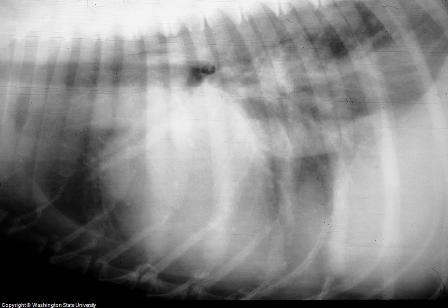
Canine pulmonary edema is a condition where fluid accumulates in the lungs, usually because the heart's left ventricle does not adequately pump.
Source: Washington State University
Types of Canine Congenital Heart Disease and Breeds More Commonly Found
Unlike human heart disease, the medical community does not yet understand the genetic defect necessary to pass heart disease from one generation to the next. The most common known congenital heart defects in dogs are:
- Ductus arteriosus (PDA) has been demonstrated to have a
genetic origin in Poodles. Other breeds where PDA is seen include the
Maltese, Toy and Miniature Poodle, and the Shetland Sheepdog.
- Subaortic stenosis
- Stenosis means that there is a narrowing of valves in the heart.
This disease has been demonstrated to be genetically passed down in the
Newfoundland.
- Pulmonic stenosis (PS) has been
demonstrated to be genetic in the Beagle. Pulmonic valve stenosis (PS)
is a stenosis (valve narrowing) or dysplasia (abnormal cell development)
of the actual valve, rather than a subvalvular lesion (a mass in the
valve). This type of heart disease is seen more often in smaller breed
dogs such as Fox Terriers, Miniature Schnauzers, West Highland White
Terriers, Beagles and English Bulldogs.
- Subvalvular arotic senosis (SAS)
- is diagnosed by finding a heart murmur and then a check for other
symptoms. This disease if very difficult to diagnose and is done with a
test called Doppler echocardiographic identification, which will show a
problem with blood flow in the left ventricular. This condition is
found in the Newfoundland and Boxers.
Ask a Question or Share Your Story
Have A Dog Heart Related Question For Our Editors or Story For Our Readers?
Do you have a Dog Heart related question for our Editors or a Helpful Story to Share? Please include information such as age, sex, breed, medical history (past diagnosis), medications your dog is taking, recent changes in behavior (lethargy, appetite), etc. Pictures are also helpful in identifying problems such as fluid accumulation in the abdomen.
We will do our best to get back to you quickly (depends on how many questions we receive each day). If you do require an immediate response we suggest using this online dog veterinary service that is available now.
Sources for Heart Disease in Dogs
"Home Care of the Heart Failure Patient"
Nelson, O.R.
Washington State University
"Canine Heart Disease"
Dukes, Joanne, MRCVS Department of Veterinary
Medicine University
Glasgow Veterinary School, Scotland, UK
Hearty Dog, http://www.heartydog.co.uk/index.html
Heart Disease in Dogs and Cats
Hines, Ron DVM, PHD
Heart Conditions: Dilated Cardiomyophaty (DCM) "Treatment for Rapid Heart Beat"
Yankee Golden Retriever Rescue
"His Heart is In Your Hands"
Canine Cardiology, New Hope Animal Hospital
"Canine Dilated Cardiomyopathy and Heart Failure"
Pawprints & Purrs, Inc.
"Hole in Dog's Heart Repaired", Advances in the Management of Canine Heart Failure
Dr. Clarke E. Atkins
Texas A&M University College of Veterinary Medicine and Biomedical Sciences
IVIS - International Veterinary Information Service
Inherited Heart Disease: Diagnosis and Screening
Kathryn M. Meurs, DVM, PhD, DACVIM
College of Veterinary Medicine
The Ohio State University


