Table of Contents
Photos of Canine Mange | Symptoms & Diagnosis | Treatment | Vet Q&A
Summary:
"Photos of mange can be a helpful way to see if your dog's skin condition can possibly be mange. Canine mange is caused by a mite that burrows under a dog's skin causing a red raised skin bump. It can appear in one location or become generalized and spread over a dog's body. Treatment can effectively be performed at home with the use of the lime-sulfur dip and the use of a medicated shampoo. A homeopathic supplement can also help to improve long term skin and coat condition."
Overview
A photo of mange can be quite jarring in terms of what the disease can do to your dog. Mange is caused when an insect called a mite burrows its way under the skin of your dog. As the mite lays eggs and the eggs hatch, the mange expands to other areas of your pet.
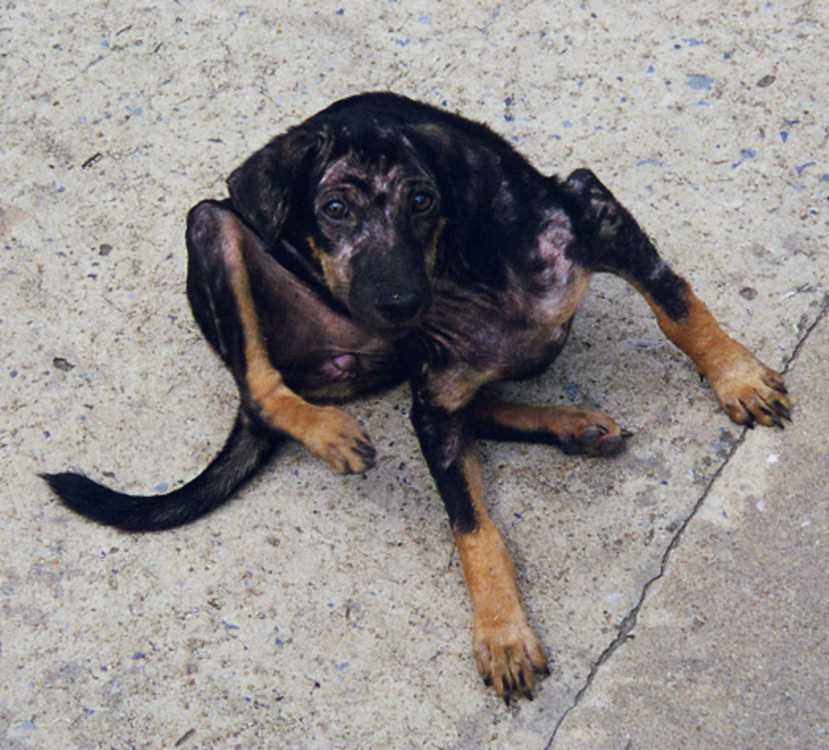
There are two kinds of Canine Mange. If your dog is hairless in one or two spots your dog probably has Demodectic Mange. If there are multiple spots you are probably seeing Sarcoptic Mange. Another name for sarcoptic mange is canine scabies. Both types of mange are caused by different types of mites.
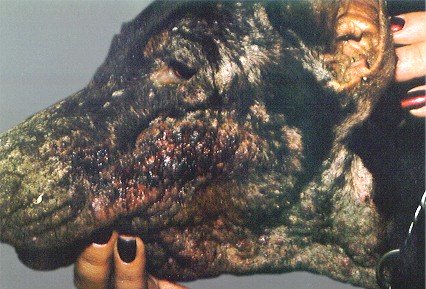
A Photo of Mange - Demodectic
A Photo of Mange - Sarcoptic Mange or Scabies
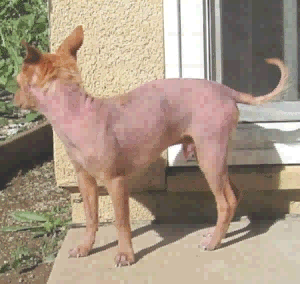
Canine Mange, Generalized
Symptoms of Mange in Dogs
Symptoms of mange include:
- Hairless areas that are small, red, have thick skin and puss
- Scaling around the eyes, mouth and front legs
- Itching which can be strong
Diagnosis of Canine Mange
Canine Mange is diagnosed by taking skin scrapings from your dog. Under the microscope your Veterinarian will look for the presence of mites in the scraping.
It can be difficult to diagnose mange since your dog might have removed the mites by scratching the affected area. Even after the mites are gone, the mites leave behind a substance (toxin) that can continue to cause itching.
One of the easiest ways to know if your dog has mange is to begin either a treatment prescribed by your veterinarian or use a home remedy for dogs with mange such as a dip applied at home. If your dog starts getting better, it most likely has mange.
Treatment of Canine Mange
Home remedies for dogs with mange start with a shampoo, followed by treatment with a dip. The shampoo acts as a moisturizer since the dip tends to dry the skin.
When treating your dog be sure to wear gloves since mange can be transmitted from a dog to humans. Also work in a well-ventilated area since dips have a strong odor (they are made from a lime-sulfur dip).
Naturasil for Pet Mange is one product that is conveniently mixed with your dog's shampoo, making it easier for your dog to accept, since it will be familiar. After using the dip, a medicated shampoo such as Synergy Labs Medicated Anti-Itch Shampoo can help to heal the skin and coat.
After feeding, mites can leave the dog and enter the dog's environment (your home) creating a risk for reinfection. For this reason, it is essential that a home be cleaned with a quality disinfectant made for this purpose such as Benzarid. Wash all of your dog's belongings and vacuum all areas thoroughly.
There are also prescription options, home mite removers and treatments if the mites have spread to anyone living in the home.
Ask a Question or Share Your Story
Have A Dog Mange Related Question or Story For Our Vet? We'll Answer It For Free
Do you have a Dog Mange Question for our Veterinarian to answer (for free!). Please include information such as age, sex, breed, medical history, medications your dog is taking, changes in diet and behavior etc..
We will do our best to get back to you quickly (it depends on how many questions we receive each day). If you do require an immediate response we suggest using this online dog veterinary service that is available now.
References
Superficial Mite Infestations
Ralf S. Mueller DipACVD, DipECVD, FACVSc
Medizinische Kleintierklinik Veterinaerstr. 13 80539
Munich, Germany


