Table of Contents
OVERVIEW | CAUSES | SYMPTOMS | DIAGNOSIS | TREATMENT | Interdigital Furunculosis (dog toe bumps) | BROCHURES
What You Need to Know About Swollen Dog Toes or Paws:
"A swollen dog paw is the result of any one of a number of things that dogs get up to and into, ranging from an insect bite to a broken toe and a prior or chronic health condition. The key is to differentiate between an injury where you should see your vet or one that you may manage at home.
Swollen toes in dogs can be caused by various issues. Related symptoms include redness between the toes, swelling on the top of the toes or paw, or limping. Causes can include:
- injury
- infection
- allergic reaction
- irritation after walking on gravel
- allergies to grasses
- broken nails
- wounds
- spider, wasp, bee stings, snake bites
- muscle disorders
- broken toe.
Here are a few steps you can take to treat a swollen dog toe:
- Examine the toe: Gently inspect the swollen toe to look for any signs of injury, such as cuts, splinters, or embedded objects. Take note of the color, temperature, and any discharge.
- Clean the area: If there are no open wounds, you can clean the area with a mild antiseptic solution recommended by your vet. Use a clean cloth or cotton ball dampened with the solution to gently wipe the toe.
- Apply a cold compress: If the swelling is recent and there are no open wounds, you can apply a cold compress to the area. Wrap an ice pack or a bag of frozen vegetables in a thin towel and gently press it against the swollen toe for a few minutes. This can help reduce inflammation and provide some relief. Be sure not to apply the cold compress directly to the skin.
- Rest and elevation: Encourage your dog to rest and avoid putting weight on the affected foot. Elevating the leg slightly can also help reduce swelling.
- Monitor for improvement: Keep an eye on the swollen toe over the next 24 hours. If the swelling persists, worsens, or if you notice any signs of pain, infection, or other concerning symptoms, it's important to seek veterinary attention promptly.
If your dog has a swollen toe and is limping, it's important to consult with a veterinarian for a proper diagnosis and treatment plan. Limping can be an indication of pain or discomfort, and the underlying cause needs to be identified and addressed.
If your dog's paw is swollen and red between the toes, it could be indicative of an infection, injury, allergies, or another underlying issue. The swelling and redness caused by infection, allergies etc. comes with other signs as well, such as matting of hair around paw or redness around hair base (follicles) or even bald patches. Depending on the cause of the swelling and redness, your vet may recommend a specific topical ointment or cream for your dog's paw.
However, in the meantime, here are a few general steps you can take:
Remember, these suggestions are not a substitute for professional veterinary advice in person. If your dog's swollen toe doesn't improve or if your dog is showing signs of pain or discomfort, it's best to consult a veterinarian for a proper diagnosis and appropriate treatment.
Some quick treatments for a dog with paw or toe swelling includes aspirin (1 adult aspirin for 30 pounds), Benadryl (25mg for small dog, more for a larger dog), Neosporin ointment or cortisone ointment to take down the swelling and pain. Never administer ibuprofen to your dog for pain as it is highly toxic. That's why, before giving your dog any medication, we suggest that you consult with a veterinarian as they may recommend other treatment options and diagnostic tests.
Wounds and other problems such as redness between toes could cause the dog to lick the paws, causing them to lick the feet raw. Itch from allergy will also cause them to lick the feet in an attempt to relieve any itch. If you see a dog licking the paws, you need to address the underlying cause. Keep an eye on your dog's overall behavior, appetite, and any changes in their condition. If you notice signs of pain, worsening of symptoms, or any concerning developments, it's important to seek veterinary attention promptly.
Make a veterinarian appointment the first time you see a lump or problem. Follow the veterinarian's advice regarding treatment and medications. If your dog continues to lick the paws during treatment, use an Elizabethan collar or bandages to protect the area being treated. If you bring your dog outside, but a waterproof cover over the area."
Overview
Digging, running, jumping, crawling, exploring, tripping or stepping on something such as a sharp rock, nail, glass or even a bee or other stinging insect can result in dog paw swelling. It should be remembered that dog has evolved over millions of years to actually do all these things, the anatomy supports it. For example, a dog's paw has 6 distinguished parts including claws, digital pads, metacarpal pads, dewclaw and carpal pads. Every part has it's own function like nails are for traction during running, digital and metacarpal pads act as shock-absorbers to protect bones and joints and helps running over rough surfaces, carpal pads are only found in forelegs and acts as 'brakes' to maintain balance, while not all dogs have dewclaws. This is natural order.
However, the accidents happen and health situations may arise. It’s a busy life when you’re a dog with so many things to see and do and places to go. While many a swollen dog paw is the result of a minor injury, and will likely not require a trip to the vet, you do need to know some basic first aid skills if you need them.
The first thing you need to know about a swollen dog toe or paw is how to assess whether or not you are dealing with something serious. This isn’t as difficult as it may sound. Simply start by observing how your dog reacts to the injury. Different reactions will indicate to you what you may be dealing with. For instance, if you try to touch the injured paw and your dog yelps in pain and won’t walk on it, you might want to get x-rays done to check for a fracture or break. On the other hand, let’s say your dog tries to bear weight, but is limping. This is likely “not” a broken toe or foot, but may be a strain or sprain.
There is also a condition referred to as "bumpy-toe" inflammation where hair follicles become inflamed or damaged, causing bumps on the paws. It is sometimes referred to as interdigital cysts, although this are not cysts per se, but funicles, which are ruptured hair follicles. When the hair follicle ruptures, it causes the skin cells to enter the dermis, acting as if there is a foreign body under the skin.
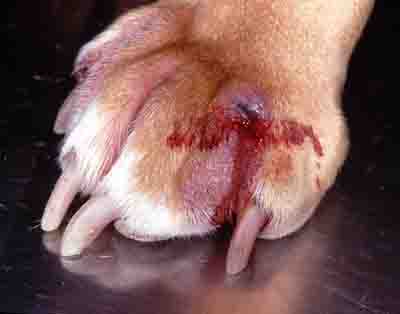
Photo Credit: Washington State University, Dr. Candace Sousa, DABVP, DACVD
Senior Veterinary Specialist, Veterinary Specialist Team
You can certainly treat sprains and strains at home with ice packs, Reiki (if you are trained in this form of energy healing, because it reduces swelling) and rest. Some people think it’s a good idea to give your dog aspirin. Honestly, we suggest you do not. Here is why. If they are in pain, they will stay off their foot and help themselves heal. If they are on drugs that stop the pain entirely, they run the risk of making their injuries worse.
Ask the vet for a middle of the road dose; one that helps dull the pain, but does not completely stop it, unless the injury is so severe that your dog needs a healthy dose of painkillers to even rest comfortably. Just remember, that if you get a certain dose of aspirin, or something else prescribed, “only” use the dose as recommended, and “not” more. More is not better, and may seriously harm or kill your dog. Typically, for a swollen dog paw, a canine patient is prescribed a dose of 5 to 10 mg per pound, 2x per day. Note that children's aspirin is 81 mg. (check the label). Only use after checking with your veterinarian. Your vet is in the best position to judge the length of treatment and dosage requirements for your dog.
Most Common Causes of Swollen Dog Paw
A swollen dog toe or paw may result from:
- Running
- Jumping
- Landing awkwardly after a jump
- Playing
- Chasing
- Digging
- Falling
- Tripping
- Getting it caught in something, like barbed wire or a car door
- Having something dropped on it, such as a rock
- Stepping on something, such as glass or a nail
- Being bitten by something like an insect or even another dog
- Age and arthritis
- Young puppies that were stepped on or dropped (swelling due to a fracture of the metacarpal bones)
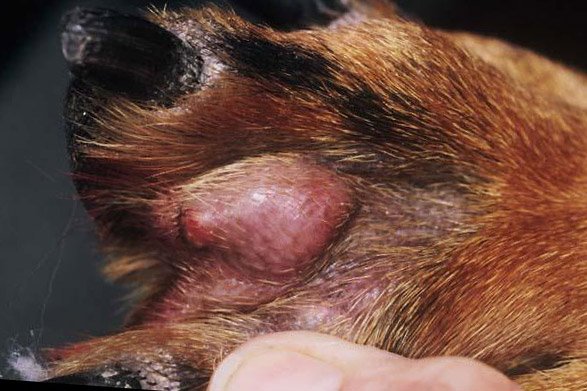
Photo Credit: Washington State University
Symptoms
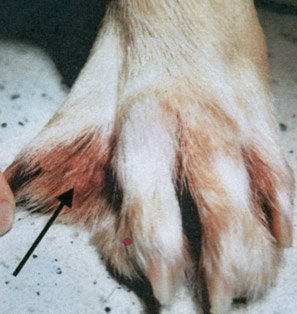
Typically, you will feel the swelling in the paw, see your dog limping, yelping, holding it in the air, not walking on it or licking or worrying the paw, by biting or nipping at it. It’s not always easy to see swelling on black pads. If your dog has pink pads, you may be able to detect swelling faster. On pink pads, you may also see redness that may accompany swelling, depending on the cause of the swollen dog paw.A swollen dog paw alone, if it is the result of a sting or other bug bite, typically subsides in about 24 hours. There is usually no infection to detect. If however there is infection, pus, tissue necrosis (dead tissue), and the paw just doesn’t look right, it’s a good idea to call your vet for help.On the other hand, if there is a puncture wound in your dog’s paw, as the result of stepping on a sharp object or even being bitten by another dog, this type of a wound does tend to get infected. If you are able to wash the wound thoroughly and carefully apply hydrogen peroxide to disinfect it; that is a good start to keeping infection at bay. Monitor the paw carefully and call your vet if you see something that doesn’t look right. Untreated infections can spread like wildfire.
Diagnosis
Your veterinarian just needs to look at your dogs pad to see if there is a problem and what that may be. If you already have an idea of what happened, it is a good idea to let the vet know right away so they can determine what might be needed to help your dog.
For example: if your dog stepped on a rusty nail, the vet may wish to administer a tetanus shot. Or if your dog stepped on glass, it may need to be extracted. If your dog was in a fight and got bitten, s/he may well need stitches and antibiotics, based on what the swollen paw diagnosis happens to be.
Similarly, if the reasons are associated with infections and/or infestation, a separate line of diagnosis and thus treatment might be required, including antibiotic therapy.
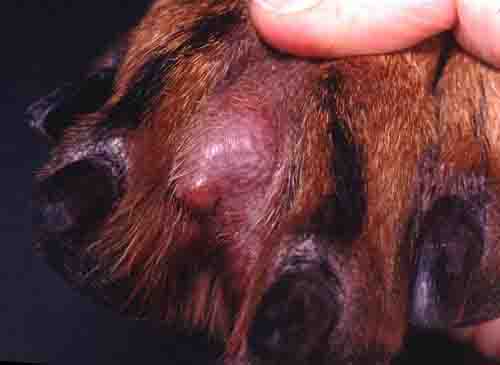
Photo Credit: Dr. Candace Sousa, DABVP, DACVD; Washington University
How to Treat a Dog Swollen Toe or Paw
There are a number of treatments you may try, depending on the type of injury sustained by your dog. More minimal injuries, try thoroughly cleaning the visible wound with warm, soapy water and/or hydrogen peroxide. Dry thoroughly and apply something like Polysporin, Aloe Vera cream or gel, or other antiseptic cream. Cover with a baby sock and vet wrap, to keep your dog from chewing it off.
Some people prefer to soak the paw with warm water and Epsom salts. This works well, but does need to be done three times a day for the first few days to ensure there is no infection. If, after about three days or so, you don’t see any improvement, your dog should see the vet and have the paw checked.
If you are dealing with stings or bugs bites, you may try cold compresses or ice packs. Five minutes on and five minutes off, at least twice an hour. This may be a challenge, as most dogs don’t like this. Don’t apply this compress/ice pack directly to their pad, instead, provide a thin barrier to prevent a freeze burn. If they are in enough pain, they may oblige and sit still for at least three minutes. If that is all you can get them to sit for, that’s good enough. You’re aiming for a reduction in swelling and anything longer than a minute will help.
If the injury appears to be a sprain or strain, some people recommend using cold packs and following them with hot packs. Personally speaking, if you are dealing with inflammation, meaning swelling, you don’t want to put heat on it. Ice it. It you are dealing with tight muscles, meaning there isn’t always a lot of swelling, heat usually helps loosen them up. You just need to know which route to take before maybe making things worse. Also, light massage of the injured paw may help, if your dog will tolerate it.
If your dog has been badly bitten by another dog on the paw or appears to have a broken toe or foot, there is not much you can do to treat this at home, other than rest and pain medications. For this type of injury, you really need to see your vet, as the dog may require surgery or even a cast or splint. Dogs recover well from this type of treatment. Repairs such as ligament tears are more complicated and difficult to perform.
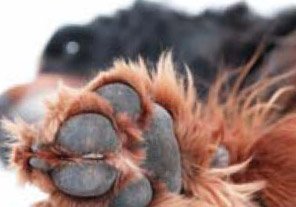
Inter digital Cysts
Inter digital cysts in the form of nodules or lumps can form in between the paw pads. One type, cutaneous horns are formed with hard tissue that are 1/2" to 2" in size. These growths need to be surgically removed.
Interdigital Furunculosis
Interdigital furunculosis is a condition where the hair follicle is inflamed or damaged, causing bumps to form on dog paws. The most common cause is is follicular inflammation. As hair follicles fill with bacteria, demodex mites, and fungi, they become inflamed. Inflamed cells caused the weakening of the follicular epithelium, resulting in follicular rupture. When ruptured, infection is pushed into deeper tissued, and becomes a more chronic condition. Causes include staphylococcal bacteria (staph) or demodex mites. Mites can gain control if a dog has a weakened immune system.(2)
The condition can vary in terms of its' severity. Larger bumps and color such as reddish purple indicate more severity.
Dogs that scratch at the bumps can enable more mites and infectious elements to enter the skin. The bumps themselves can also be ruptured by excessive licking. The condition is common in dogs with short hair or with bristle coats such as bulldogs.
Interdigital furunculosis is diagnosed by taking a medical history (did bumps appear before licking or after licking), or some other cause. A veterinarian will often take a skin scraping and examine the sample with a microscope. The cells themselves will reveal clues such as the type of fungus or bacteria present in the wound. Dogs may need to be sedated during the testing process since furuncles may cause pain.
Treatment will depend on the underlying cause and what type of infection is in found during testing. If a veterinarian finds demodex mites and infection, a veterinarian will recommend something to kill the mites and another medication to eliminate any infection. Note that the skin surface will heal several days or weeks before the underlying tissue is healed. For this reason, treatment can last for several weeks. A veterinarian may also recommend that the paws be soaked 1x or 2x to encourage drainage. Do not soak the paws without direction from your veterinarian, since in some cases it can weaken the skin surface, making the problem worse.
Have A Dog Paw Related Question For Our Editors?
Do you have a Dog Paw related question for our Veterinarian or a Helpful Story to Share? Our Vet will answer it for free! Please include information such as medical history (describe visits to vet and any diagnosis/test results), age, sex, breed, medications your dog is taking, recent changes in behavior (lethargy, appetite, the way the dog walks or favors the paw), etc.
We will do our best to get back to you quickly (depends on how many questions we receive each day). If you do require an immediate response we suggest using this online dog veterinary service that is available now.
What Other Visitors Have Said
Click below to see contributions from other visitors to this page...
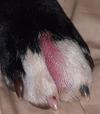
Swollen and Purple Dog Toe 
Sadie is a 10month 53lb pitbull who has swelling toe that started 4days ago. She isn't walking on it. I have pictures. Today it's red/purple-ish Could …
Swollen Blistered Pads Long Broken Nails Not rated yet
My dog paws are swollen and have sores and I’m guessing because he licks them a lot or because of his nails
I have tried many different things and can …
Irritated Dog Paw With Limp Not rated yet
My dog is limping and licking his paw. the skin around the pads has a reddish dark red raised area surrounded by normal looking skin. What are possible …
Dog Broken Paw? Not rated yet
My dog yesterday was in her cage and it started to Thunder outside and she is super afraid of thunder. And when i opened her cage she kept lifting her …
Brochures:
References:
Reduce Swelling in a Dog Paw
(1) Fracture and Dislocation of Metacarpal Bones, Metacarpophalangeal Joints, Phalanges, and Interphalangeal Joints
By C. D. Newton
(2) Bumpy Toe Inflammation, May 2021, Cornell College of Veterinary Medicine


