Summary:
"Dog ear infections can be infuriatingly difficult to treat and account for 20% of visits to the veterinarian. They are more easily treated if caught early as an otitis externa or outer ear problem.
Look
for telltale signs such as dogs that scratch or paw at the ears and
head shaking. Skin irritation and itch may or may not be present. Other
signs include ears that cause pain to the dog when touched or
inflammation inside the ear. Dogs that continually scratch the ear can
cause a more serious problem which results in the rupturing of the
tympanic membrane.
Common causes of dog ear infection are water trapped in the ear, foreign material (grass awns), yeast, atopy (inhaled seasonal allergy), hypersensitivity to foods, bacteria, immune mediated or autoimmune diseases (pemphigus foliaceus) or mites (Otodectes and Demodex). Ear infections are not caught from another pet.
Treatment depends
on the underlying condition and should be in consultation with
a veterinarian. If caught early, ear infections in dogs can be easily
treated. Treatment options range from prescription antibiotics or
anti-fungal agents, ear cleansers and natural ear drops. Veterinarians
often add a glucocorticoid such as prednisone, which can help reduce
inflammation and improve the speed of healing. Do not apply any
cleanser or treatment before speaking to a veterinarian and avoid
alcohol based products, as these can be irritating."
For prevention, all dogs should have canine ear hair plucked on a regular basis, particularly those breeds that are susceptible to a dog ear infection."
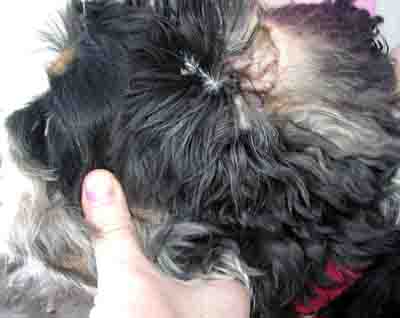
Photo Credit: Washington State University School of Veterinary Medicine
Overview
Ear infections are one of the most common and frustrating problems dealt with by dog owners and veterinarians. Ear infections are usually very treatable if caught and addressed early, so it is beneficial for dog owners to be aware of the common signs of ear infections, as well as treatment and prevention.
A dog ear infection, otherwise known as otitis externa (inflammation of the ear canal), or just otitis, occurs when a pathogen invades the tissue of the external ear canal and causes an infection. The pathogen involved can be either yeast or a bacterial organism. Otitis occurs in any breed of dog during any season, but is more common in the spring and summer months. Otitis is often associated with allergic conditions, such as atopy and food allergy. Sometimes the otitis will be accompanied by itchy or irritated skin, but many times it is not. In fact, in many cases of food allergy chronic otitis is the only abnormal sign the dog displays.
Anatomy
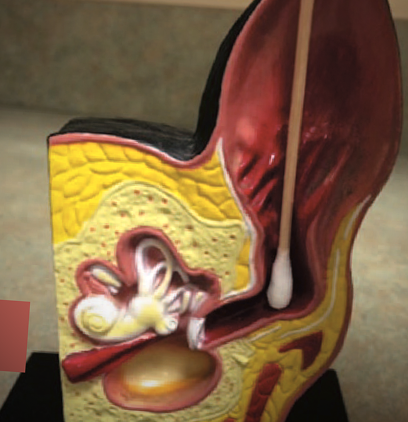
Dog ears are structured differently than human ears making them more susceptible to ear infection. In humans the ear canal travels horizontally whereas in a dog the canal moves from the outer ear vertically downward before make a turn toward the ear drum. This turn makes it easier to collect debris, dirt and wax, allowing bacteria to colonize and take hold as an infection.
Types of Ear Infections
There are three main types of ear infections and each requires different type of treatment.
 Dog Ear Mites
- Ear mites (Otodectes
cynotis): This is the most common type of ear infection. Usually both
ears are affected. To treat it, the ears are first cleaned thoroughly.
Then a medication such as ivermectin is massaged into the ear. A second
treatment may be performed in two to four weeks, just to make sure all
the mites have been killed.
It is generally recommended that all pets in the home be treated at the same time. You may also want to clean the rooms where you dog lives to make sure that no mites remain and then cause reinfection. A good choice for indoor mite removal is Benzarid. They also sell a power steam cleaner for effective outdoor mite removal. Secondary infections in dogs with ear mites are common and generally involve bacteria or yeasts. - Bacterial or fungal/yeast ear
infections: These are usually simple, first time dog ear
infections. In this case the
ear
tissue is normal except for being a little irritated. One or both ears
may be affected. These respond readily to treatments for dog ear
infections. The affected ear is cleaned daily. The cleanser may contain
a topical steroid to reduce inflammation and/or an antibiotic to fight
infection. Oral antibiotics may also be given, particularly if your dog
has a fever, which would indicate a bacterial infection. Avoid alcohol
based products. See your veterinarian at the first sign of an ear
infection since early detection results in a faster and better result.
- Allergy
- Swimming
Chronic, repeat ear infections
The ear tissue becomes thicker, spongier, and more productive (produces more wax and other discharge). These infections improve with treatment but keep coming back. Both ears are usually affected. These are most common in dogs with pendulous ears like cocker spaniels and basset hounds.
When there are repeat dog ear infections, it's often due to allergies. There are mast cells concentrated in the dog's ear canals, just like the mast cells in humans' respiratory tracts. These mast cells produce histamines and other inflammatory chemicals in response to allergens. When these chemicals are released in the ears, they stimulate the production of excess ear wax and other secretions.
The waxy, gooey ears provide an ideal place for skin bacteria to grow. They also attract yeast spores. To treat these infections, it is necessary to deal with the underlying allergies, the bacterial infection, and the yeast infection.
Predisposing and Perpetuating Factors
Certain breeds are predisposed to
developing dog ear infections, but any breed can be affected due to
these
related problems. Eliminating these factors do not mean that a dog will
never have another ear
problem.
- Breeds with Excessive Hair that has been plucked (iatrogenic trauma): Poodles English sheepdog, Airedale terrier
- Anatomical Factors such as breeds with pendulous ears: Cocker
spaniel, Labrador Retriever
- Narrow ear canals or folded ears: Shar-pei
- Moisture in the ears from swimming or high humidity environment
- Under treatment due to a lower dose of medications than is needed when treated or the length of treatment is too short
- Presence of bacteria or Malassezia pachydermatis (yeast)
- Infection that progresses to the middle ear (Otitis media)
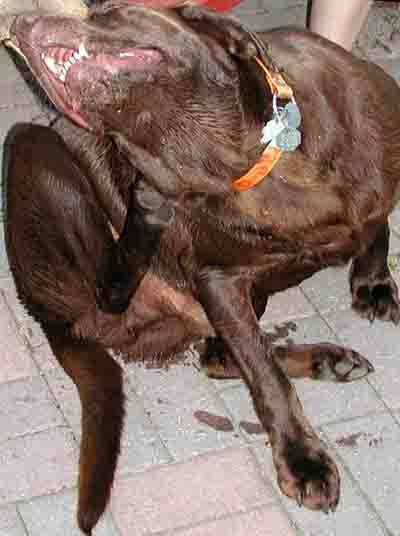
Scratching and head tilting are two of the symptoms.
Photo Credit: Washington State University, School of Veterinary Medicine
Symptoms
It is usually fairly easy to tell when a pet is experiencing the onset of an external dog ear infection. The classic signs of otitis are head-shaking, face rubbing on furniture, shaking or tilting the head, pawing or scratching at the ears, and reddened/inflamed ears with discharge or abnormal debris present in the canal. Dogs with chronic or more advanced cases may be lethargic and avoid play in addition to acting as in pain when the ears are touched. If an ear infection spreads to the middle ear, a dog can have vertigo like symptoms and appear dizzy or off-balance.
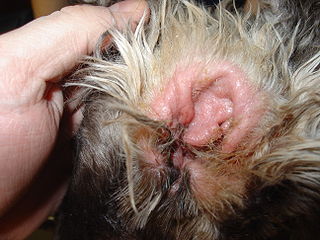 Dog Ear Infection in 3 year old
Cocker Spaniel. Ear wax exudate is present, swollen and ear canal inflamed
Dog Ear Infection in 3 year old
Cocker Spaniel. Ear wax exudate is present, swollen and ear canal inflamedSource: Joel Mills
In more severe cases of otitis, a very pungent odor may also be present and the dog’s ears may be very painful to the point where it will not allow or will cry out with handling of the head or ears.
- Inhalant Allergy: Redness on ears and ear canal (may be only
symptom)
- Contact Allergy: Suspect problems with topical medications if dog
ear infection gets worse after treatment
In order to prevent a dog ear infection from becoming severe, it is important for owners to recognize and act on the signs of early ear infections. If a dog is shaking his head or scratching his ears more than normal, this should not be ignored. Lift the dog’s ear pinna and look into the ear canal. If you see reddened or inflamed ear tissue or abnormal discharge within the ear canal, you should seek veterinary care right away.
It is best to avoid over-the-counter ear cleaners and medications until after you have spoken to the veterinarian. Many of these cleaners contain alcohol, which can be irritating and painful to an already irritated ear. Furthermore, putting agents into the ear before the veterinary examination can hinder the vet’s ability to properly diagnose the type of infection.
Ear Discharge and Causes of Ear Infection in Dogs
The color and consistency of any dog ear discharge can indicate the cause of a canine ear infection. Vets will commonly test the discharge in order to reach a diagnosis.
Exudates/Discharge, Symptoms and Related Causes of Ear Infection in Dogs |
|
|---|---|
|
Dog Ear Infection Symptoms |
Probable Cause of Dog Ear Infection |
| Dark Brown to Black and Waxy |
dog
ear yeast infection |
| Dark Brown to Black and dry to powdery |
dog
ear mites |
| Pale Yellow, Cheesy |
Pseudomonas (bacterial canine ear infection) |
| White, creamy to Cheesy |
Candida (yeast) |
| Dog Ear Itch (puritic) |
Yeast, Mites, Bacteria |
| Yellow/tan purulent (pus) |
Bacteria |
| Ulcerative (inflamed red
lesions or skin) |
Pseudomonas (bacterial) |
| Fruity Smell |
Yeast |
Diagnosis
A veterinarian will start by taking a detailed health history. Tell the veterinarian when the ear problems started and if the patient was treated for an ear or skin disorder. When an ear problem started the first time can help the veterinarian narrow down possible causes.
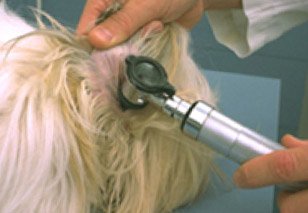 Veterinarian Examining Ear Canal Using An Otoscope
Exudates/Discharge, Symptoms and Related Causes of Ear Infection in Dogs |
|
|---|---|
|
Dog Age |
Probable Cause of Dog Ear Problem |
| 6 months to 5 years |
Atopic dermatitis (atopy) -
particularly if a seasonal issue, food reaction such as allergy |
| 7 years or older |
Food allergy, less likely to be
atopy |
Once a history is taken, the veterinarian will examine the ears starting with the pinnae or outer ear. Unless the infection is severe enough to cause pain that prevents thorough examination, the vet will likely use an instrument called an otoscope to visualize the ear structures. If a dog is in pain the patient may require sedation. It will also be determined if the eardrum or tympanic membrane is ruptured, or if any infection or problem spread to the other side of the membrane. In cases of chronic infection the membrane can thicken. Since the ear is associated with several nerves that can affect other parts of the body such as the face, a middle ear infection (otitis media) can cause some facial paralysis and deafness.
The veterinarian will collect samples of any ear debris for testing. Lab tests will quantify the amount of yeast and bacteria that are present in order to confirm a dog ear infection diagnosis. Even small amounts of bacteria or yeast can cause a reaction in the ears and may be all that is needed to justify treatment. Any chronic or severe infections are caused by several different types of bacteria, the most severe being Pseudomonas. If the vet notices a significant amount of bacteria, a sample will be sent to the lab for identification. Based on the type of infection present, the vet will prescribe an ear medication that contains an antifungal, antibiotic, steroid, or all three. The vet may also prescribe an ear flush or cleaning agent in cases where a lot of physical debris is present.
The vet will also take swabs of the ear canals and look at the material under a microscope to identify the pathogen or pathogens involved in the infection. Most first-time infections or mild infections are caused by a species of yeast called Malassezia or by a bacterial infection.
If a dog does not respond to dog ear infection treatment, it could mean that a resistant bacterian such as Staphylococcus could be the cause. Suspected middle ear problems can be diagnosed with the help of a CT scan. If other problems are detected, such as a tumor then surgery may be required.
What to Tell Your Veterinarian
When reviewing a dog ear infection with your veterinarian, provide the following information:
- When did the dog ear symptoms start?
- Does your dog have any problems such as excessive scratching, chewing, biting, rubbing or licking?
- Does your dog live outdoors or indoors?
- Is your dog on heart worm medication?
- Are there other pets in the home?
- Do any of the people in the home have a new skin problem?
- Has the dog recently been at a groomer or in a kennel?
- Have any siblings had skin problems?
- What does your dog eat (include any snacks)?
- Are the ears better or worse today than normal?
- Doe the dog ear condition change with each season?
Dog Ear Infection Treatment
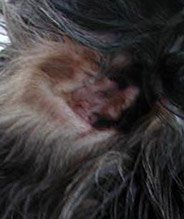 Otitis in Cocker Spaniel Ear
Any dog ear infection treatment approach starts with a cleaning. Cleaning should often be used along with prescription treatment. Do not use a product with alcohol as this could be irritating. Instead consider an ear cleaner similar to Dermapet Ear Cleaner since it is PH balanced and combined with boric acid to improve effectiveness. Cleaners are formulated to liquefy and soften any wax. Ear cleaners with gentamicin and enrofloxacin are particularly effective.(1) Bacteria in the debris can also trigger inflammation, so cleaning by itself can bring some inflammatory relief. Note that not all dogs respond well to home ear cleaning, and may require cleanings in the veterinarians office.
Swelling and Pain
If the ears are swollen or in pain, the use of glucocorticoids for
up to two weeks can help to reduce any inflammation. Pain is addressed
with acetaminophen or Tramadol. NSAIDs cannot be used if a steroid is
being used.
Medications
Topical medications are the treatment of choice for otitis externa (outer ear infections). Products are formulated with an antibacterial or anti-fungal agent (Claro is a prescription single does medication approved by the FDA for canine otitis externa) plus glucocorticoids. Mineral oil based products are good at covering the ear surface and in keeping the ear clean.
The specific medication selected will be based on the type of bacteria or fungus causing the problem. For example Neomycin or Gentamicin are used for gram-positive bacteria, but only Gentamicin tends to be used for gram negative bacteria (although both can be used for both, in the case of gram-negative, Gramtemicin can be the better choice). Anti-fungal medications such as Nystatin is used for yeast infections (Malassezia).
In most cases, a dog should improve in 3 days after treatment, with any infection being resolved in 2 weeks. A return visit will be needed to confirm that the infection has been fully eliminated.
If the veterinarian believes that the infection as spread to the middle ear, than an oral medication is warranted. This can also include an antifungal or antibiotic for bacteria.
Allergies and Dog Ears
Treating allergies can be tricky, but it is an important part of
chronic treatments for dog ear infections. Many dogs are allergic to
fleas, so if your dog has fleas, getting those under control may solve
the allergy problem. Otherwise, you'll need to look at possible food
allergies. Hill's Prescription Diet d/d makes several food choices for
dogs with allergies. Try feeding your dog one of these. Of course, work
closely with your vet to treat your dog's allergies as well.
Recognizing the early signs of an ear infection in your dog will allow you to get prompt care and prevent the infection from progressing to a more severe infection. Be sure to avoid over-the-counter ear medications and cleaners unless recommended by your vet, and follow your vet’s instructions for home care and follow-up visits. If your dog suffers from frequent ear infections, consider using a homeopathic formulated to improve ear health such as Ear Dr.
Keeping Dog Ear Infections form Recurring
To keep dog ear infections from recurring, owners and veterinarians need to do the following:
- Complete a thorough ear examination
- Remove any obstructions such as hair and wax
- Clean dog ears prior to applying any therapies
Ask Our Vet A Question About Treating Dog Ear Infections and We Will Answer It For Free
Have A Dog Ear Infection Question For Our Veterinarian?
Do you have a Dog Ear Infection Question for our Veterinarian? We'll answer it for free! Please include any helpful information such as age, sex, breed, medical history, medications, advice from your veterinarian and picture of the condition if you can.
We will do our best to get back to you quickly (depends on how many questions we receive each day). If you do require an immediate response we suggest using this online dog veterinary service that is available now.
What Other Visitors Have Asked About Canine Ear Infections and Suggestions from our Vet
Click below to see contributions from other visitors to this page and suggestions from our Veterinarian...
Treating A Severe Dog Ear Infection 
I have a sweet dog named Eskie who is about 10 years old. She has symptoms such as being unsteady on her feet and her head is tilted to one side after …
Permanent Dog Ear Yeast Infection Issue Not rated yet
My little 12-year-old female Yorkie mixed dog has had ear problems for many years.No vets could ever figure it out why, and no matter what solution they …
Puppy Ear Concerns Not rated yet
My puppy (5 months old) has had thick black/dark brown ear wax. There are excessive amounts and when I cleaned the ear it slightly red and there are white …
Can I give my dog yogurt to combat chronic yeast infections in his ears? Not rated yet
Can I give my dog yogurt to combat chronic yeast infections in his ears? '
He's 7 years old and chronically develops brown discharge from his ears. …
Why Is One Dog Ear Up and One Down? Not rated yet
Reader Question : My 12 pound, 13 yr old floppy-ear Yorkie was taken to the vet because one dog ear is now erect and never flops down anymore.
I am …
Brochures:
Brochures on canine ear problems:
Canine Ear Infection Treatment
(PDF Download)
Dog Otitis Treatment (PDF
Download)
References:
For additional reading on Canine Ear Problems:
(1) dvm360 tookkit; Otitis Management, June 2017
Examining and Medicating Dog Ears
Washington State University School of Veterinary Medicine
Ears The Basics
Craig E Griffin
Animal dermatology clinic
San Diego, Ca
Canine Ear Infection Medicine


