Summary:
"Symptoms of an anal gland dog problem occur when the canine anal glands are unable to empty naturally. Anal sacs are two sacs that are the size of or smaller than a pea. They are on the sides of the dog anus at about 9PM and 3PM and contains strong-smelling liquid used to mark the territory. Normally, the anal sacs empty when the dog has a bowel movement, but sometimes they don't empty as they should, causing them to possibly become irritated or infected. Symptoms associated with a problem include odor, a dog scooting the rear across the floor and other signs of discomfort. Perianal infection (infection around the anus) can also cause problems.
See a Veterinarian if you observe any of the following:
- Your dog is in pain when you touch the anus
- Any visible signs of infection such as sores and growths
- Problems emptying the anal sacs and the appearance of the fluid. If you see blood, pus, black paste)
- Frequent blockages
Treatment includes antibiotics for any infection, and manual manipulation of the sacs to drain any fluid. Long term relief is achieved with a higher fiber diet and the addition of a natural remedy to the diet, to name two. If it becomes chronic, surgery could be recommended, but it is a difficult surgery and other methods should be tried first. The dog anal sacs should be examined as part of regular veterinary care to ensure that they are emptying properly."
Overview of Canine Anal Gland Problems
Where Are Anal Glands in Dogs?
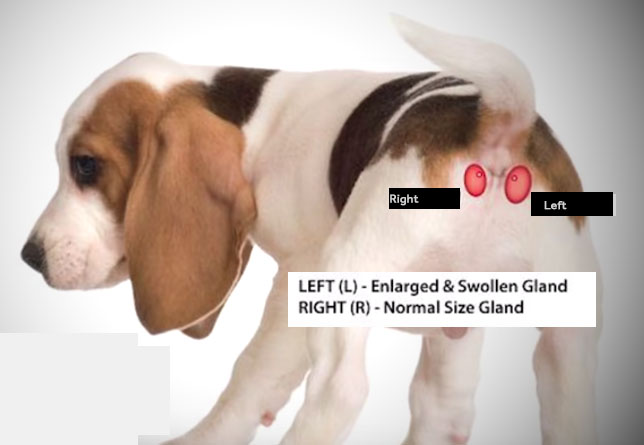
Dog anal gland sacs are two small sacs situated just below and to either side of the anal opening. The anal glands are located at 9PM and 3PM around the anus if you picture the face of a clock.
What Are Dog Anal Glands and What Do They Do?
Dog anal glands manufacture and secrete a strong smelling fluid that is used to mark territory. When the anal glands are healthy and your dog is bathed regularly, the anal glands do not have much of a smell to humans, although other dogs can smell them well. That’s why dogs like to sniff each other’s behinds – that’s part of how they recognize each other, from the scent of the fluid produced by the anal glands, which is unique to each dog. Anal glands are supposed to empty naturally when a dog has a bowel movement.
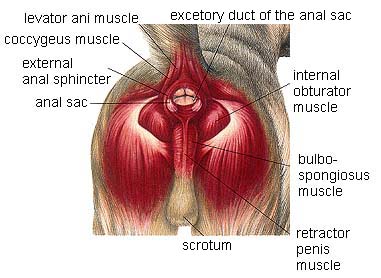
The pictures in this section are reprinted with permission by the copyright owner, Hill's Pet Nutrition, from the Atlas of Veterinary Clinical Anatomy. These illustrations should not be downloaded, printed or copied except for personal, non-commercial use.
Symptoms of Anal Gland Dog Problems
Symptoms of anal gland problems usually include a bad smell. The glands can become impacted or infected, causing them to produce a thicker than normal fluid that has a bad odor. Dogs may attempt to lick or bite at the area if they are experiencing discomfort. Your dog may also “scoot” across the floor on his bottom with his tail up (called scooting). If your pet cries when going to the bathroom or shows signs of pain, then the anal glands may have become infected.
Small breeds are more susceptible to anal gland problems than large breeds.
Diagnosis of Anal Gland Dog Problems
Impacted and infected dog anal sacs are common anal gland dog problems. Your vet will be able to diagnose them just by examining your dog. No special tests will be needed.
Rarely, cancer can develop in the anal sacs. This is more common in females than in males. Cancer of the anal sacs is diagnosed with a biopsy (skin sample). A needle is used to extract some cells from the tumor, and those cells are then examined under a microscope.
There are three anal gland disease stages:
- Stage 1: Anal sac impaction: when the anal sac liquid becomes thick, causing the sacs to become distended and it makes emptying difficult
- Stage 2: Anal sacculitis: In this stage the anal sacs become infected with a bacterial infection. You may notice liquid which has a bit of blood or is yellow in color.
- Stage 3: Anal sac abscess: An abscess can cause pain and a red hole that breaks through the skin area next to the anus. The glands will begin to change color, start with red and then purple. As the gland becomes infected and swells it can rupture through the skin. The sac can't be emptied with the fingers, with your veterinarian possibly lancing the sacs in order to help them drain.
Other glands in the area such as fistulas (puncture holes around the anus) and rectal polyps (stick out from the anus) may also appear as a canine anal sac problem. Fistulas are seen in breeds such as German Shepherds, Setters and Retrievers. Another problem, Perianal gland tumors (at the base of the tail) , is another problem near the anus that is seen in male dogs over age 7 that have not been neutered.
Treatment of Canine Anal Gland Problems
Treatment of anal gland problems is usually pretty straight forward. If the glands are impacted (backed up), they can be manually expressed (emptied). Your vet can do this, and he or she can show you how to do it so that you can do it yourself in the future if needed. Your vet will show you how to use your fingers or a thumb and forefinger to gently apply pressure on either side of the anal opening - on the outside of the glands. Press inwards and upwards and you should see the fluid being expressed.
If the glands are infected, antibiotics will be prescribed for your
dog. Infected glands will probably need to be expressed manually until
the infection has cleared up.
Natural Dog Anal Gland Treatment
We have several natural approaches that are worth a try for problems with anal glands in dogs:
- Pet Alive AnalGlandz is formulated to treat infected anal glands in dogs naturally. It is a 100% natural, safe effective herbal remedy for preventing unpleasant odors and promoting anal gland health.
- Epsom Salts: Purchase Epsom salts from Amazon or a local pharmacy and prepare according to the box. Prepare in hot water, soak cotton balls or a wash cloth in the Epson sales. Hold the wash clothe on the anal area so that it soaks and surrounds the anal glands. It pulls the toxins out of the anal glands and heals surrounding tissues (similar to a human Zitz bath). Hold the wash clothe for 10 minutes on the anus 2 to 3 times per day for a week.
- Silica 6x: Silica is a homeopathic remedy that helps push things out of the body. Give it to your dog 3x a day for 1 week and then 2x a day for the following week. Silica is available at any health food store.
- Myristica (myristica sebifera): According to Dr. Deva Khalsa, try the remedy Myristica 30c instead of Silica. When giving Myristica for dogs, give three times a day, Get the anal glands fully expressed then start the Epson Salts right after that.
Dietary Change and Prevention
If your dog frequently has problems with his anal glands becoming clogged, your vet may recommend changes to his diet. A high fiber diet may be recommended in order to make his stool more bulky. This will cause his stool to help express the anal glands when he defecates.
Cancer
Cancer usually occurs in only one of the anal sacs. If your dog has cancer of an anal sac, he will need to have the tumor surgically removed. The surgery has a high rate of success at curing the cancer.
Emptying Dog Anal Sacs (Expressing the Sacs)
You can use your fingers to help your dog empty the sacs or if the foul odor of the liquid means that you need to have them emptied. We suggest wearing latex gloves and possibly doing this procedure in a tub. Afterward a bath is called for.
The easiest way is to lift your dog's tail with your hand. Using the other hand gently squeeze the skin on each side of the gland. You should be able to see and feel a pea sized gland if they are full.
You can also put the tip of your forefinger in the anus and use the thumb to apply pressure to one of the glands.
Brochure for Additional Reading
Dog anal gland and sac issues. Understand the causes, disease stages, signs, diagnosis and prognosis.
Ask Our Vet A Question or Share Your Story
Have a Question for our Editors and Readers about Dog Anal Gland Disease or have some helpful advice?
Do you have a question for our Veterinarian about Dog Anal Gland Disease? Share it! Our Vet selects several questions a week to answer for free. Just provide your dog's breed, age, sex and medical history.
We will do our best to get back to you quickly (depends on how many questions we receive each day). If you do require an immediate response we suggest using this online dog veterinary service that is available now.
What Other Visitors Have Said
Click below to see contributions from other visitors to this page...
Dog Anal Gland Removal and Home Expression 
Reader Question on Removing Dog Anal Glands
I have German Shepard x and she is 10 years old, she has recently been diagnosed with Anal Gland problems, …
Dog Anal Gland Ruptures and Treatment
I noticed on Wednesday that my 7-year-oldChihuahua started scooting around on her bottom. She had not had any problems in the past with this area, but …
Dog Anal Area Odor Treatment Not rated yet
My yellow lab, going on three in April, very healthy and up to date on all his shots recently has had an unusual odor coming from his anal area. I noticed …
Burst Dog Anal Sac Treatment Not rated yet
I have a female Boston Terrier who will be 6 years old next week. About 2 years ago she had an infected canine anal gland that swelled up and looked like …
References
Treatment of Perianal and Anal Sac Tumors
Kirpensteijn, J.
Anal Sac Disease - Washington State University College of Veterinary Medicine


