Summary:
"Canine kennel cough treatment is required when a dog is suffering from a bacterial infection called Bordetella bronchiseptica (also called infectious tracheobronchitis or ITB). The condition can be transmitted from dog to dog, usually through nose to nose contact with an infected dog, or the secretions from an infected dog in a closed environment such as a kennel, training class, vet's office or groomer. The condition is currently referred to as Canine Infectious respiratory complex (CIRDC).
Dogs that have been vaccinated for Kennel Cough (infectious tracheobronchitis) may still catch CIRDC, which is a summary term for multiple infectious agents.
Some dogs catch a virus at the same time of the bacterial infection, allowing the bacteria to quickly invade the respiratory tract. Dogs will exhibit kennel cough symptoms within 2 weeks after exposure, including a mild infrequent cough to more chronic or severe symptoms such as fever, lethargy and a constant cough. Similar symptoms can be cause by heartworm, so if your dog isn't on a preventative, a vet will test for this as part of the initial examination.
If your dog is coughing for more than a few days, and if you observe the other symptoms mentioned, see your veterinarian for treatment. Vets will often prescribe a cough suppressant and if the disease is chronic or has resulted in a case of canine pneumonia, your pet may be kept in a veterinary hospital for intravenous antibiotics, fluids and possibly oxygen therapy. Vaccination for kennel cough is not 100% effective as it does not protect against all strains of the disease. Most cases heal without treatment and are not life threatening."
What is Kennel Cough?
Canine kennel cough treatment is necessary when your dog contracts kennel cough from an airborne bacteria (also called infectious tracheobronchitis or ITB). It is one of the most common infectious diseases in dogs. Kennel cough is most commonly caused by a bacteria called bordatella bronchiseptica. Along with the bacteria, dogs often contract a virus which makes it easier for the bacteria to invade the respiratory tissues.
The disease effects the lining of the trachea causing minor irritation. Dogs with Kennel cough tend to cough every couple of minutes throughout the day. In mild cases, coughing will be less frequent.
The disease is usually contracted where large groups of dogs are together in close quarters such as a dog show or kennel. It can pass from nose to nose contact and through contact with secretions from an infected dog. Immunization does not protect against all strains of CIRDC.
Symptoms of Kennel Cough
A kennel cough is a very distinct cough and sounds like your dog is clearing its throat. A dog with Kennel Cough will tend to cough when engaged in activity or exercise.
Symptoms of Kennel Cough usually appear up to two weeks after exposure.
To diagnosis Kennel Cough a Veterinarian will rub the larynx and see if that causes the dog to cough. If your dog expels mucus when coughing, more tests such as an x-ray will be done to see if the cough resulted in the development of pneumonia or distemper.
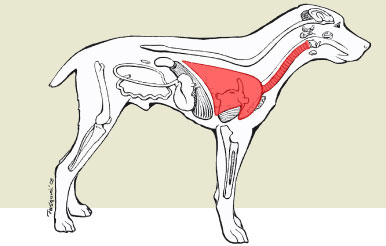
Source: Cornell School of Veterinary Medicine
Diagnosis
Kennel cough is categorized as being complicated or uncomplicated.
In the uncomplicated form of the disease diagnosis is based on your dog's medical history, physical exam, and any clinical signs.
In the complicated form of the disease (dogs with pneumonia) a blood test (CBC) and X-0rays can be helpful in making a differential diagnosis from other sources of similar symptoms such as fungal pneumonia, congestive heart failure or pyothorax.
The veterinarian may also take an airway sample for evaluation.
Kennel Cough Treatment
Treatment for uncomplicated forms of Kennel Cough involve:
- Being isolated from other dogs for 2 to 3 weeks
- Hydration
- Hygiene
- Cough suppressants (butorphanol or hydrocodone).
- If the veterinarian suspects bacterial pneumonia, then an antibiotic such as doxycycline is prescribed.
In the complicated form of the disease a dog may need to be kept at the veterinarian's office for IV fluid hydration therapy and oxygen therapy. The dog may also need an antibiotic such as doxycycline or clindamycin or ampicillin and fluoroquinolone. Patients need to be isolated from other dogs.
In rare cases a dog may need a bronchodilator.
When released from the clinic, a dog may need to continue taking an antibiotic.
If the cough is severe, your dog will cough for extended periods of time and may throw up food or mucus. The color of the mucus ranges from white to green (green means more serious). If this is the case see a Veterinarian immediately.
Minor to moderate forms of Kennel Cough usually go away with no
treatment. If the cough lasts longer than 7 - 10 days, then you should
have your dog evaluated for other airway or lung diseases, although the
disease could last as long as 21 days.
If the dog has a good appetite and is otherwise normal, no antibiotics will be used and the disease will just run its course.
Prognosis
Uncomplicated forms of Kennel Cough resolve in 10 to 14 days after symptoms begin.
Complicated Kennel Cough can last from 2 to 6 weeks.(1)
There are cases where complicated forms of the disease can progress into severe pneumonia, multiple organ disfunction or sepsis.
Kennel Cough Vaccine
While an important part of canine kennel cough treatment, vaccinations are not 100% effective against every strain of the disease. It is usually recommended for show dogs or dogs that are frequently in a kennel. After having the disease, some dogs become resistant to future occurrences.
Immunization against core and non core pathogens may not prevent CIRDC, but many believe it reduces the severity of the disease.
Puppy Kennel Cough
There are several home approaches for puppy canine kennel cough treatment that can be tried for a puppy (or adult for that matter).
- One home treatment for a puppy with kennel cough is to try Pediatric Robitussin 4x per day. This approach has been used for dogs as young as two. If your puppy does not respond, antibiotics are called for. Check the label to make sure the medicine does not contain ibuprofen or acetaminophen since these can cause liver damage. Ask your veterinarian for the correct dose (no more than 1/2 teaspoon to avoid overdose).
- Put puppy in the bathroom for 20 minutes and vaporize with Vicks 2x a day. Do this for 4 to 5 days. If you see green mucus after 3 days, return to the Veterinarian.
Have A Dog Kennel Cough Question For Our Vet?
Do you have a Dog Kennel Cough Health Question for our Editors or a Helpful Story to Share? Please include information such as age, sex, breed, medical history, symptoms and medications.
We will do our best to get back to you quickly (depends on how many questions we receive each day). If you do require an immediate response we suggest using this online dog veterinary service that is available now.
Vet Suggestions and Other Reader Questions
Click below to see contributions from other visitors to this page...
Dog Dog Kennel Cough When Not Eating or Drinking Not rated yet
My dog has kennel cough and is on antibiotics but is not eating or drinking. how can i get him to eat and drink?
Vet Suggestion Dog with Kennel Cough …
Reference
1) Clinicians Brief
(2) Cornell University, Baker
Institute


