Table of Contents
What You Need to Know | Symptoms | Diagnosis | Interrupting the Flea Lifecycle | Treatment
What You Need to Know about Dogs and Fleas:
"Fleas are the most common skin parasite that affects dogs. The fleas can cause a skin allergy called canine flea allergy dermatitis (FAD) which as the name implies is an allergic reaction. Even if you believe your dog does not have fleas due to a clean home or indoor lifestyle, they could have been brought into the home by another dog or unsuspecting human. Skin reactions are allergic reactions to flea salivary proteins injected into the skin of the dog during feeding and are the most obvious sign.
Flea dirt is adult flea feces that is composed of a semi-digested blood meal and is another sign that your dog has fleas. Some dog owners will see flea dirt on their dogs but no actual fleas. The "flea dirt" resembles tiny specks that resemble black.pepper. The dark specks are most easily seen if using a flea comb or your fingers, run it in the opposite direction of the hair at the skin surface. Pay attention to the groin between the back legs, the tail, and the dog's center.
Ingesting a flea can lead to problems such as tapeworm (fleas are intermediaries for the tapeworm) or the plague (rare but possible and very serious and deadly to dogs and humans). If the dog gets the plague it causes painful lymph nodes, swollen lymph nodes, appetite loss, and fevers. Plague is caused by the bacterium Yersinia pestis (Bubonic Plague or Black Death). The bacterium causes large abscesses, pneumonia, and large abscesses. The disease is seen mainly in the Southwestern U.S. and is diagnosed with a blood test or lymph node aspirate. Treatment is with the antibiotic Ciprofloxacin.
Fleas can transmit bacteria to the dog, causing an intracellular infection in areas such as the cells that line blood vessels, in macrophages (immune cells), and in intracellular location such as red blood cells. In the cells lining blood vessels, the bacteria can hide from the dog's immune system.
Once bacteria take hold, they can move into the heart causing inflammation (endocarditis), immune-mediated arthritis, damage to the eyes such as uveitis, or cause recurrent fevers.
Tapeworms are not life-threatening, but they cause symptoms such as your dog dragging its' anus across the floor. If your dog has tapeworm you might discover small worm segments around the anus or a rug, or something that looks like white rice on a fresh stool. Other symptoms associated with tapeworm are diarrhea or weight loss. Tapeworms can be easily treated with praziquantel, which is the active ingredient in tick and flea preventatives such as Sentinel Spectrum or Interceptor Plus. Note tapeworms can return unless you also remove the source of the fleas.
While fleas can be seen with the naked eye, they are good at hiding out of sight. The easiest way to detect fleas is to use a fine-toothed flea comb and note if you see black and white specks which are the eggs and feces. It looks like a combination of salt (eggs) and black pepper (flea feces). A quick tip is to comb any black flecks onto a damp or wet paper towel. If you crush the specks and see red, which confirms the presence of blood, then you have confirmed the presence of fleas. Prime locations to spot fleas are on the stomach and base of the tail.
Canine fleas are difficult to remove from your dog and home. For every 1 flea on your dog, odds are another 100 are living nearby. A female flea laying eggs can deposit up to 50 at a time.
Treatment options fall into 3 categories:
- Spot Ons Such As Canine Advantage (recommended, no toxicity to mammals)
- Collars (not recommended) and Shampoos
- Tablets (work fast, good for large infestations)
Dips and foggers are not recommended. There are better, less toxic alternatives to dips. If you have a large infestation in your home that requires a fogger, you will be better off calling in a reputable exterminator from a network such as Home Advisor.
Treatment involves a few simple steps:
- Kill fleas that are currently on the dog with a medicated shampoo or for severe infestations use an oral tablet supplied by a veterinarian.
- When the dog is dry, prevent future fleas with a Spot-on such as Advantage. While this product kills fleas and lice, others will help with parasites such as ticks.
- Thoroughly clean your dog's environment by washing all items and using a natural plant-based spray or disinfectant.
- Treat tapeworm if your dog has the symptoms described above.
Relative to their size, a single flea can consume a significant amount of blood. A severe infestation can cause anemia or death in puppies if left untreated.
We recommend checking with your veterinarian for the best product for your dog, particularly if you live in environmental conditions where fleas thrive, which is in warm climates or when you have warm weather. See our guide to dog flea treatment options."
Overview
Allergies from canine fleas are caused when the flea bites your dog's skin. The reaction itself is due to sensitivity to the saliva in the flea's mouth. A typical flea allergic reaction will have your dog itching the moment they come in contact with the fleas. Itch from flea allergies could even continue after all the fleas have been killed.
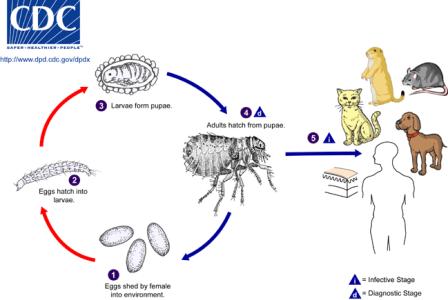 There is a 4 stage flea life cycle, moving from egg to larvae, pupae, and adult. Female fleas can deposit up to 50 eggs. Dog flea eggs hatch in 3 to 4 days and feed on environmental debris. Larvae form pupae in cocoons, that are covered with sand, rocks, pebbles, and other items. After 3 to 4 weeks they hatch and seek a host such as a dog or even people.
Source: Center for Disease Control
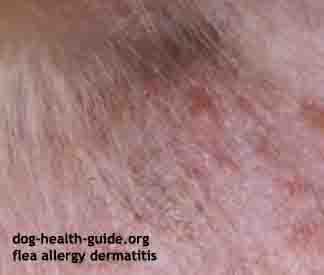 Dog Flea Allergy Dermatitis Skin Reaction
Dog Flea Podcast
This podcast by Dr. Bernadine Cruz from the American Veterinary Medical Association provides an excellent overview on dogs and fleas, treatment, and prevention.
Dog Flea Symptoms
Symptoms of a canine flea dog parasite skin problem are typically a combination of bumps and pimples. Skin reactions occur either right after being bitten by a flea or they have a delayed reaction in 1 to 2 days. Fleas start feeding within 5 minutes of finding a host. A dog can also have an immediate and delayed skin reaction at the same time. The size of the skin reaction depends on the hypersensitivity of the dog to the flea bite antigen and the amount of antigen injected into the skin by the parasite.
Flea bites are usually found on the rear, under the legs, tail, and belly. Canine flea symptoms usually start at the tail and rump (rear end). Itching can cause secondary problems with hair loss and dry skin. A dog with fleas will act like it is uncomfortable, resulting in the dog trying to chew, scratch, and lick affected areas.
Secondary dog flea symptoms include:
- secondary skin infections or irritated skin
- broken hairs
- discolored hair that is brown in color
- alopecia (hair loss)
- areas of red skin (erythema)
- discolored skin
- skin scaling
- firm skin bumps (papules)
- papules that have opened, which are then crust covered
- itch
If you only see these types of symptoms on the rear half of your dog, fleas are the most likely cause. When your dog goes to itch this area, their hair can fall out and their skin becomes dry. If you draw an imaginary line around the center of your dog and only see symptoms in the rear half, it is probably fleas.
If the condition continues, crusty skin lesions can form.
Diagnosis of Flea Hypersensitivity
A veterinarian will take a dog's history, look for visible symptoms such as actual fleas and flea feces in addition to specific skin tests. The veterinarian will also differentiate this condition from other possible causes of the dog's skin condition.
At home, the best way to check for canine fleas is to place your dog on a piece of white paper or a damp paper towel. Brush the coat and if you see white and black grains of what looks like sand. The droplets are actually lea eggs and feces. There is also a skin test that your Veterinarian can use to test for flea allergy and fleas.
Entire Life cycle
When a flea lands on a dog it will start feeding. They produce eggs after 36 hours to 2 days. A female flea produces 40 to 50 eggs a day, producing 2000 during the first 100 days. It takes 12 to 14 days for a flea to go from egg to adult. Most fleas on a dog are actually in the form of an egg, adults are estimated to be about 5% of the total population.
When a flea lays eggs on a dog they fall off and land in areas where the dog lives, such as on a bed or where the pet eats. Flea eggs will hatch in 1 to 10 days on each surface and then move around the home into places away from light such as deep into carpets, under furniture, etc. In 5 to 10 days they grow into adulthood and produce a cocoon that protects them from the environment. They can last in the cocoon for up to 50 weeks. When a host appears such as a dog, the fleas will leave the cocoon and jump onto the dog (or another pet). If they do not sense a host, they can live outside the cocoon for 2 weeks. If they cannot find a host, they will bite a human for food.
To interrupt the flea life cycle it is important that your plan kills adult fleas. We suggest using an insect growth regulator such as a spot-on to interrupt the lifecycle. The home needs to be thoroughly cleaned to remove any problems for humans and other pets (see below).
Flea Treatment for Dogs
The goal of a dog flea treatment is to eliminate fleas from their body, hair, and where they live. All pets that live with the dog should be checked as well. Your Veterinarian will treat fleas with creams and antibiotics to avoid infection. You can also use an antihistamine to help with the itching.
Step by step flea treatment for controlling fleas on dogs:
- Bathe Your Dog: Get rid of fleas currently residing on a dog's body using medicated flea shampoo which kills young and adult fleas. For a large infestation see a veterinarian for an oral dog flea pill.
- Grooming: Purchase a flea comb to pull the fleas from your dog's coat. Comb daily to ensure that any new fleas are immediately removed from your dog.
- Treat Symptoms: Address any symptoms such as itch.
- Eliminate fleas from the dog and pet owner's home: Whatever approach you choose, be sure to follow the manufacturer's directions. Eliminating fleas on your dog just removes only part of the flea problem. Flea eggs can fall from your dog and adult fleas can easily jump from your dog into your home. If you only treat your dog, he will quickly be re-infested with fleas. Consider using a plant-based home flea spray. To remove the fleas from your home try and avoid clutter in the places where your dog lives, since fleas can easily hide. Be sure to vacuum the area at least 1x per week. There are some natural flea products such as Fossil Dust that can be used safely in the home to kill fleas that are in the home.
To kill fleas on upholstered furniture remove the couch cushions, remove any covers and wash in hot water (if you can.). Vacuum the cushions and the couch using a brush attachment or hose (remove vacuum bags outdoors when done). If you have a bagless vacuum then empty it into a plastic bag, seal, freeze it for one night to kill any fleas and then dispose of it. - Use a Preventative: Use a preventative that interrupts the flea lifecycle such as a spot-on (called an IGR or insect growth regulator) such as Advantage (recommended due to no toxicity for mammals).
More detail on each product for dogs flea control and to prevent fleas can be found below:
Home Dog Flea Treatments
To remove fleas from the dog's body at home, owners can use a dog flea shampoo. We no longer recommend dips since a shampoo plus the use of a Spot-on is a better option. Flea shampoos alone will kill fleas, but do not have a residual effect. After bathing your dog, wait until the dog dries and then use a topical spot on to both treat and then prevent future dog flea problems (or a tablet product described below).
Popular brands of dog flea medicine topical products and ingredients are:
- Frontline Plus (fipronil) - a liquid topical product that kills fleas in 24 to 48 hours. Provides protection for 90 days and ticks for 30 days. Frontline Plus (unlike plain Frontline) also kills lice and helps to control sarcoptic mange (regular frontline just addresses fleas and ticks). Frontline Plus is labeled for puppies under 8 weeks. Regular Frontline should not be used with puppies under 10 weeks (check the label). Retains effectiveness when wet.
- Advantage (imidacloprid - recommended) - topical applied 1x per month, kills 98% to 100% fleas within 12 hours. Not to be used on puppies under 7 weeks. A newer brand/formulation is called Advantix. Advantage has shown no toxicity to animals that are mammals.
- Revolution (selamectin) - topical 1x a month product that protects against fleas as well as heartworm, roundworms, hookworms, fleas, ticks, and mites.
These products for treating fleas are more expensive than lower-cost brands. They are generally considered to be safe and should be started 1 month prior to the flea season which is usually April in areas with 4 seasons. Fleas come out when the weather is above freezing and you are heading into spring. Check the manufacturer's directions for all products for the proper use and other precautions. For example, many of these products cannot be used within 3 days of the flea bath and puppies (usually under 10 weeks of age) have certain restrictions as well. Note that flea preventatives can take several hours to days after application, so if you see a flea, it just might mean that the product needs time to work. Be sure to apply the spot-on to the skin, not hair.
Do not apply a spot-on immediately after bathing, since it will greatly reduce the effectiveness of the products. Follow manufacturer's directions which usually call for waiting 2 to 3 days. Also, check the directions for how soon you can bathe a dog after spot-on treatment (also usually 2 to 3 days).
To naturally address any itching, a product such as an Itch Soothing Spray could bring some relief for any suffering related to dogs and fleas.
For more information on this dog parasite skin remedy see our guide to dog flea medicine. Note that flea home remedies such as brewer's yeast, ultrasonic flea collars, sulfur, and garlic are not effective at eliminating and killing fleas.
We do not recommend the use of dog flea collars or any type of collar for dog parasite skin flea and tick prevention as these can get caught on objects and harm the dog.
Dog Flea Pills
In addition to dog flea spot-on topical preparations, there are also different tablet-based products that can help with dogs and fleas. To speed healing in cases where there is a more severe dog parasite skin flea infestation, a veterinarian might recommend Capstar tablets (Nitenpyram). Capstar comes in tablet form and immediately kills fleas on the dog's body. The pills start working in 15 to 30 minutes, with over 90% eliminated in 24 hours (used in dogs that are older than 4 weeks). It is often used in combination with a longer-term preventative such as the spot-on Revolution/Frontline Plus.
Pills such as Sentinel (lufenuron plus milbemycin, also a preventative for heartworm) or Program (lufenuron - very popular) are given to a dog 1x per month with food and are known as IGRs or insect growth regulators. This means that they don't kill adult fleas, but prevent the flea larvae from becoming a pupa (the stage before adulthood, thereby interrupting the flea lifecycle). These are available with a prescription and take from 30 to 60 days to fully work as the flea fully work as a complete preventative (existing adult fleas die and larvae are prevented from becoming adults). These are used as an alternative to a spot-on.
Why Efforts to Get Rid of Fleas Might Fail
There are several reasons why flea treatment might not work. If this is the case, review this checklist for proper dogs and fleas treatment:
- Did you treat all pets and dogs in your house? Since fleas spread from host to host, it's important to make sure that all dogs (cats, animals) are flea free.
- Did you apply treatments consistently without missing any applications?
- Did you follow the manufacturer's directions?
- Did you buy cheaper lesser known over-the-counter spot-on that may not be as effective?
- Did you thoroughly clean your dog's environment, including the dog's bedding and carpeting (see below).
Prevention and Removal of Fleas in the House
In addition to using a spot-on, a dog's environment should also be disinfected to ensure that all fleas are gone and kept from infesting the dog again. This can be accomplished with a quality disinfectant such as Benzarid and by a complete vacuuming of the affected areas. It is a good idea to repeat the treatment after 3 to 4 weeks. One of the natural ways to remove fleas from the home is to use a plant-based natural home flea spray.
To remove fleas from carpets use a product such as Flea Busters which can get to the lower carpet fibers. After vacuuming be sure to remove dispose of the vacuum cleaner bag outdoors. Products such as Mineral Salts, Borax, and Fossil Dust (diatomaceous earth) will help to kill both larvae and flea eggs in a dog's environment, but not adults (don't use if you also have a cat). Because of this, they will take some time to work. These are not necessary if you use the Benzarid combined with vacuuming the home.
To remove fleas from hardwood floors first vacuum, and then use a product such as Pine-sol. Vacuuming will remove most fleas, To be extra sure, a natural approach is to sprinkle some diatomaceous earth (fossil dust) on the floor, and then vacuum after an hour.
AVMA Brochure on External Parasites
For additional reading review this brochure from the American Veterinary Medical Association on External Parasites.
References
How Do I Treat Fleas and Other Parasites
Dr. Chiara Noli, DVM, Dip ECVD
Ospedale Veterinario Cuneese, Borgo San Dalmazzo (CN) - Italy
Protecting Pets from Fleas and Ticks
Environmental Protection Agency
Fleas and Their Control
American Kennel Club


