Table of Contents
Overview | Symptoms | Diagnosis | Treatment | Ask Our Vet A Question For Free
Summary:
"Sarcoptic mange is a contagious condition passed by mites from dog to dog or wild animal such as a fox to a dog. The condition can occur in a specific or localized areas of the body, or if left untreated, the condition will spread into a "generalized" form which affects areas all over the body.
Diagnosis should be made by your veterinarian, and treatment options include over-the-counter and prescription dips or medicine."
Overview
Symptoms of Sarcoptic mange (dog scabies) are red bumps or papules, itch, and a scaling or hardening of the skin. If your dog scratches the bumps, it results in hair loss occurs and possibly skin infection.
Treatment options include a lime-sulfur dip that can be purchased over the counter, a spot-on such as Frontline (Fipronil), or a prescription topical that contains Selamectin (Revolution). Other treatments such as Ivermectin based medications have side effects in some dogs such as herding breeds, so they should be avoided.
Scabies mites can spread from dog to dog, and dog to human, however, humans are not a good host for the parasite and quickly die.

Symptoms
Scabies are characterized by papules (red bumps on the skin) and crusty areas that can be seen on the ears, ankles, face and elbows. If a dog is well groomed, it is possible that a dog has scabies, but does not have the red bumps or papules in a condition called scabies incognito. The condition can cause thick and wrinkled skin.
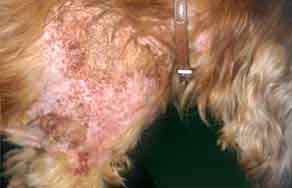
Source: Royal Veterinary College, University of London Veterinary School
Diagnosis
Your veterinarian will make a diagnosis based on a review of your dog's symptoms and history. Skin scrapings may be helpful in making a diagnosis, however it is accurate 100% of the time. Other tests are also available, but if your veterinarian suspects scabies, she may recommend proceeding with at least treatment with a lime-sulfur dip.
A time honored test for scabies is to rub the ear flap in your fingers. If your dog scratches on the same side then scabies are probably present. For a definitive diagnosis your veterinarian will scrape the skin and analyze the result.
Sometimes the symptoms of scabies remain even when the mites are gone since mites leave behind a toxin that causes dog's to itch.
Ask Our Vet A Question or Share Your Story
Have A Dog Scabies Related Question or Story For Our Vet?
Do you have a Dog Scabies or Mange Question for our Vet or a Helpful Story to Share?
Please include information such as dog age, sex, breed, medical history, symptoms, medications your dog is taking, changes in behavior, illness in other pets in the household or anything else that could help our Vet help you.
We will do our best to get back to you quickly (it depends on how many questions we receive each day). If you do require an immediate response we suggest using this online dog veterinary service that is available now.
What Other Visitors Have Said
Click below to see contributions from other visitors to this page...

Scabies on me and my dogs what to do Not rated yet
Reader Question: My dog is scratching and has warts on his paws. The hair is also falling out.
Suggestions from our editor:
Hi Patricia,
Based …
Scabies and Infestation of other Pups Not rated yet
Reader Question: Scabies and Risk to Other Puppies
How long is a pup with dog scabies contagious to other dogs when treated? There is a pup in desperate …

Can Mange be Mistaken for Ringworm Not rated yet
Reader Question: Differentiating Ringworm From Mange in Dogs
I took my 10 week old puppy to the vet because I noticed 3 patches of missing fur which …
References
Superficial Mite Infestations
Ralf S. Mueller DipACVD, DipECVD, FACVSc
Medizinische Kleintierklinik Veterinaerstr. 13 80539
Munich, Germany


