Summary:
"Dog diarrhea is common and has a number of causes including infection, ingestion of foreign objects, food allergy, food intolerance (inability to digest) and parasites. Causes can be mild, such as stomach upset, to cancer. A common cause is the rapid switch from one diet to another or giving a diet that is difficult to digest such as a high-fat diet.
Diarrhea in dogs can appear suddenly (acute) or be chronic, which means that it lasts for a long time. In most cases, canine diarrhea in healthy dogs is caused by an inflammation or infection in the intestinal tract, a condition called gastroenteritis.
Since dogs naturally eat items they find outdoors such as a dead animal or plant which causes gastrointestinal irritation, they are prone to diarrhea. Most cases that are caused by ingesting items outdoors and will go away with no medical intervention. Diarrhea can also be caused by natural changes in your dog's GI tract as they get older. For example, around 8 years of age the table scraps your dog used to tolerate well now can result in diarrhea.
Diarrhea can be a serious problem so if your dog has diarrhea for more than a day or 2, call your veterinarian. Your veterinarian may provide a vial for a stool sample to determine if the problem is due to a parasite or a bacterial overgrowth. If one of these are the problem, your veterinarian will provide a medication.
When To Visit The Vet:
Signs of a more chronic or severe case requiring a trip to a veterinarian includes seeing canine diarrhea and vomiting together, a dog that refuses to eat, lethargy or avoidance of normal play, bloating, or acting as if the dog is in pain.
Puppy diarrhea or mild diarrhea in smaller breeds can quickly cause dehydration, so a trip to the vet is warranted.
Treatment For When "My Dog Has Diarrhea":
If your adult dog only has diarrhea as a symptom, then the best approach is to withhold food for 12 - 24 hours. Water should never be withheld to prevent dehydration. After 12 - 24 hours, provide a bland diet in small amounts such as cooked, never raw lean ground turkey and white rice. Food should be served in the quantity of 1 tbsp per 10 pounds of body weight every few hours for 12-24 hours after the fasting period. Increase the amount of food provided as long as the diarrhea is improving. Continue for 1 - 2 days and then gradually restore the normal diet in 3 to 4 days.
If symptoms don't improve after trying the aforementioned diet change or if diarrhea is frequent see your veterinarian to avoid dehydration and for a complete diagnosis. Your dog might need an antibiotic or other treatment for the condition such as being treated for whipworms, a common diarrhea cause. Dietary change to a hypoallergenic diet or highly digestible, low-fat diet for 3 to 4 weeks might help to address any dietary intolerance problems. Digestibility of the diet is very important when treating diarrhea since nutrients that are mal-absorbed can result in a worsening of diarrhea and bacterial overgrowth."
Overview
Most cases of diarrhea in dogs can be cured by implementing a fast for 12 - 24 hours followed by a temporary switch to a bland diet. Persistent canine diarrhea, changes in behavior or diarrhea and vomiting together indicate a more complicated problem that requires the care of a veterinarian.
Never stop providing your dog with water to avoid dehydration. If a dog will not drink try ice cubes. If your dog still refuses to drink, particularly if small breed or puppy with diarrhea, contact your veterinarian as soon as possible.
What is Chronic Dog Diarrhea?
Chronic diarrhea in dogs is when the consistency, frequency and volume of bowel movements changes for over 3 weeks. It can occur in the small intestine (also called small bowel), colon, or large intestine, or in both the large and small bowel.
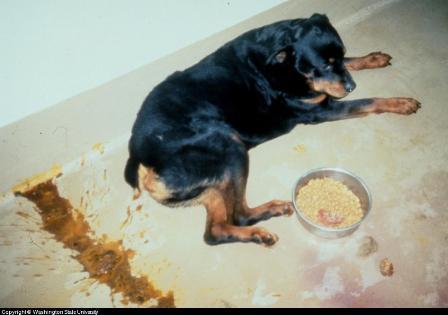
Diarrhea often stops after the toxins have been eliminated from the body
Source: WSU College of Veterinary Medicine
What Causes Dog Diarrhea?
Dog diarrhea causes vary based on if the small intestine or large intestine is involved.
Dog Diarrhea Causes - Small Intestine
- Parasites (worms)
- Abnormal food digestion (maldigestion). Caused by lower production of digestive enzymes in the pancreas
- Bacterial infection and small intestine bacterial overgrowth
- Fungal infection (aspergillosis, histoplasmosis
- Dietary problem such as food intolerance
- Food allergy
- Gluten sensitivity (seen in Irish Setters)
- Change in diet without a gradual transition
- Viral infection (rotavirus, distemper, parvovirus, coronavirus)
- IDB (inflammatory bowel disease)
- Poisoning
- Reaction to medications
- Blockage due to a foreign body
- Intussusception (folding of the intestine)
- Stomach ulcers (gastroduodenal ulcers)
- Surgical removal of the intestine (short-bowel syndrome)
- Lymphangiectasia: lymphatic vessel dilation
- Cancer or tumor
- Pithiosis (water mold)
- Liver disease (hypoadrenocorticism or Addison's Disease)
Dog Diarrhea Causes - Large Intestine
- Parasites
- Bacterial infections
- Fungal infection (histoplasmosis)
- Pythiosis (water mold)
- IBD - Irritable Bowel Disease (several types such as colitis)
- Tumor or cancer
- Algae infection (Prototheca)
- Eating something that your dog should not have eaten (hair, bones)
- Fiber
- Metabolic problems caused by too much waste product in the bloodstream (uremia)
- Unknown causes (called idiopathic or irritable bowel syndrome)
Dog Diarrhea Problems and Signs
Canine diarrhea is a symptom of many diseases and is a reflection of a problem in the way your dog's body is absorbing nutrients. When this system becomes out of balance due to an infection, illness, allergy, parasites or medication that your dog doesn't tolerate well, the body reacts with diarrhea.
Dog Diarrhea Guide |
|||
|---|---|---|---|
|
Dog Diarrhea Problems |
Possible Cause |
Action |
|
|
More than a few drops of Blood in Diarrhea |
Possible serious illness or intestinal disease |
Visit Vet ASAP |
|
|
Diarrhea and Vomiting |
Poisoning, Parvo, Illness |
Visit Vet ASAP |
|
|
Change in Behavior such as Depression |
Illness |
Visit Vet ASAP |
|
Combination of:
* Fluid buildup in the tissue such as swelling in the legs |
Small Intestine Problem | Fast for 12 to 24 hours. Provide water or ice cubes. After fasting period, change to bland diet such as cooked lean ground turkey or chicken plus rice for 12 - 24 hours. See Veterinarian if condition does not improve. | |
| Diarrhea - including
mucus, bright red blood * Constipation * Increased frequency of defecation * Difficulty defecating or urinating (Tenesmus) * Inability to defecate without pain or difficulty (Dyschezia) * Vomiting * Weight loss |
Large Intestine Disease | Fast for 12 - 24 hours. Change diet to chicken/rice for 24 hours. See Veterinarian if condition does not immediately improve. | |
| Diarrhea only symptom | Mild Infection, allergy, food intolerance | Change diet to chicken/rice for 24 hours. If recurs see Vet. | |
| Dog Yellow Diarrhea | Food Intolerance, Eating of non-digestible object | Hold food for 24 hours. Change diet to chicken/rice after 24 hours. Plenty of water. If recurs or doesn't stop after 24 hours see Vet. | |
| Black Feces | Bleeding or irritation in the digestive tract | See your veterinarian to be checked for serious disease | |
| Light colored feces | Liver problems | See your veterinarian | |
| Grey feces with strong odor | Calm digestive system. Withhold food for 24 hours. Provide water. Use chicken/rice diet. | ||
Symptoms of Dog Small Bowel Diarrhea
Symptoms of small bowel diarrhea can include:
- Larger bowel movements than is normal for your dog
- Increased frequency of bowel movements (2 to 4x per day).
- Loss of weight
- Polyphagia (increase in appetite) - occurs when the digestion of food isn't normal, or the food isn't being correctly absorbed
- Melena - black tarry stools which indicates the presence of blood. There is an absence of mucus or red blood in the bowel movement.
- No difficulty in defecating (difficulty referred to as dyschezia)
- Excessive gas, stomach gurgling or rumbling
- Vomiting
- Loss of body condition
- Dehydration
- Enlarged abdominal lymph nodes
Symptoms of Large Bowel Diarrhea
Symptoms of large bowel diarrhea in dogs include:
- Fewer bowel movements than normal
- Higher frequency of bowel movements (over 4/day)
- Lack of weight loss
- Red blood in the bowel movement (hematochezia)
- Dog is in pain when defecating, or is straining
- Excessive gas
- Vomiting (not all dogs)
- Change in body condition
- Veterinarian finds that the intestines are have thickened
Diagnosis
When first seeing a case of diarrhea, the veterinarian will attempt to determine which part of the intestine is causing the problem (small intestinal involvement or large bowel diarrhea.) The veterinarian will try and first determine if parasites such as worms are the cause. Once this is ruled out, tests will be needed such as blood analysis and in more chronic cases, abdominal imaging. The veterinarian will try and determine if diet or the ingestion of things the dog should be be eating are the cause. Tests will also determine if the cause is a bacterial infection.
If causes such as parasites, food intolerance, and bacteria are ruled out, the veterinarian will look to causes such as Idiopathic Inflammatory Bowel Disease (IBD).
Dog Diarrhea Treatment
Most veterinarians will begin dog diarrhea treatment by checking your dog for parasites. If this is ruled out then they move on to dietary change. See below to answer the question "what can I give my dog for diarrhea."
Mild Diarrhea in Dogs Treatment
For suspected mild gastrointestinal causes, such as intestinal tract inflammation, a vet will recommend fasting for 12 - 24 hours followed by small amounts of a bland diet, such as cooked lean ground turkey and rice. Feed at 1tbsp per 10 pounds of body weight. Provide a small serving every few hours for 12 - 24 hours after fasting. If the diarrhea improves, gradually increase the amount of bland diet provided over the next 1 - 2 days. Over the next 3 - 4 days, transition back to your dog's normal diet, by gradually reducing the amount of bland food, replacing it with your dog's normal diet.
If a fecal sample is tested, the veterinarian will prescribe medications to treat the cause. For abnormal bacterial overgrowth in the stool, an anti-biotic will be prescribed to get normal bacterial back into the GI tract. Metronidazole is commonly used to get control of a diarrhea problem due to bacterial growth. It stays in the GI tract and does not effect the dog in other ways.
If there is inflammation in the bowel, a product that soothes the GI tract is needed. One product that can be sent home with the patient is called Kaolin Pectin Suspension, which is given every 4 hours.
Persistent Diarrhea in Dogs Treatment
For cases that do not go away, a vet may also recommend dietary change, but with a switch from your dog's current diet to a commercially available hypoallergenic diet to see if food allergy is the cause. This type of diet can also be prepared at home. Many vets suggest a commercial diet that contain hydrolyzed proteins since this type of protein is absorbed better into the body. Most dogs do well with this type of diet and will respond in one week to 10 days. Dietary choices include Hill's i/d (canned or dry) and Purina EN. Both are suitable for puppies and adults.
If this doesn't help, medications are prescribed that help with canine diarrhea caused by issues such as colitis. Usually this involves the drug metronidazole and an increase of fiber in the diet. Other choices include antibiotics to fight any bacterial infection (metronidazole, tylosine, tetracycline).
If this doesn't work then additional testing is done including blood tests, examination of the digestive system and biopsies of the intestines.
After ruling out other causes your veterinarian may indicate that your dog as Irritable Bowel Syndrome (IBD). Treatment for this condition includes several weeks of prescription corticosteroids. If it works the drug is slowly decreased in dose over time.
Treatment for Vomiting with Diarrhea
Most causes of dog vomiting with diarrhea includes withholding water and food by mouth while providing intravenous fluids in the veterinarians office. This will last until the dog does not vomit for 12 to 24 hours. After that water is provided in small amounts followed by providing a commercial GI diet for 3 to 5 days. The regular diet can then be reintroduced.
Chronic Idiopathic Large Bowel Diarrhea
Treatment for large bowel diarrhea of unknown cause may often be achieved by adding a soluble fiber to a commercially available GI diet such as Hill's i/d. One approach is to add psyllium hydrophilic mucilloid (Metamucil). Add 2 tbsp./day of Metamucil.(1)
Natural Remedies for Dog Diarrhea
If diarrhea is a persistent problem and all of the above has been ruled out, then it might make sense to try restoring balance to your dogs digestive system such as Runni Poo Relief. It includes ingredients known to improve digestive function and health such aslantago major (Plantain), Alchemilla vulgaris (Lady’s Mantle) and Podophyllum (6C), all known for helping to restore normal stools. Discuss this option with your veterinarian.
Brochures
These free brochures on diarrhea in dogs can be downloaded and provide excellent advice for different types of diarrhea.
Small bowel and large bowel (intestine) dog diarrhea causes. Suggestions for how to stop dog diarrhea.
Suggested dog diarrhea dietary choices for cases that include just diarrhea, diarrhea and vomiting, lymphangiectasia, and inflammatory bowel disease. Discussion of the beneficial effects of probiotic bacteria and soluble fiber.
Dog Health Guide Diarrhea Resources
Information on Canine Diarrhea:
Control
Dog Diarrhea
Common Causes of Canine Diarrhea
Problems with the Pancreas
Diarrhea due to Enzyme Deficiency
Diarrhea and Irritable Bowel Disease
Small and Large Intestine Problems
Viral
Causes
Parvo
virus
Illness as a cause of dog diarrhea
Dog with Diarrhea Symptoms
Gray Color
Yellow Color
Vomit Color
Vomit
and Diarrhea Together
Symptoms of Intestinal Causes of Diarrhea
Treatment of Dog With Diarrhea
Canine
Diarrhea Over the Counter Human Medication
Pepto-Bismol
Kaopectate
Immodium
Dog Diarrhea Diet
Chicken
and Rice Diet
Use of Probiotics and Prebiotics
Natural
Medicine
Ask Our Vet a Question About Your Dog's Diarrhea
Have a Diarrhea Related Question For Our Editors or A Story to Tell About This Topic?
Do you have a dog diarrhea or other digestive system related question for our Editors or a helpful story to share? Please include information such as age, sex, breed, medical history, diet changes in behavior and medications.
We will do our best to get back to you quickly (depends on how many questions we receive each day). If you do require an immediate response we suggest using this online dog veterinary service that is available now.
Vet Responses to Reader Questions
Click below to see contributions from other visitors to this page...
Chicken Rice Diet for Dog Diarrhea? 

I am surprised to see that so many suggest chicken-rice diet in cases of dog diarrhea. Chicken and beef are the greatest allergens with dogs. I have a …
Help For Outdoor Dog That Has Frequent Diarrhea Not rated yet
Reader Question: Dog Diarrhea Help For Outdoor Dog
My Dog has had one diarrhea stool each day for about 5 or 6 days, maybe a couple of days longer. …
References for
Dog Diarrhea
(1) Dietary Management of Diarrhea in Dogs and Cats; Michael S. Leib DVM, Virginia Maryland Regional College of Veterinary Medicine
(2) F.P. Gaschen; School of Veterinary Medicine; Louisiana State University
(3) Small Intestinal Diarrhea, Causes and Treatment; Frederic GAschen, Dr. med. vet.


