Table of Contents
Pregnancy Tests | Dog Pregnancy Day by Bay Timeline | Labor Stages | Brochures | Q&A
Summary:
"Pregnancy in dogs, like in humans, is a time of anticipation and careful monitoring. As an owner, it's crucial to know what happens each day from day one to ensure your dog's health and prepare for the arrival of the pups. This day by day guide to dog pregnancy will walk you through each step, starting at day 1. Buckle up for a thrilling journey of life in the making!
Intervention is minimal when it comes to a pregnant dog. However, it is always better to go for a 'Breeding Soundness Examination' before conceiving. Your veterinarian can guide you about the steps and requirements depending on the history. You can however help
your dog by making changes in the way you feed her and in preparing a
safe and comfortable place to give birth. Pregnancy occurs
approximately 11 to 14 days after insemination or conception. A veterinarian can feel
the swelling of the uterus approximately 3 to 4 weeks later and may decide to carry out an ultrasound test.
Canine pregnancy lasts approximately 63 days (range is 56 to 70 days). Determining the exact day your dog became pregnant may or may not be difficult, depending on the circumstances, but we'll give you some general guidelines to follow."
Canine Pregnancy Tests
Dogs experience the estrous cycle, it is different from the human menstrual cycle. The estrous cycle has four stages: Proestrus, Estrus (the fertile stage), Diestrus, and Anestrus. Every stage comes with it's specific signs, while successful mating typically happens during the Estrus phase, which can last from 5 to 14 days. The female dog is only receptive during the Estrus phase.
There are several methods for detecting a pregnant bitch. These include:
- Ultrasound: Can detect fluid filled uterine vesicles as days 18 -
20 after ovulation. Heart beat can be detected by day 23 to 24, with a
clear heartbeat on day 25. This is the most definitive method for
confirming pregnancy in dogs. Tests are usually scheduled for day 28-30
for a clear reading and to avoid error introduced by looking for the
heartbeat too early. It is recommended to carry out an ultrasound examination as soon as after 28 days of conception, at this stage even the number of embryos can be estimated.
- Manual Palpitation (touching from outside the body): Manual
palpitation of the female bitch at day 22 can often indicate
pregnancy. The visible signs of pregnancy can be seen at around 35 - 38 days.
- X-Rays: Can't be used until the skeleton forms, which
approximately day 44 or 45.
- Test for Relaxin: This blood test can be used on days 23 to 25,
but reliability improves around day 30. In general, blood tests are unreliable as indicator for pregnancy in dogs.
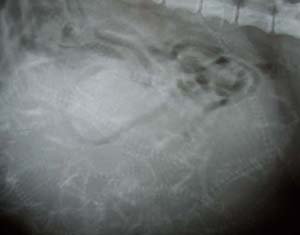
Using an X-Ray Pups can be counted by looking at the number of spinal columns.
Dog Day by Day Pregnancy Timeline
Here's a basic day-by-day timeline of what you might expect during a dog's pregnancy. This is a general timeline and individual dogs may vary. Always consult with a vet if you have concerns about your dog's pregnancy.
Month 1: Mating, Fertilization, Embryo Development and Early Pregnancy
During days 2 - 4 a fertilized egg or zygote travels down the fallopian tubes towards the uterus. This process takes a few days with no noticeable pregnancy symptoms. During days 5 to 20 after reaching the uterus, fertilized eggs will implant themselves into the uterus lining around day 16 to 20. This period is when early embryonic development begins. The The fertilized egg divides into multiple cells, forming a ball-like structure. The cells differentiate into an outer layer that develops into the placenta and an inner layer that will become the puppy. Sometime between day 21 and 28 you may start to notice physical changes in your dog such as increased appetite, enlarged nipples, or weight gain.
Dog Fetus:
- Days 1 through 4: Pregnancy starts when the dog ovulates, which is called the data of whelping. Dog sperm will reach an ovum on day 4 (48 to 73 hours). Dogs typically mate multiple times over the course of several days, and it's common for conception not to occur immediately after mating. Sperm will reach the eggs in the female's oviducts within a few days.
- Day 7 - 14 (Embryo Development) : The fertilized eggs will start to form into embryos and will travel to the uterine horns for implantation.
- Day 16 (Early Pregnancy Begins): By around the third week the dog embryos embed in the uterus lining. This is when physical changes might start to be noticeable. Some dogs may experience morning sickness, including loss of appetite or vomiting.
- Day 22: Dog fetus begins to take shape
- Day 25: At around 25 days or after, a vet can use an ultrasound to confirm the pregnancy.
- Day 29+: Growth of the embryos and development into fetuses; thus number of embryos can be estimated at this stage with ultrasound
Bitch:
- For the first three weeks or so of your dog pregnancy, you
may
not notice any symptoms. She may become more affectionate and she may
begin to eat more than usual. Her nipples may enlarge slightly. Four to
five weeks into pregnancy, a clear mucus vaginal discharge may be
noticed. This will continue until your dog gives birth. The vulva will
remain swollen. Continue normal exercise and nutrition.
- At 28 - 30 days into the suspected dog pregnancy, your veterinarian can perform a blood test to determine if your dog is indeed pregnant. This test checks for the hormone relaxin, which is produced when the fertilized egg implants. With small litters (less than three puppies) false negative results may occur. In general, blood tests are not considered reliable to determine pregnancy in dogs. The ultrasound and physical examination is thus recommended as preference.
- Also at about 28 days into the pregnancy, your vet will be able to pick up fetal heartbeats with ultrasound. This will verify that your dog is pregnant and your vet can give you an estimate as to how many puppies she is going to have. About this same time, your vet may be able to palpate the uterus and feel the fetuses. This may not be possible on large dogs or one that has puppies under the rib cage. A stethoscope at day 25 can confirm a puppy heartbeat, but not the number of pups in the litter.
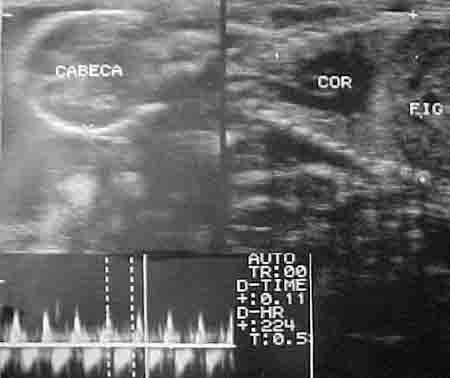
Source: Washington State University
- Discharge from the vagina appears at the end of the 1 month
mark
- Teats become enlarged, particularly at the nipple base.
They
also become pinker.
- Less physical activity
- Bitch may have what is described as morning sickness. See a Vet if you notice a lack of appetite accompanied by lethargy.
Month 2: Growth of the Embryos, Continued Fetal Development
During this period the fetus begins to develop more rapidly. Spinal cords form, and they are starting to look like miniature dogs. Your dog may begin to show changes in behavior, such as increased affection or bouts of morning sickness due to hormonal changes. Around day 36, as the pregnancy progresses, your dog may start exhibiting nesting behaviors. This includes seeking out quiet, comfortable places to rest and give birth.
- Day 32: The embryo takes shape with the eyelids taking on a distinct shape
- Day 35: Toes become visible. Around day 35, they start to look like little dogs, and their heartbeats may be detectable by ultrasound.
- Day 36+: The fetus continues to grow and develop and your dog's belly will enlarge. This is a good time to increase the pregnant dog's food intake, usually by about 25%.
- Day 40: Claws take shape
- Day 45: Coat and skeleton starts to form. Vets recommend
that
the female gets wormed at this point to avoid passing parasites on to
the litter.
- Day 50: Once the skeleton forms, a Vet can take an X-Ray
to
determine the number of puppies. This is the beginning of the final stages of pregnancy. Your dog will likely be quite large and uncomfortable during this time. The puppies are continuing to grow and get into position for birth. You may be able to see and feel the puppies moving within your dog's belly.
- Day 58: The female will look for a nesting area to give
birth. Clip any hair around the females vulva and set up the whelping
area.
- Day 59 to 63: Signs of labor include restlessness, panting, pacing, or "nesting" behavior. Labor can last anywhere from a few hours to a day. During labor, she will deliver the puppies, usually with 30-60 minutes between each one.
Changes in Bitch:
- Weight increases about 20% to 55%
- Appetite change with an increase
- Increase in urination frequency
- Behavioral change
- Day 35: Provide more food to meet increase in
appetite.
Do not overfeed. You may need to supplement her diet and it is recommended to increase food intake by 10% per week after a confirmed pregnancy.
- Enlarged and firm abdomen (days 45 to 50)
- May notice clear odorless discharge from the
vagina. If
discharge has a color or an odor, consult with a veterinarian.
- Around day 30 to 35 you may be able to feel the puppies
by
touching her belly. She might become more affectionate and displays a clingy behavior.
- Day 42+: Keep pregnant dog quarantined (no other dogs or
pets) to avoid the spread of disease, but make sure she isn't fully isolated.
- Day 45: you will see a decrease in appetite. Offer
small meals throughout the day.
- Day 45 to 60: pups have bone formation that can be picked
up
via x-ray. An x-ray can indicate the size and number of pups.
- Day 50: spot puppy movement in the belly.
Fetus:
Around the 60th day of the pregnancy, x-rays may be taken to determine for sure the number of puppies and make sure that size-wise they can fit through the birth canal. X-rays are not recommended earlier in the pregnancy because they can be harmful to developing fetuses. For more information see our guide to whelping signs.
Month 3
Changes in Bitch
- You may see milk when pressure is applied to the nipples
- Day 58+: considered to be full term, average length of
dog
pregnancy is 63 days
- Dog waist will trim as puppies move into position for
birth
canal. This indicates birth is approximately 7 days away.
- Day 61 or 62: Appetite loss or gone and dog will have a
lower
body temperature. When temperature falls, indicates pups will be
born in 12 to 24 hours. Take temperature daily over last 7 days via
rectum. Normal temperatures is 101 Fahrenheit (38.5
Celsius). Change to 97/98 Fahrenheit or 37 Celsius coincides with
birth in 12 to 24 hours. Consult a veterinarian if temperatures
are higher than these benchmarks, as it could indicate the presence of
infection or fever.
- At or around day 61 to 65, the pregnant bitch will appear
to
nest such
as appearing more agitated or restless.
- Other signs of birth include hiding, digging, changes in behavior, pacing, panting and shivering. Also may see more time being spent in whelping box.
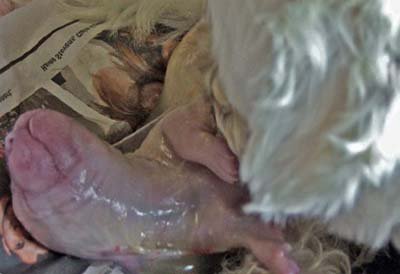
Stages of Dog Labor
Stage 1:
Temperature drop to 98.4 Fahrenheit (or lower) from normal temperature of 100 to 103 Fahrenheit. As noted above, temperatures lower than 98.4 Fahrenheit indicate that birth is in 12 to 24 hours. Eyes dilate, appetite declines and dog may change behavior such as trying to hide.
Stage 2:
Puppies begin to move out of the birth canal. Bitch might shiver an shake accompanied by vulva licking. Puppies can be normally born hindquarters first or nose first. The mother will break the sac, clean the puppy, cut the umbilical cord (about 1 inch from body) and eat the placenta.
Stage 3:
The mother will
rest after each puppy is born. Puppy deliveries are spaced about 30 minutes to one hour. Times
vary by dog. Dogs deliver in different positions, including lying down
or standing/squatting. Don't interfere or distract the
dog. It takes a puppy 10 minutes to move through the birth
canal to birth.
If the puppies are born faster than the mother can clean each pup, you may need to assist. Use a piece of wet gauze to wipe the puppy's face. Clean the coat against the grain with a soft towel. If puppy is not breathing, open mouth with a finger and blow gently into throat. If you need to cut the umbilical cord, first, tie umbilical cord 1 inch from puppies body, and then another knot further from the body. Use thread or dental floss. After using floss or thread, then cut the cord between the 2 knots you created.
If puppies can only move partially from the birth canal, tear open the sac at the feet or face, depending on which way the puppy is facing. Grab the feet or head and when you see a contraction, help guide the puppy down. If you cannot move the puppy or if the mother appears to be in pain, call a Veterinarian.
Tip: A blue puppy tongue indicates that dog is not getting enough oxygen.
If puppies sound like they have lung fluid (called aspiration, when you hear fluid like noises when breathing), place puppy in your hand. Use 2 fingers to cradle face. With other hand sing hands downward to make the puppy gasp. Downward motion helps to drain the mucus and fluid from the lungs. Repeat until lungs are clear. You can stop when the puppy's lounge is pink or red (indicating that pup is getting oxygen).
You may want to have a "warm box" heated with a hot water bottle wrapped in a towel to keep puppies warm during an extended birthing process. It is not unusual for a pregnant dog to want a bathroom break. Watch for the delivery of additional puppies during the break. Napping during extended birthing is normal. Consult a veterinarian if napping looks to be extended due to mom's exhaustion.
Veterinary Emergencies: If vaginal discharge is dark green and you do not see a birth in an hour, call a veterinarian immediately. If pup is born rump first and mother is pushing without delivering, call Vet immediately. If the birthing process pauses for 2 hours and more puppies are to be born, contact the Vet.
Care When Pregnant or Whelping
Feed your dog a premium adult dog food for the first few weeks of her pregnancy. In the fourth week of dog pregnancy, add some premium puppy food to her diet. Each week, replace some of the adult food with puppy food, until during the last week of her pregnancy she is eating all puppy food.
Your dog will need to eat several small meals each day instead of one or two large meals as the pregnancy progresses and the puppies take up more and more space. At the end of her pregnancy, she may need to eat every three or four hours.
As long as she is eating a premium commercial dog food, there should be no need to add any supplements to her food. Check with your vet to see what he or she recommends. Supplementing her diet after confirmation of pregnancy may be essential.
During dog pregnancy should get regular, but not strenuous, exercise throughout her pregnancy to maintain her muscle tone and prevent excessive weight gain.
About two weeks before your dog is scheduled to begin whelping pups, prepare a whelping box for her to give birth in. This gives her time to get used to the birthing box. Otherwise, she'll give birth in the closet or in your bed. Keep a close eye on her as the time approaches, or she may do that anyway.
During the time your dog is lactating you may want to consider a natural dietary supplement that helps your dog's body meet the extra demands that comes with milk production. Herbs such as Saw Palmetto, Cleavers, Echinacea purpurea (immune system) and Baryta carb (urinary tract) support the production of colostrum (mothers milk that contains antibodies and nutrients).
A healthy dog can usually deliver her puppies without assistance. Ask your vet what, if anything, you should do to help her when the time comes. Signs of whelping include restlessness, panting, licking the vulva, hiding, shivering and in some cases vomiting.
When to Call the Vet during Dog Pregnancy:
- If the discharge that comes before delivery isn't followed by birthing (green/black discharge)
- If a puppy cannot be removed from the bitch
- 4 hours between deliveries of puppies in the litter
- If the pregnancy is lasting more than 65 days
- Extended labor of 2 hours or more
- Symptoms such as tremors, panting or vomiting
- Higher than expected temperature (see above) during last 7 days of dog pregnancy
Brochures
Download these free brochures for more information on dog pregnancy:
Guide to management of a pregnant bitch. Detailed information on how to care for a pregnant dog.
Dog pregnancy timeline with descriptions of what to expect and look for each week.
Ask Our Vet A Question or Share Your Story
Have A Question About Canine Reproduction or Story That Can Help Others?
Do you have a Canine Reproduction related Question for our Editors or a Helpful Story to Share? Please include information such as age, sex, breed, medical history, skin and other symptoms, medications your dog is taking, recent changes in behavior, etc. A picture of any visible condition would also be helpful.
We will do our best to get back to you quickly (depends on how many questions we receive each day). If you do require an immediate response we suggest using this online dog veterinary service that is available now.
What Other Visitors and our Veterinarian has said
Click below to see contributions from other visitors to this page...
Blood on Bedding During Gestation Not rated yet
Tilly is a 5 yo healthy Hungarian Vizsla...
She is potentially around day 37 of gestation.
Today I noticed a stain on her bedding which may be blood …
References for Dog Pregnancy
IVIS
Pregnancy Management in Dogs and Cats
Concannon, Patrick W., and Verstegen, John
Understanding And Monitoring Canine Pregnancy
Patrick W. Concannon. Ph.D., Dipl. ACT (Hon.)
Department of Biomedical Sciences, Cornell University, Ithaca, NY 14853
USA


