Summary:
"Symptoms and signs of dog mange include red papules (bumps), hairless areas and constant itching by your dog. Since diagnosis is difficult, begin treatment to see if there is any response. A lime-sulfur dip with a medicated shampoo is the safest approach. Prescription medications can have side effects in some dogs and should be used with caution."
Overview
Signs of Dog Mange refers to microscopic bugs in the mite family that burrow under your dogs skin. The mites are too small to be seen by the naked eye and are often referred to as having a mangy dog. There are two types of canine mange called Demodectic Mange and Sarcoptic Mange (also called dog scabies).
Canine Mange in mature dogs should be kept under control by a strong immune system. Dogs that get mange tend to be young, so their immune system isn’t fully developed or are older and have a weakened immune system due to some other cause. Look for other factors that may be the cause such as cortisone injections (steroids), diabetes, cushings disease or hypothyroidism.
Puppies with Demodex Mange - Can a Dog be Born with Mange?
The answer is yes. Almost all puppies are born with mites they acquire from their mother. The Mange should heal by itself in under one month if it is demodectic mange and as their immune system matures. Your veterinarian may recommend a dip such as amitraz for 2 to 4 weeks until the condition disappears. Clinical signs of dog mange only appear when puppy mange infestations get larger.
If a dip is not needed, Mange in puppies involves cleaning any skin lesions during. A natural shampoo such as Mange Mites Shampoo or a medicated shampoo that contains Benzoyl Peroxide are used.
Photos of Mange on Dogs
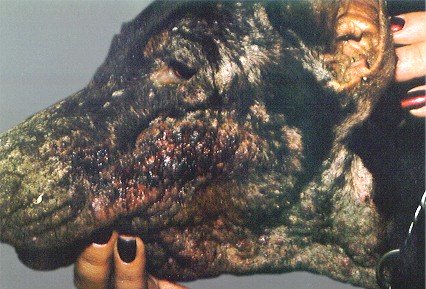
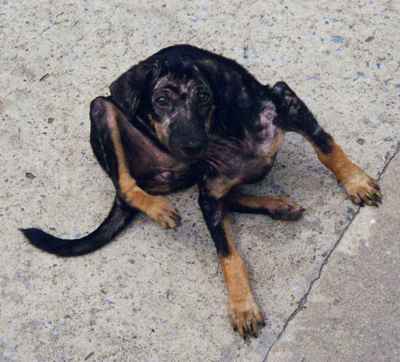
Symptoms of Mange in Dogs
The symptoms of mange are usually:
- Small red hairless area
- Hairless area with pimples, thick skin and puss
- Scaling around the eyes, mouth and front legs
- Itching since the motion of the mite in and on the skin is extremely itchy. (intense scratching or itching is a characteristic of scabies – also knows as sarcoptic mange)
Diagnosis of Dog Mange
Your veterinarian will scrape your dog’s skin and analyze the sample under a microscope for mites. The diagnosis for demodectic mange and sarcoptic mange is based on the type of mite that is found. Cigar shaped mites are demodectic and round mites are sarcoptic. A skin scraping for dog scabies will not always be accurate.
Since diagnosis based on signs of dog mange are only accurate 50% of the time (mites may have been removed by your dogs constant scratching leaving only itchy toxins behind), most owners will treat for mange and see if there is a reduction in symptoms.
Treatment of Dog Mange
Different treatments are used depending on the type of mange your dog has and the age of the dog.
For younger dogs the mange should heal itself in 6 to 8 weeks. Cases of several months are not unusual.
Canine Mange Dip
Your Veterinarian will often prescribe Paramite dip (an organophosphate) or Mitaban dip (Amitraz), which is not available over the counter. Mitaban can be particularly toxic to animals. The disease typically resolves within one month to six months of application of treatments.
When using a dip such as Paramite or Mitaban wear gloves and only use in a place with good ventilation. Sponge on the dip for 10 minutes, allowing your dog’s feet to soak in the rinse. Let the dip dry on the dog. Repeat the process every 2 weeks (read the directions on the dip carefully). Keep your dog from getting wet between treatments.
You may also use Naturasil for Pet Mange. This is a way to treat the mange outbreak without a prescription. It mixes with your dog's normal shampoo making for easier application. The active ingredient is Lime-sulfur, which is approved by the FDA as being safe on mange mites. Veterinary clinics world-wide use sulfur as a treatment on dogs and puppies.
Treatments should continue for 3 months. There are side effects (most often seen in puppies) such as tiredness, vomiting, diarrhea, dizziness and an odd walk or gait.
Antihistamine for Itching – Itching can be helped with antihistamines such as Benadryl (diphenhydramine) with dosage based on your dog’s weight (1 to 3 milligrams per pound).
If you have more than one pet or dog, you should treat all animals in the house. Dog products usually cannot be used on cats so check all labels before using. Also, mites can jump to humans so wash after handling.
DO NOT use motor oil for Canine Mange. The oil can be toxic if licked by your pet. DO NOT use corticosteroids Also corticosteroids (cortisone) may control the itch, but actually lowers immunity to mites, allowing them to multiply faster.
Your dog's environment should be disinfected to avoid reinfestation from any mites that moved off your dog. Use a strong disinfectant designed to safely kill any mites in the home such as Benzarid. Wash all of your dogs belongings in detergent.
Supplements to Speed Recovery
After the mange is treated, skin condition can be restored with a Omega-3 Fatty Acid supplement for dogs. Natural remedies could also be of help to support overall skin health such as Skin and Coat Tonic.
To prevent future cases of mange, a natural repellent spray, that can be safely sprayed on dogs before they go outside may be of help. One product to consider is Mange Mites Spray.
References and Further Reading
The
Doctors Book of Home Remedies for Dogs and Cats
Prevention Magazine
Hound
Health Handbook
Brevitz, Betsy DVM
Canine Scabies: An Update
Didier-Noel Carlotti, Doct.-Vét., DECVD
Cabinet de Dermatologie Vétérinaire, Heliopolis B 3
Bordeaux-Mérignac, France (EU)
Ask Our Vet A Question And We Will Answer It For Free
Have A Dog Mange Related Question or Story For Our Vet? We'll Answer It For Free
Do you have a Dog Mange Question for our Veterinarian to answer (for free!). Please include information such as age, sex, breed, medical history, medications your dog is taking, changes in diet and behavior etc..
We will do our best to get back to you quickly (it depends on how many questions we receive each day). If you do require an immediate response we suggest using this online dog veterinary service that is available now.
What Other Visitors Have Said
Click below to see contributions from other visitors to this page...
Does my dog have mange? 
My 12 year old female collie mix has a serious skin problem. She is bald on all 4 of her legs, her back, neck and face. One of her bottom eyelashes have …
Home Remedy for My Puppy with Mange
I have a 13 week old pup with mite mange. I have tried medicated shampoo that didn't work, Now I am trying the old wise tale of borax and 3% hydrogen …
Chronic Demodex Mange Not rated yet
Reader Question: Does Demodex Improve After Progestanin Administration?
The dog began to show obvious symptoms of Demodex mange at approx 4 months …
Puppy with Mange Not rated yet
Our Puppy has mange and her eyes are swollen red and are swelling shut. What can we do to make the swelling go down and help her heal from the sores?
…


