Table of Contents
Overview | Anatomy | Symptoms | Diagnosis | Treatment | Hearing Loss | Cleaning | Prevention | Q&A | Brochures
Summary:
"Identifying the trigger for canine ear problems can be frustrating with possible multiple causes including infection (bacteria, yeast, mites, fungus), allergy (atopy, food), water (swimmers ear), foreign objects and tumors. Inflammatory conditions are referred to as Otitis externa and occur in 15% to 20% of dogs.
Symptoms include head shaking, rubbing the ear against furniture, head tilting and ear scratching.There may or may not be inflammation (called otitis), red skin or itch. Dogs with advanced cases may appear wobbly or lethargic and act in pain when the ears are touched.
Treatment includes medicated drops and possibly antibiotics with most dogs showing improvement in several days with complete resolution of the problem in 2 weeks. Some cases can be frustrating and require multiple tries before the right approach is identified. If it is a frequent problem check if hair is blocking the ear and try a supplement such as natural drops."
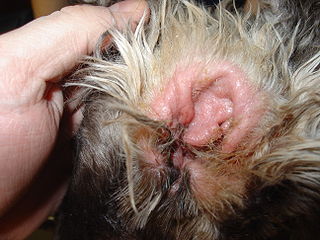
Wax discharge and inflammation present
Source: Joel Mills
Overview
The most common canine ear problems are excessive ear wax build up, ear mites (Otodectes cynotis), dog ear hematoma and ear infections. Infections may be bacterial or fungal, and may be limited to the outer ear (otitis externa) or may also include the middle ear (otitis media). Allergies can also be the cause such as Canine Atopy or yeast infection.
Some dog breeds are more susceptible to ear problems than others. For instance, dogs with hairy inner ear flaps, like schnauzers and miniature poodles, are prone to heavy wax build up and infections.
If the cause is due to a tumor or abnormal cell growth your dog could be suffering from dog neoplasia.
Otitis is the term used to refer to inflammation in the outer, inner and middle ear (externa, interna and media respectively). Chronic otitis is diagnosed when inflammation lasts for more than 1 month. If dog ear inflammation happens frequently, as is common in some dog breeds, then a veterinarian will recommend routine ear cleaning as a preventative measure. Inflammation in general is often difficult to diagnose with many veterinarians referring patients to a dermatologist.
Dog Ear Anatomy
There are differences in the way the ear is structured between breeds. In general the dog ear has three structural areas:
- Outer Ear: Consists of the ear canal and the external ear flap. Area where sound vibrations enter from the outside world. The outer or external ear is formed by two pieces of cartilage and a bony skin covered canal. It ends at a structure called the typanic membrane. the outer ear canal is between 5 to 10cm in length and is divided into horizontal and vertical portions.
- Middle Ear: Contains the auditory ossicles and the eardrum. The ossicles are the small bones that transmit the eardrum sound vibrations to the inner ear.
- Inner Ear: Contains the cochlea, which houses nerve endings that receive sound vibrations and pass nervous system signals along to the brain.
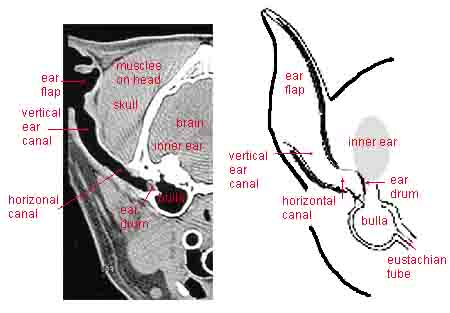
Photo Credit: Washington State University School of Veterinary Medicine
Symptoms
When a dog scratches an ear, it can cause canine ear problems such as tears and bleeding between the cartilage of the ear flap and the skin, a condition all hematoma. Symptoms include an ear that causes pain for the dog, and that is warm and swollen to the touch.
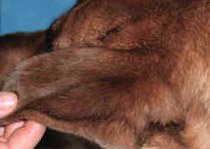
School of Veterinary Medicine
Canine ear problems and related symptoms include:
- Heavy wax build up in the ears (dark brown to black and waxy
indicates yeast, dark brown to black and dry indicates mites)
- Redness
- Dirty looking ears
- Cheesy Discharge (indicates pseudomona, a type of bacteria)
- White discharge (indicates candida, a type of yeast)
- Bad smell or odor from the ears (yeast may have sweet smell)
- Ear scratching or itch (indicates yeast, mites, or bacterial infection)
- Yellow pus (infection)
- Excessive head shaking or tilting the head from side to side
- Rubbing ears against other surfaces
- Blisters
- Ear hair loss
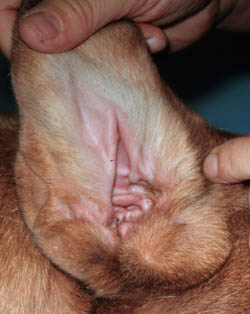
In a healthy canine ear, the inside of the ear should be pink with the possibility of a little black discharge.
Cells that cause inflammation are only
found in 1 in 10 normal ears. Bacteria is also present in very low numbers.
Diagnosis
Canine ear problems are usually easy to diagnose, although some cases of canine ear problems that involve inflammation can be a challenge. Your vet can often diagnose them simply by looking into your dog's ears. To confirm the type of infection, your vet may use a cotton swab to take a sample of the wax or discharge from your dog's ear and look at it under a microscope. Most problems can be managed medically with medications vs. the rare number that require surgical management. A veterinarian will move through five phases when making a diagnosis.
- Clinical Assessment: the veterinarian will examine the ear canal, and feel the ears. A device called an Otoscope enables the veterinarian to have a magnified view of any exudate (ear wax, debris), and if there are any ulcers, masses or problems with the ear drum (tympanic membrane.) If a dog is experiencing ear pain the veterinarian may avoid direct examination and opt for treatment with a steroid or topical until the discomfort subsides. If needed, a vet can take a sample for lab testing (Otic cytology). The test can determine what organism is causing the problem (yeast, cocci) and the degree of the problem. The degree of inflammation can also be determined. Treatment can depend on what is found through examination or the lab test.
- Treatment: Inflammation may need to be reduced for effective treatment. If this is the case a corticosteroid will be used. Ears are cleaned by flushing using saline solution. Your veterinarian may recommend at home ear cleaning using salicylic acid or other methods to ensure that the ear canal stays clean (2x - 3x per week). Treatment is based on what is found. For example, a topical antibiotic can be effective for certain ear infections such as Pseudomonas spp.
- Monitoring: A veterinarian will want to see your dog 2 to 3 weeks after treatment begins to determine if the selected approach was effective. An Otoscopic examination will be performed to recheck the ear canal.
- Maintenance: Inflammation can cause the ear canal to change, increasing the frequency of ear infections. If this is the case, then repeated ear flushes 1x to 2x a week might be required.
- Identification: A veterinarian needs to make a specific diagnosis of what occurred in order to prevent future cases. There might also be underlying conditions that trigger otitis externa such as Cushing's disease, hypothyroidism, allergy (atopy). Other causes are neoplasia or foreign bodies in the ear.
If the ear problem looks like a pimple or a tick on the ear, review our guide on dog ear blisters.
Hearing Loss
Partial or complete hearing loss in dogs is one of the canine ear
problems that can be passed on
genetically or be caused by a disease (called acquired deafness). Even
healthy parents can pass on hearing loss to a puppy if the parents are
genetically disposed to the condition. The condition is diagnosed using
a BAER test (Brain stem Auditory Evoked Response).
The most common cause is external ear canal disease called otitis externa, which is the result of an infection that progresses into the inner and middle ear. When the ear canal gets filled with was, pus or mite debris, the sound waves do not reach the eardrum in part of completely. This reduces a dog's hearing to some degree. This is why hearing loss in some dogs can be to varying degrees. In some dogs, after wax and debris is removed, hearing returns. If the dog ear disease is allowed to become chronic, the eardrum can be breached, leading to inner ear disease and permanent impaired hearing.
As you imagine, hearing loss due to disease is gradual and worsens as the infection develops and causes damage.
Other causes of hearing loss in dogs is called Ototoxicity, which is ear poisoning. In this condition, a dog that is exposed to certain medications (antibiotics, ear cleaners, chemotherapy) or chemicals (household chemicals) can suffer from damage to the inner ear or the nerve that sends balance and hearing information from the inner ear to the brain. Some effects might be reversible if the hearing loss is quickly identified and addressed.
Age related hearing loss is due to some degeneration in the inner ear. This can occur with or without the presence of an infection.Treatment
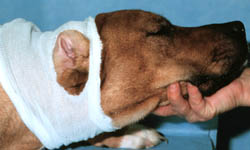
The key is to avoid canine ear problems such as infections in the first place. When your dog is healthy, it is generally recommended that you clean or check the ears weekly. This will help prevent wax build up. Ask your vet for a cleaning solution. Dampen a gauze pad with the solution and wipe the inside of your dog's ear. Don't use cotton balls as they can leave behind wisps of cotton inside your dog's ears. Clean his ears as far as you can reach. Your vet can demonstrate the procedure for you.
If your dog has ear mites, his ears will need to be cleaned with a special dog ear infection medicine medicated solution. Usually only one cleaning is required and your vet will do this when he or she diagnosis your dog with ear mites. If additional cleanings are required, your vet will show you how to do them. If you believe the mites are from the environment surrounding your dog, continue cleaning the area with Benzarid.
If your dog has an ear infection, he will need antibiotics. These will come in the form of pills that you dog will need to take for 10 - 14 days. Clean his ears daily during this time. Your vet may give you a medicated solution to clean his ears with, and may also prescribe medicated ear drops.
For small dogs with an ear infection a regular sock can be used to hold the dogs ears back or for larger dogs you can tape them together to help air flow.
Cleaning Dog Ears
Clean the ears in an area that is easy to clean such as outdoors or in a bathroom that has a tiled floor. Start by flooding the ear with a cleaning solution made for dog ears (1/2 to 1 teaspoon). Follow your veterinarian's or manufacturers instructions, which usually calls for flooding the ear (vs. only using a few drops). The ear cleaning solution should remain in the ear for 60 seconds. Gently massage the base of the ear to loosen any debris. When done, use a cotton ball to remove the debris (only with real cotton balls, not synthetic). DO NOT USE A Q-TIP since this can push debris deeper into the ear, or it can puncture the ear. If you do use them, do not go past the point at which you can see.
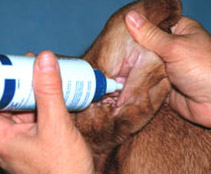 Photo Credit: Washington State University School of Veterinary Medicine
Squeeze the dog ear wash into the ear canal. Also apply several drops to the inside of the ear flap. The bottle needs to be inserted only a few millimeters into the ear canal. Do not force the bottle tip into the canal. Also do not forcefully squeeze the bottle in order to avoid damaging the ear drum from the force of the liquid entering the ear. Be gentle.
The dog will usually shake its head as soon as the wash is inserted into the ear, shaking out much of the solution.
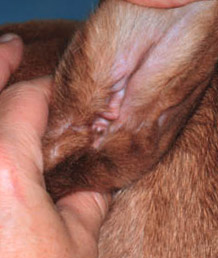 Photo Credit: Washington State University,
School of Veterinary Medicine
Photo Credit: Washington State University,
School of Veterinary Medicine
To spread the dog ear cleaning
solution in the ear canal, massage the
ear base.
Repeat the cleaning process 2x a day for 1 to 2 weeks. The process can then be 1x or 2x a week once the condition has been brought under control.
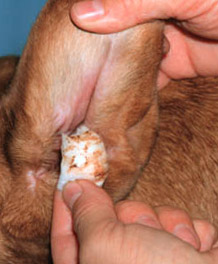 Photo Credit: Washington State University
If you see just a bit of tan or
brown wax on the external ear canal,
wipe it away with a cotton ball dipped in ear cleaning solution or
hydrogen peroxide.
Prevention of Canine Ear Problems
One of the simple things you can do to help with canine ear health is to keep your dog's hair from blocking the opening of the ear. Plucking a few hairs to allow good air flow into the ear with help prevent infection. Regular ear cleaning can also be helpful. When choosing an ear cleaner, avoid products that contain alcohol since this can be irritating and instead look for one that is similar to Dermapet.
If your dog continually gets ear infections or other canine ear
problems, you might want to try
supplementing their diet with herbal ear drops to see if it cuts down
on the frequency. A good product to try is PetAlive
Ear Drops. Look for ingredients such as:
- Melaleuca alternifolia: for external inflammation and to treat various skin conditions
- Tea Tree Oil: soothes and reduces inflammation in the ear as well as treat any bacterial, fungal or mite infection that is present).
- Rosmarinus officinale (Rosemary): topical pain reliever and antiseptic/disinfectant herb. Several of the compounds in rosemary have also been shown to have anti-inflammatory effects.
- Calendula officinalis (Marigold): herbal ingredient used to treat skin problems and promote healing of wounds. It is an excellent anti-inflammatory and prevents infection with its anti-bacterial, anti-viral and anti-fungal properties. Marigold has been shown to assist the regeneration of damaged skin tissue.
- Verbascum thapsusis: anti-inflammatory and antiseptic herb. Good for healing of skin when applied topically and has a long history of use for ear conditions and in ear drops.
The key to treatment of canine ear problems is early detection, so if you suspect a dog ear problem bring your dog to the vet as soon as possible.
Ask Our Vet A Question About Dog Ear Problems or Share Your Story
Have A Dog Ear Health Question For Our Veterinarian, We'll Answer It For Free?
Do you have a Dog Ear Health Question for our Editors or a Helpful Story to Share? Please include information such as age, sex, breed, medical history and picture of the condition if you can.
We will do our best to get back to you quickly (depends on how many questions we receive each day). If you do require an immediate response we suggest using this online dog veterinary service that is available now.
What Other Visitors Have Asked and Suggestions From Our Veterinarian
Click below to see contributions from other visitors to this page...

Dog Head Shaking 
Hi, I have a 7 year old male lab, and for the past week he is constantly shaking his head as if his ears on the problem. I have checked both dog ears, …
Dog Red Ear Problem
My dachshund/chiwienie mix is a 3 yr old female. She has redness and a little scaliness in one of her ears. I notice in the morning that there is no heat …
Black Crust on Outer Dog Ears
My chihuahua developed a black crust that formed around his outer ears at about 10 months of age. We had two BLOOD panels done on him and all came back …
Dog Ear Wax, Infection and Cleaning Not rated yet
Reader Question: Caring for Dog Ears and Wax Buildup
My BMC has had dirty looking ears since I got her. There was a time when I was sure she had an …
Treating Swollen Dog Ears Not rated yet
Reader Question: Treating Swollen Dog Ears
Hello, my German shepherd is four years old and is pregnant. Her problem is that she has dermatitis and …
Sudden Dog Deafness Not rated yet
We noticed that our dog Furbaby (part Dobie, part Old Shepherd) was constantly scratching her ears & dragging her head on the carpet. We took her to the …
Too Much Dog Ear Wax Not rated yet
Reader Question: Excessive Dog Ear Wax
I recently had my vet examine my poodle/mix because he was batting at his ears excessively. The exam showed …
Dog Ear Problems plus Twitching Not rated yet
I have a mixed dachshund and chihuahua. he has been shaking his head and scratching his ear. The wierd part is that when he is panting hard, his heart …
Dog Ears Bleeding After Surgery Not rated yet
My dog just had ear surgery to remove a dog ear hematoma - blood under the ear from a vein. I would like to know what i can put on it to stop the bleeding? …
Brochures and References:
Brochures on canine ear problems:
Common Dog Ear Problems
(PDF Download)
Dog Ear Infections (PDF
Download)
For additional reading on Canine Ear Problems:
Examining and Medicating Dog Ears
Washington State University School of Veterinary Medicine
Ears The Basics
Craig E Griffin
Animal dermatology clinic
San Diego, Ca


