Table of Contents
Summary:
"Canine food allergy (food hypersensitivity) occurs when a dog's immune system reacts to an ingredient in their diet. Affected dogs tend to be younger (under 1 year) with no predisposition based on heredity with the exception of the Soft Coated Wheaten Terrier.
It can cause symptoms such as itch (pruritis), skin rash (seborrhoea), and gastrointestinal problems such as diarrhea. Treatment involves the use of an elimination diet where the diet is reduced to a simple carbohydrate and protein. This diet is fed to the dog for a minimum of 6 weeks (avoid all other foods such as treats). If the dog improves, the diet is continued for another 4 weeks. Foods are gradually added back in to determine which ingredient is the cause of the allergy."
Overview
Canine food allergy problems in dogs are less common than allergies to allergens in the air (atopy) such as pollen.
Food allergies are seldom from hormones, additives or preservatives. They are usually due to a natural food product such as meat, milk, eggs, fish, beef, pork, horse meat, grains, potatoes, soy or additives. Of these the most common problem ingredients are beef, chicken, corn and diary.
Switching to organic food will not help since all of these are the same in their organic form. It is not unusual for a dog to develop an allergic reaction to a food they have been eating for several years.
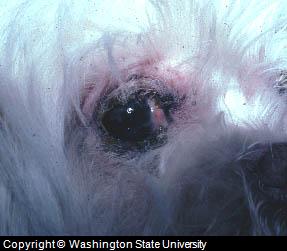
Canine Food Allergy Symptoms
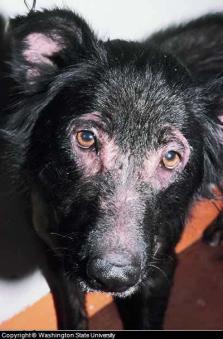
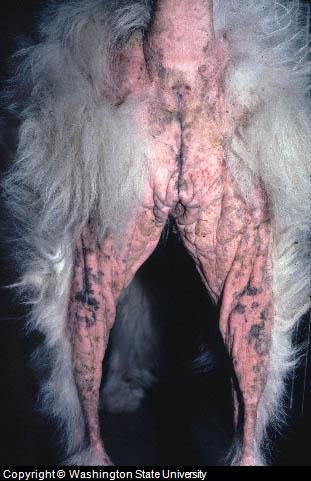
If your dog is allergic to food, symptoms usually are non-seasonal, occur within 24 to 72 hours, but can happen in up to 2 weeks. Like other allergies, you will see your dog itch frequently, see small red skin bumps or raised areas of skin. You will usually see the allergic rash on the belly, back of the legs, ears and feet.
Symptoms appear similar to flea allergy and canine atopy (allergic reaction to pollen, foods, etc.).
Treatment and Diagnosis of Canine Food Allergy
The key to diagnosing a food allergy is to eliminate as many foods as possible and then see if the allergic reaction disappears. Your Veterinarian will put your dog on a diet that consists of as few ingredients as possible (called hypoallergenic canine diet). Just switching dog foods doesn’t work as each has too many ingredients. Also, antihistamines and allergy shots tend not to work. Treatment will also be initiated to address any symptoms.
It takes as many as 10 weeks to see if a test diet is working. Recent studies have shown that a diet prepared at home is the best course of action. If this isn’t practical, consider simple combination dog food such as Hill’s salmon/rice or duck/potato. It is suggested that when testing different foods, your dog should only drink water.
To help the skin heal, therapies such as the use of steroids may be needed, although this approach doesn't always work. Antibiotics can be helpful (neomycin) and are applied as a powder or ointment. Skin therapies are tested first to determine if the dog is sensitive to the medications. A homeopathic product such as Allergy Itch Ease can help to reduce symptoms such as rash and itch.
Your dog may not like the change, but be careful with the temptation to also provide a treat since the treat itself could be the cause. One substitute for treats is fruit since fruit rarely is the cause of allergic reaction.
Once you find something that works, stay with it.
Ask a Question or Share Your Story
Have A Dog Allergy Question For Our Editors or Story For Our Readers?
Do you have a Dog Allergy related Question for our Veterinarian? Please include information such as age, sex, breed, medical history, skin and other symptoms, medications your dog is taking, recent changes in behavior, etc. Submitting a picture of any condition will help to provide a more complete answer.
We will do our best to get back to you quickly (depends on how many questions we receive each day). If you do require an immediate response we suggest using this online dog veterinary answer service that is available now.
References
Hound
Health Handbook
Brevitz, Betsy, DVM
“Atopic
Disease and Allergy”
Greek, Jean, DVM, ACIDM
New Hope Animal Hospital
“Atopic Dermatitis: Clinical Signs and Diagnosis”
Beale, Karin M. DVM
Gulf Coast Veterinary Specialists
Dog
Owner’s Home Veterinary Handbook
Giffin, James M. MD & Carlson, Liisa D., DVM
“Diagnosis & Management of Adverse Food Reactions in
Dogs”
Lloyd, Professor David, Hawkshead
Campus
Royal Veterinary College
“Optimal use of Hypoallergenic Diets”
Osborn, Sarah Colombini DVM
Southwest Veterinary College,
Houston TX
“Flea Allergy Dermatitis”
Ihrke, VMD, Professor of Dermatology
School of Veterinary
Medicine, University of California
Diagnosing, Treating and Preventing Food Allergy
Richard EW Halliwell, MA VetMB PhD MRCVS DECVD
Professor, University of Edinburgh, Royal (Dick) School of Veterinary Studies
Summerhall, Edinburgh, UK


