Summary:
"Color blindness in dogs exists in all dogs when compared to human eyes. Dogs cannot see certain colors such as red, orange or green. They can tell the difference between these colors although they appear yellow or blue. They can see the colors yellow, blue and violet."
Overview
Dogs are not color blind in the sense that they can only see in black and white. However, they cannot see all of the colors that humans see. Color blindness in dogs limits their color vision to yellows, blues, and violets. Dogs can't see red, orange, or green; those colors appear yellow or blue to them. Of course, dogs can also see black, white, and shades of gray.
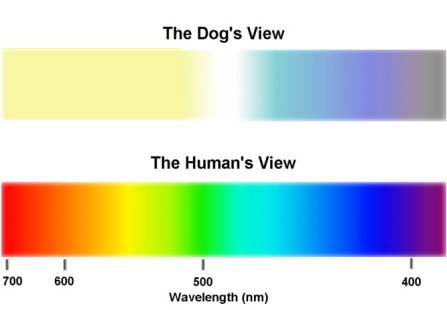
The reason dogs can only see certain colors is because of the photoreceptors in their eyes. Both dogs and humans have rods and cones in their eyes, but humans have more cones, while dogs have more rods. Also, humans have three types of cones, but dogs only have two types.
Rods are responsible for vision in low light, which is why dogs can see well in dimly lit areas and at night. Another reason they can see well at night is because they have a structure called the Tapetum Lucidum. This is a reflective surface behind the retina. It reflects light back through the retina, and is what sometimes makes dogs' eyes appear to glow in the darkness.
Although dogs have more rods than humans and can see well in low light, they cannot see colors well because rods do not pick up color. Cones, on the other hand, are responsible for color vision.
Humans also have an area of the eye called the fovea centralis, which is densely packed with cones, and is responsible for picking up sharp visual detail. Dogs do not have this. Therefore they don't see the fine details of things.
Even though color blindness in dog effects how they can see, dogs are attuned to movement. If you throw an orange ball onto the green grass, a dog will see it as yellow against yellow. However, he will be able to track the movement and fetch the ball. Dogs are better at tracking movement than people are.
Dogs also have better peripheral vision than humans, meaning their visual field is greater. However, they do not judge distance as well.
Of course, dogs use their other senses as well as their vision to help them find their food and track things. They have keen senses of smell and hearing.
Being somewhat color blind does not hinder a dog in the least, as you know if you've ever watched a dog in action. Dogs are able to find their way around, run and play, and live happy, active lives without seeing the full spectrum of colors.
Sources
DogTime
Dr. P's Dog Training (Spectrum Picture)
University of Wisconsin, Steven's Point
Canine Vision
Plonsky, Mark PhD


