Table of Contents
Overview: Stomach | Small Intestine | Large Intestine | Colorectal | Anal Sac | Vet Q&A
Summary:
"Dogs with gastrointestinal cancers, such as canine intestinal cancer or stomach cancer (gastric adenocarcinomas, gastric leiomyosarcoma) are usually male and 10 years of age or older. Some commonly refer to the disease as belly or abdominal cancer. Tumors or cancer in the perineum, intestines and stomach are common in dogs.
This review covers tumors of the gastrointestinal tract, which stretches from the anus to the mouth. The function of the tract is to absorb nutrients and digest food. The stomach is the part of the gastrointestinal tract that breaks down proteins. The small intestine reaches from the stomach to the colon and also breaks down food.
In the case of stomach cancer, cancer starts in the stomach wall and quickly spreads to the gastric lymph nodes, omentum (fat on the bottom edge of the stomach), liver, duodenum (first part of the small intestine), pancreas, spleen, esophagus, adrenal glands and lungs. The most common type of tumor in the stomach is adenocarcinoma. Most cases of stomach cancer are malignant (the type that spreads).
For intestinal cancers (small and large), depending on the type, a localized tumor is surgically removed. The prognosis depends on the ability to completely remove the tumor and the effectiveness of other therapies such as chemotherapy and radiation, if needed. If the tumor can be completely removed a dog can be "cured" of the cancer. See below for information on specific types of cancer such as anal sac and colorectal tumors.
Treatment can involve chemotherapy, radiation therapy, surgery or a
combination of therapies. Information on specific types of tumors
can be found below. Consult with your veterinarian about
treatment options, the prognosis, side effects and costs associated
with each."
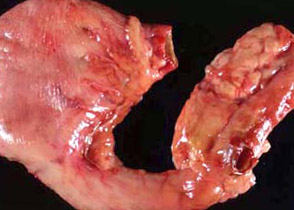
Overview: Canine Abdominal, Stomach or Gastric Cancer
Dog stomach tumors are usually malignant (cancerous). Removal of the tumor is often to relieve pain or other symptoms triggered by the tumor. The incidence is highest in dogs 10 years of age or older.
The most common type of tumor in stomach cancer tumor is adenocarcinoma. Other types include:
- adenoma
- leiomyoma
- leiomyosarcoma
- lymphoma
- carcioids
- sarcomas
- mast cell tumors
- plasma cell tumors
Most tumors are found in the lower 2/3 of the stomach and the pylorus, which is at the opening into the duodenum.
Symptoms
Symptoms associated with canine intestinal cancer and stomach cancer include:
- Vomiting (with or without blood)
- Weight loss
- Loss of appetite
- Diarrhea (cancer in the lower intestine)
- Projectile vomiting
Diagnosis
Your Veterinarian will perform a series of tests as part of a standard
diagnosis procedure:
- Complete blood count
- Serum biochemistry analysis (watery fluid of the blood)
- Urinalysis
- Survey radiographs of the chest cavity
- Abdominal ultrasound
Your veterinarian will look for masses on the ultrasound in the stomach and entire gastric region. They will also look at the lymph nodes near the stomach. A sample of any masses found and the lymph node may be taken with a needle for further testing in a lab.
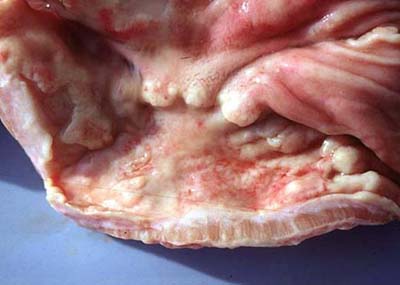
Treatment of Stomach Cancer in Dogs
If surgery is recommended, any masses will be removed. Masses will be sent to a lab for additional examination. Surgery should help remove anything that was obstructing your dog's gastric system, immediately improving your pets health.
Many gastric adenocarcinomas are over a large area of stomach wall making surgery difficult. In over 75% of cases the cancer will have spread (metastases) to lymph notes, the liver, peritoneum and other parts of the body.
Surgery alone generally has a poor outcome when used without other
forms of treatment. Survival times of surgery alone is 2 to 4 months.
To ensure that all the cancer cells are killed, chemotherapy has been shown to be effective and usually starts 1 week after surgery. A common treatment cycle is chemo (Adriamycin) every 2 weeks for 5 treatments and then weekly (Cytoxan chemotherapy, along with daily Doxycycline (for antiangiogenesis) and Piroxicam (immune support as a COX2 inhibitor) and monthly (Vincristine) treatments.
Chemotherapy may result in some stomach discomfort including upset stomach, diarrhea and vomiting. Scientific studies are anecdotal when it comes to survival rates after surgery and chemotherapy. Ask your veterinarian to see if additional studies have been performed.
Some Homeopathic Veterinarians like to supplement treatment with natural herbal remedies known to bolster the immune system and protect against the progression of cancer and tumors. A good choice to consider is PetAlive C-Caps Formula for Prevention and Treatment of Cancer in Pets.
The goal is to put the cancer into remission.
Prognosis
Most canine intestinal cancer and stomach cancer is advanced when diagnosed, resulting in a poor prognosis for recovery. If caught early enough, treatment could result in remission over a 1 to 2 year period. However, a recent study showed that the cancer could come back as early as 3 days to 10 months after treatment.
Gastric Leiomuyoma or Leiomyosarcoma
Gastric Leiomyoma tumors are invasive with 30% spreading to other parts of the body.
Treatment involves surgery and chemotherapy. For surgery, the tumors can be easily removed and if the tumor has not spread, the dog is considered to be cured. Tumors can recur if not completely removed during surgery. Survival rates are approximately 1 year after surgery. While results from chemotherapy are anecdotal, it is used along with surgery.
Gastrointestinal Stromal Tumors (GIST)
With gastrointestinal stromal tumors, approximately 30% will spread to other parts of the body. Surgery alone can result in a cure if a tumor has not spread and if it can be easily removed.
In people, this type of tumor responds to a type of chemotherapy that uses what is called c-KIT inhibitors. More research is needed on this type of chemotherapy in dogs.
Small Intestinal Dog Tumors
Small intestinal dog tumors occur in dogs 10 years of age or older. There are several types of small intestinal tumors in dogs. These include:
Common Types:
- adenocarcinoma
- leiomyosarcoma
- lymphoma
Less Common Types:
- leiomyoma
- GISTs (see above for information)
- Carcinoids
- Plasma cell tumors
- Mast cell tumors
Intestinal Adenocarcinoma
Adenocarcinoma tumors have a matastatic rate of 70% (probability that
tumor will spread). The tumor tends to spread to the lungs, omentum,
liver and lymph nodes.
Treatment:
Surgery, chemotherapy or a combination of therapies are an option. Surgery is the primary treatment with a mean survival time of 10 months. If while in surgery, it is determined that the cancer has spread, the survival time falls to 3 months. Ask your veterinarian if results are available for the use of chemotherapy.
Small Intestinal and Cecal Leiomyosarcoma
Approximately 30% of intestinal leiomyosarcomas will spread (metastasize). The spread of cancer often affects the liver, but can also spread to the lungs, omentum and lymph nodes.
Treatment:
Surgery is the primary treatment method. If the tumor has not spread (metastases), survival times is approximately 12 months (median). If the tumor is a leiomyosarcoma of the cecum this time reduces to 8 months. If the tumor has started to spread, then the survival time is 3 months. Ask your veterinarian about data on the use of chemotherapy.
Large Intestinal Tumors
Most dog tumors in the large intestine are in the rectum, called colorectal tumors). Dog breed is not a predictor of large intestinal cancer with the average age of the patient of 11 years or older. A smaller percentage (10%) is a dog colon cancer. The most common type is an adenocarcinoma. Other types of tumors include:
- leiomyosarcoma
- lymphoma
- plasmacytoma (of the rectal wall)
Dog Colorectal Cancer or Tumors
These types of tumors are not likely to spread.
Surgery and other techniques such as electrocoagulation and cryotherapy have been used. Complete removal of a local occurrence occurs in 50% of cases. Dogs that have multiple nodules have a 12 month average survival time. Dogs with what are called annular tumors have a survival time of 2 months. Once surgery is complete, the prognosis depends on the extent of the disease. If a dog has a single colorectal carcinoma the average survival time is 32 months.
Chemotherapy is not frequently used since dog colorectal tumors tend to be localized or limited to one area. Radiation is often not used due to toxicity concerns.
Dog Anal Sac Tumors (Adenocarcinoma of the Anal Sac)
Like other tumors, the average age of the patient suffering from dog anal sac cancer or tumors is 10 years of age or older. There is a higher incidence in Cavalier King Charles spaniels, English cocker spaniels and Springer spaniels. In some cases, an owner will see some type of rectal mass, which is why this type of tumor is often diagnosed during a routine veterinary examination.
In 50% of cases the tumor will spread (metastases), spreading to the iliac and sublumbar nodes. Other sites where the cancer frequently spreads includes the liver and lungs, followed by the bones and spleen.
Treatment:
Treatment is primarily surgery to remove any mass. Small masses can be removed and result in long survival times (over 3 years). If the tumors cannot be completely removed, then survival times decline to a median of 8 months. If this is the case, then other forms of treatment can be combined with surgery such as radiation. Chemotherapy may also be used to control tumors.
Brochure
Ask Our Vet A Question or Share Your Story
Have A Question For Our Veterinarian About Cancer in Dogs?
Do you have a question or story about canine cancer? Share it! Our editors will try their best to answer your question for free.
Please include information such as age, breed, sex, medical history, medications, diagnosis, cancer stage,has it spread and anything you believe that will help us answer your question.
We will do our best to get back to you quickly (depends on how many questions we receive each day). If you do require an immediate response we suggest using this online dog veterinary service that is available now.
Reader Questions and Vet Suggestions
Click below to see contributions from other visitors to this page...

Canine Intestinal Lymphoma or Dog Inflammatory Bowel Disease 
I couldn't be more terrified! My Yorkie is 16 months old. She was hand raised after being rejected at birth and was a little behind for a few weeks. She …
Labrador Retrievers Dying at Young Age Not rated yet
Chocolate Lab in 2008 at age 2 years old had loss of appetite & diarrhea. Blood work showed high White count & high EOS. Went through about 6 weeks of …
Dog Sick and Not Eating after Intestinal Cancer Treatment Not rated yet
Reader Question:
My 10 year old female golden retriever has been sick and over the last week is not eating after being treated for intestinal cancer. …
References
From top to Bottom: Canine Gastrointestinal Tumors
Kenneth M. Rassnick, DVM, DACVIM (Oncology)
Cornell University College of Veterinary Medicine, Ithaca, New York, USA
Vet Surgery Central
University
of Georgia
College of Veterinary Medicine


