Table of Contents
Overview | Squamous Cell Carcinoma (SCC) | Skin Melanoma | Cutaneous Hemangiosarcoma | Fibrosarcoma | Mast-cell Tumor (MCT) | Cutaneous Lymphoma | Diagnosis | Vet Q & A
Summary:
"Canine skin cancer symptoms are difficult to detect and diagnose. There are several types of skin cancer, and your vet will examine your dog's skin and recommend further testing to confirm any suspected cancer. Surgery is often needed, as well as other treatments and follow up to watch for regrowth."
Overview
Dogs are 35x more likely to get skin cancer than humans. It is almost impossible to tell by sight if your dog has skin cancer. The only way to tell is to take a biopsy (skin sample) and then test it at a laboratory.
Like humans, areas where your dog has thin hair or no hair (the belly) can get sunburns that could turn into skin cancer. Ask your veterinarian to recommend a suntan lotion if your dog gets too much sun.
Types of Canine Skin Cancer
Canine Squamous Cell Carcinoma (SCC)
This type of canine skin cancer takes the form of lumps or sores and is usually from too much sun. They tend not to spread (metastasize) and can be treated through removal via surgery, cryotherapy (freezing) or chemotherapy ointment. Some SCC's are more difficult to treat such as those on the nose, near the nails or in the mouth.
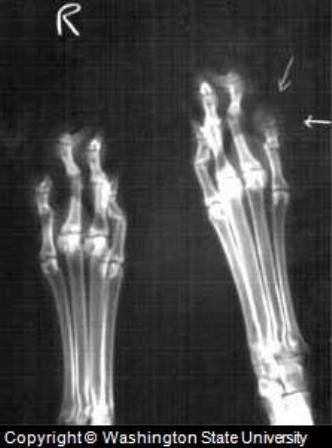
Canine Skin Melanoma
Dog skin cancer symptoms related to melanoma can be a small black spot or a lump. These can be of many shapes, and with or without hair. They tend to grow slowly and can be treated with removal via surgery, cryotherapy or chemotherapy ointment.
Canine Cutaneous Hemangiosarcoma
This cancer forms in the lining of blood vessels and usually is found on the spleen or a heart chamber. For canine skin cancer symptoms on the skin, it takes the form of soft spots and can bleed. Surgery is usually the treatment of choice.
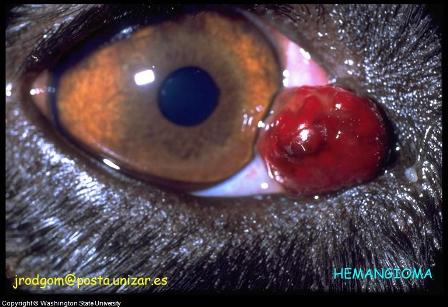
Hemangioma of the Third Eyelid
Canine Fibrosarcoma
This type of cancer can occur anywhere in the dog's body and forms in the tissue. Surgery is usually chosen to remove the cancerous area.
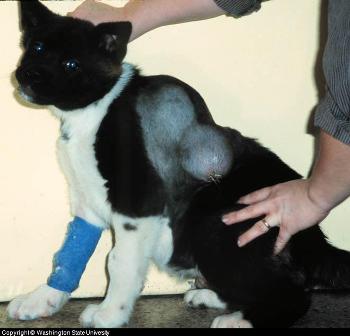
Akita Pup with Fibrosarcoma
Canine Mast-cell Tumor (MCT)
Mast Cells are white blood cells. They take on many appearances and can grow and then shrink. Mast Cells that are localized on the skin can be removed with surgery. If they have spread, then other treatments such as chemotherapy are needed.
Cutaneous Lymphoma
Canine Cutaneous lymphoma is a cancer of the white blood cells with lumps on the skin as the canine skin cancer symptoms. The skin sores can be itchy. Surgeries for areas that haven't spread followed by chemotherapy to be sure everything was removed are often recommended.
Diagnosis of Canine Skin Cancer Symptoms
A non invasive procedure such as fine needle aspiration can be used to confirm the presence of cancer. If positive, then more aggressive forms of treatment such as a biopsy and removal of the cancerous area can be done.
Prior to a biopsy procedure, your veterinarian will look to see if their are any other diseases present by doing diagnostic tests such as checking blood count, testing the urine, chest x-ray, and check of the lymph nodes for swelling and lumps.
Ask Our Vet A Question or Share Your Story
Have A Question For Our Veterinarian About Cancer in Dogs?
Do you have a question or story about canine cancer? Share it! Our editors will try their best to answer your question for free.
Please include information such as age, breed, sex, medical history, medications, diagnosis, cancer stage,has it spread and anything you believe that will help us answer your question.
We will do our best to get back to you quickly (depends on how many questions we receive each day). If you do require an immediate response we suggest using this online dog veterinary service that is available now.
Sources
Nutrition and Cancer: New Keys for Cure and Control 2003!
Gregory K. Ogilvie, DVM, DACVIM (Internal Medicine & Oncology)
Colorado State University
Ft. Collins, CO, USA
Prostatic Disease in the Dog
Peter E. Holt, BVMS, PhD, ILTM, DECVS, CBiol, FIBiol, FRCVS
Professor of Veterinary Surgery, University of Bristol
Department of Clinical Veterinary Science
Langford, Bristol, UK
Lymphoma
Antony Moore, BVSC, Diplomate ACVIM
Director, Veterinary Oncology Consultants
379 Lake Innes Drive
Wauchope NSW 2446
Australia
Canine Brain Tumors: Improvements in Diagnosis and Treatment
R Chun
School of Veterinary Medicine
University of Wisconsin-Madison
Neoplasia of the Nervous System (spinal tumors)
S. Long
School of Veterinary Medicine
University of Pennsylvania
Current Therapy for Canine Oral Tumors
M. Kessler
Tierklinik Hofheim, Germany
Dog Owner's Home Veterinary Handbook
James M. Giffin
Liisa D. Carlson DVM
Hound Health Handbook
Betsy Brevitz, DVM
Washington State University
College of Veterinary Medicine


