Table of Contents
Summary:
"Dog blood types are different than the types found in people. There are 12 blood types, although 6 are considered major types and 42% of dogs have the same type, which is universal. Recipients need to be matched to the appropriate blood type."
Overview
Blood is made up of a liquid called plasma and red blood cells, white blood cells, and platelets. Oxyglobin is a synthetic blood substitute that is sometimes used to treat dogs that are anemic (too many red blood cells) or have lost blood. The red and white blood cells and platelets are made in the bone marrow and then released into the plasma to be circulated throughout the body.
There are 6 major dog blood types out of a possible 12, but 40-45 % of all dogs have a universal canine blood type. Sixty percent of Greyhounds have a universal blood type. Boxers, Irish Wolfhounds, German Shepherds, Dobermans, and Pit Bulls are often universal donors as well. This is important because only dogs with a universal dog blood type (DEA 1.1 negative) can be blood donors. Most dogs can receive the universal dog blood type, regardless of their own blood type. Tests are available to ensure a good "cross match" between your dog and the blood donor.
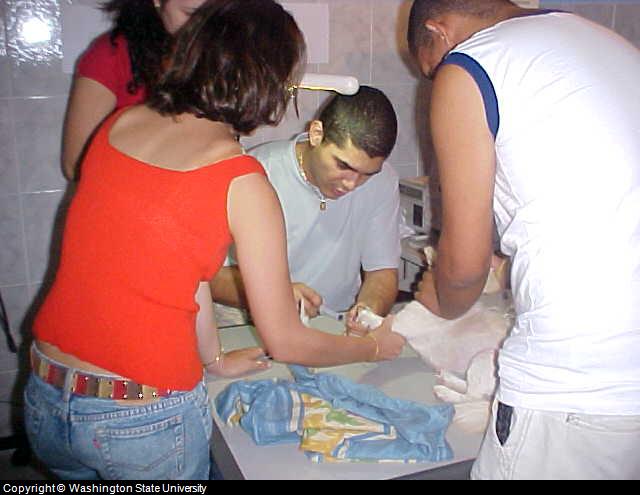
Source: Washington State University
Dog Blood Types and Compatible Donors
In an emergency a dog can receive a transfusion from another dog that is of a different type since dog blood does not have antibodies. After the first transfusion antibodies develop which require that a good "major crossmatch" is achieved between compatible donors.
To ensure your pet's safety if a blood transfusion is ever needed, it's a good idea to know his blood type. A quick and simple blood test is all it takes for your veterinarian to type your dog's blood. It's recommended that all dogs have this procedure done as part of a well-visit to the vet and that owners know this information in case it is ever needed.
Only DEA 1.1 negative blood should be given to DEA 1.1 negative dogs. DEA 1.1 positive dogs may receive DEA 1.1 negative or positive blood. Any dog that received a transfusion should be rechecked for type if greater than 4 days have passed.
Dog Blood Banks and Donors
Some vets have their own dogs that they use as blood donors, while others use a blood bank. Some blood banks have their own dogs they use as donors, while others rely on "volunteers". As there are more and more advances in veterinary surgical procedures, and as people have more income to spend on medical care for companion animals, the need for blood donors increases. Some blood banks have "blood drives" to seek donations.
To volunteer as a donor, a dog must generally be between one and seven years of age, at least 50 pounds, in good health, not on any medication except for heartworm/tick prevention, and able to remain calm and well-behaved during the donation procedure. The donor dog must be current on all vaccines. A potential donor will be tested for his blood type - only those with a universal dog blood type are accepted as donors. Donation takes between 15 and 25 minutes.
Blood that is donated should be checked for infectious diseases such as Babesiosis and Leishmaniasis that are known to be transmitted via blood transfusion.
When
a dog donates blood, the blood is usually taken from the jugular vein,
which is the large vein in the neck. A dog usually gives about 16
ounces of blood. Donating takes about ten to fifteen minutes. The
procedure is not painful. Dogs are usually rewarded with treats
afterward.
Sources
Current Canine and Feline Blood Typing Methods and Issues
U. Giger
University of Tennessee
Josephine Deubler Genetic Disease Testing Lab
School of Veterinary Medicine
University of Pennsylvania
Canine and Feline Blood Donor Screening for Infectious Disease
K. Jane Wardrop, Nyssa Reine, Adam Birkenheuer, Anne Hale, Ann Hohenhaus, Cynda Crawford, and Michael R. Lappin


