Table of Contents
Causes | Euthyroid Sick Syndrome | Symptoms | Pictures | Ask Our Vet A Question For Free
Summary:
"Canine hypothyroidism is a condition that is usually caused by an autoimmune disease. It occurs when a dog's immune system attacks the thyroid gland, resulting in destroyed tissue (also called lymphocytic thyroiditis).
This destruction results in abnormal gland function and a decline in the amount of hormone produced by the thyroid gland. Since this hormone regulates many body functions, dogs experience multiple symptoms such as hair loss, weight gain and lethargy.
Diagnosis includes blood
and other tests to confirm that symptoms are due to hypothyroidism and
not some other disorder. The disease rarely occurs before age 4,
with an average age of 7. The incidence is 1 in every 250 dogs."
Overview
Lifelong treatment is required and includes synthetic hormone replacement therapy combined with supportive treatments such as dietary supplements that promote thyroid health and skin condition. The dose will be adjusted until the right levels of hormone therapy is identified. Most clinical symptoms will disappear once hormonal levels return to normal.
If left untreated dogs can suffer from atherosclerosis (build up of plaque that causes heart disease) or can fall into a mental stupor along with other disorders that can cause death.
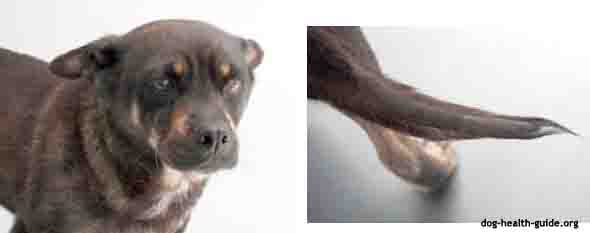
Source: Dr. C. Melian
Causes
Hypothyroidism in dogs is a disorder of the thyroid gland, a small gland in the neck attached to the trachea and below the larynx. Its primary function is to regulate metabolism. It has many functions, but is best known for regulating the metabolism. Specifically it speeds up the heart rate, respiratory rate and the replacement of cells. Over time, the disease can get progressively worse.
Hypothyroidism canine occurs when the thyroid becomes underactive and does not secrete enough thyroid thyroglobilin hormone. Since the thyroid is underactive, metabolism is decreased.
Primary Causes: (95% of cases)
In most cases, hypothyroidism occurs when the dog’s own immune system attacks and starts to destroy the thyroid gland (Lymphocytic thyroiditis or autoimmune thyroiditis, a form of primary hypothyroidism). Idiopathic thyroid atrophy and Lymphocytic thyroiditis account for 95% of cases, with the number for each type at 50%.
In the remaining 5% of cases there could be a tumor present (called neoplastic destruction of thyroid tissue), an iodine deficiency, infection or thyroid destruction due to radioiodine treatment, as the result of a surgery or a reaction to medications.
There is no genetic or inherited basis for primary hypothyroidism in dogs. There is a form of congenital hypothyroidism in Toy Fox terriers and Giant Schnauzers.
Secondary Causes:
These types of hypothyroidism in dogs is rare. In this case the problem starts with the pituitary gland, the gland that produces the hormone TSH, which is used to signal the thyroid gland to function. Problems with the pituitary gland include pituitary gland tumors, inherited problems that cause the pituitary to operate abnormally, or a problem with the way the TSH hormone is metabolized.
Tertiary Causes:
This type of hypothyroidism canine refers to problems in the hypothalamic region of the dog's brain. In these cases TSH production doesn't exist or is at low levels due to abnormal brain function.
Age and Breeds
The disease generally occurs in dogs age 4 to 10, and has a higher prevalence in certain small and and large breed dogs.
Large Breed Dogs:
- Golden Retrievers (high risk)
- Doberman pinschers (high risk)
- Great Danes
- Irish Setters
Small Breed Dogs:
- Miniature Schnauzers
- Cocker Spaniels
- Poodles
- Dachshunds
Dog
Congenital Hypothyroidism
(Rare, also called Juvenile Onset
Hypothyroidism)
There is a form of hypothyroidism canine called congenital hypothyroidism that involves enlarged (called goitrous) or normal sized thyroid gland (non-goitrous). The condition results in too much TSH being released. Breeds susceptible to this form of the disease are Giant schnauzers and Toy fox terriers. The condition is also seen in dogs where there is below normal secretion of hormones from the pituitary gland (called panhypopituitarism).
Euthyroid Sick Syndrome (ESS)
When dogs have another disease it can affect T4 levels. Correcting levels in this case with hormone replacement therapy can be dangerous and may harm the patient. For this reason, veterinarians will base the diagnosis on more than just a test of T4 levels. Skin problems are not a common cause of Euthryroid Sick Syndrome, however, deep skin infections (pyoderma) and generalized demodicosis mange.
Dog Hypothyroidism Symptoms
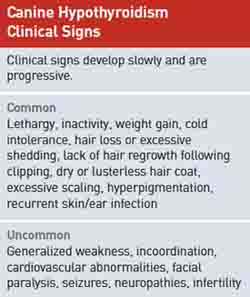
Dog hypothyroidism symptoms are consistent with a clear slowing down of your dog including reduced levels of energy, a reluctance to go for walks, avoidance of play or just tiring out earlier than normal. Said another way, the mental status and physical activity of the dog declines. Other symptoms include weight gain without increase in food consumption, intolerance to cold, and changes to appearance such as a loss of coat shine (dull look), hair loss (it is common to see hair that has been cut grow back more slowly than usual), seborrhea and dry skin.
Three of the symptoms, hair loss (on both sides of the body, usually on the trunk), weight gain and lethargy are seen together in 40% to 50% of all cases. Hair loss alone is a characteristic of 80% of cases.
Other symptoms can include infections on the skin (pyoderma), which
is recorded in 14% of cases. Infections are caused when hormonal
changes make the skin susceptible to infection. Skin changes that could
indicate hypothyroidism in dogs include thickening of the skin and skin
swelling (myxedema).
In a minority of cases, owners will see hyper pigmentation (black spots, in 10% of cases). Less than 5% of cases symptoms can include conjunctivitis and facial paralysis.
Male dogs can see a decline in fertility while females can have
prolonged periods or a failure to move through their cycle.
Body Systems Impacted By Hypothyroidism
Since the thyroid regulates metabolism, most major systems of the body are affected including:
- The skin
- Reproductive system
- Eyes
- Muscles
- Nervous system
- Gastrointestinal system
- Endocrine and metabolic function
- Cardiovascular system (heart, circulation)
- Change in behavior
With so many body systems potentially being involved, symptoms are not always the best indicator of the disease.
Hypothyroidism in Dogs That Show No Symptoms
Symptoms in hypothyroid dogs develop slowly, with some patients appearing asymptomatic (without symptoms). This does not mean that treatment isn't required. In general, dogs that are acting healthy and have none of the dog hypothyroidism symptoms associated with the disease should not be tested for T4. The test is best used when a Veterinarian suspects that a dog's symptoms can be explained by the disease. False-positive test are common and a lower result will just require additional tests that are not necessary.
Canine Hypothyroidism: Pictures of Symptoms
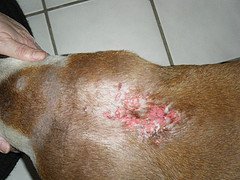
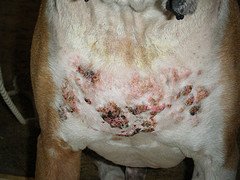
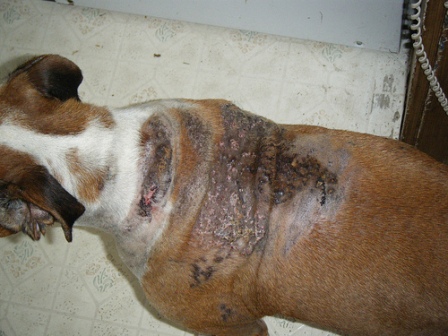
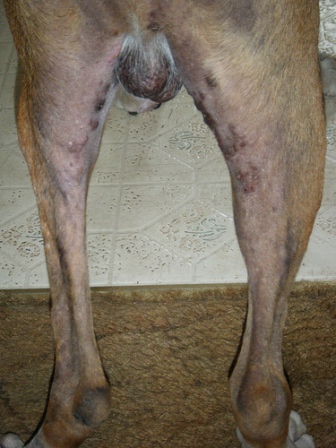
Dog hypothyroidism symptoms include alopecia (hair loss) and lesions on the skin which spread from the dorsal (back) to ventral (abdomen) surface. Lesions then move to the inner thigh. Areas could bleed, and turn black in color.
Ask the Vet
Have A Question About Hypothyroidsim or Story That Can Help Others?
Do you have a Canine Hypothyroidism related Question for our Editors or a Helpful Story to Share? Please include information such as age, sex, breed, medical history, skin and other symptoms, medications your dog is taking, recent changes in behavior, etc. A picture of the condition would also be helpful.
We will do our best to get back to you quickly (depends on how many questions we receive each day). If you do require an immediate response we suggest using this online dog veterinary service that is available now.
What Other Readers Have Asked and Suggestions from our Vet
Click below to see contributions from other visitors to this page...
Canine Hypothyroidism Treatment and Symptoms Help 
I have a 9.5 yr old Boxer named Rebel, colored tan and white. My dog weighs 50 pounds down from 55 pounds,the weight prior to the illness.
The illness …
Is weight loss typical of Hypothyroidism? Not rated yet
My German Shepherd is just turning 6. 2 months ago he had 4 seizures in a two week span. Took his sugars at the time, as I am a Type 1 diabetic, and they …
References For Canine Hypothyroidism
Dog
Owners Home Veterinary Handbook
Fourth Edition
Eldredge, Debra DVM
Carlson, Liisa DVM
Carlson, Delbert DVM
Giffin, James MD
Diagnosis and Treatment of Canine Hypothyroidism and
Thyroiditis
J.C. Scott-Moncrieff
School of Veterinary Medicine
Purdue University


