Table of Contents
Overview | Flea Allergy | Atopy (Environment & Seasonal)
Food Allergy | Testing & Diagnosis | Treatment | Q&A
Summary:
"Identifying the source and best treatment for canine skin allergy is a frequent problem that often requires multiple trips to the veterinarian. It is the most common cause of skin conditions in dogs. The most diagnosed types of skin allergies in dogs includes flea allergy, environmental or seasonal allergy (atopy or hay fever) and dog food allergies. Symptoms for all types of dog skin allergies such as hair loss, secondary skin infections and itch are similar, but each type of skin allergy has unique characteristics and presentations that can help an owner distinguish one type from another as described below. Symptoms can also be confused with other canine skin conditions such as ringworm, mange and immune-mediated skin disease. Treatment for a dog with a skin allergy is based on the underlying cause of the problem."
Overview: Skin Allergies
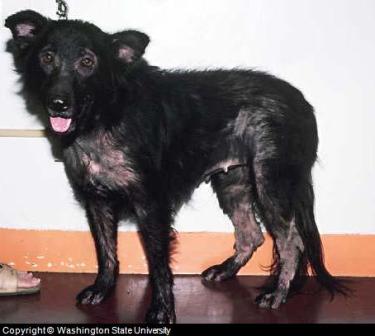
The three most common causes of canine skin allergy are dog flea allergies, an environmental allergy such as pollen or mold (called canine atopy), and dog food allergy. Any investigation should start with eliminating these common causes before moving on to other possible reasons for a canine skin condition.
Where your dog has an allergic reaction can be a clue as to the cause. If the allergy is at the mouth and you had just purchased a new plastic dog dish for example, this could be the cause. Redness around a flea collar could be caused by the collar itself.
Senior Veterinary Specialist, Veterinary Specialist Team
Pfizer Animal Health, Washington State University
Many chemicals can cause your dog to have an allergic reaction. This usually occurs in areas that are not covered by hair. Common causes include soap, shampoo, wool, leather, plastic/rubber dog dishes, insecticide, paint, carpet, wood preservative, neomycin (many skin medicines).
Immediately bring your dog to a Veterinarian or Emergency Center if your dog's face is swollen or looks puffy. This could be a sign of a severe allergic reaction that needs immediate treatment.
Canine Skin Allergy Due to Fleas
(Flea Bite
Hypersensitivity)
Dog flea allergies are the most common type of canine skin allergy. This condition is confusing for dog owners since it is a year round problem that many owners believe is seasonal. To be clear, the problem is worse during the late summer and fall.
Fleas do not die in the winter and may not be seen by the owner on the dog (they are good at hiding). A small number of fleas can result in a flea allergy skin problem.
Canine Flea Allergy Skin Symptoms
Symptoms of canine skin allergy from fleas includes itch primarily above the tail base and on the back of the thighs, but can effect the entire body. Dogs will chew on the itchy areas, causing hair loss, red skin and skin irritation. The chewing can also introduce bacteria, which will result in a skin infection. Flea bite hypersensitivity does not typically affect a dogs face or the front of the body.
Canine Flea Allergy Treatment
To treat dog flea allergy, first use a product to kill the fleas on the dog such as a herbal flea dip. Follow this by a product made for dog flea protection recommended by your veterinarian such as Frontline.
Canine Atopy - (Canine atopic
dermatitis)
Environmental Dog Skin Allergy and Dogs with Seasonal Allergies
About 1 in 10 dogs get some type of canine skin allergy (also called Atopy) from substances in the air. Allergies tend to appear during certain times of the year when specific types of allergens such as pollen, ragweed and mold are present.
- Weed Pollen – Late summer and fall
- Tree Pollen – March and April
- Grass Pollen – May, June, July
Certain breeds have a higher incidence of canine atopy including:
- Bichon Frise
- English Bulldogs
- Shar-Pei
- White Highland, Cairn, Scottish, Boston, Sealyham, Wire-haired fox Terriers
- Lhasa apsos
- Cocker Spaniels
- German Shepherds
Dogs with Allergies Seasonal Symptoms
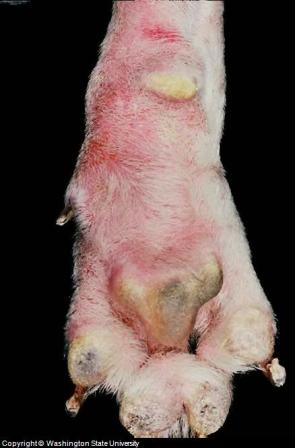
Dogs with allergies of this type do not show symptoms seen in humans such as runny nose, nasal congestion and itchy eyes. Instead, canine atopy results in itchy skin all over the body, but most severely on the feet and underbelly. Dogs will lick feet to the point of severe infection and redness. Other areas more frequently affected include the face, feet, front legs, ears and armpits.
Dog Atopy Treatment
Treatment for canine atopy involves avoiding the substance that triggers the allergy or reducing the sensitivity to the substance via dog allergy shots (only 60% to 85% effective). A hypoallergenic dog shampoo such as DermaPet Dermalyte may also bring some relief.
Bull Terrier Dog with Skin Allergies on Paw
(Atopic Dermatitis)
Senior Veterinary Specialist, Veterinary Specialist Team
Pfizer Animal Health, Washington State University
Canine Skin Allergies From Food
Canine food allergy is the third most common type of allergies in dogs. The allergic reaction is to a protein found in commercial dog food, dog treats or table scraps given to the dog. A dog can become allergic to a food at any time, even if a dog has been eating that food for years with no issues.
Dog Food Allergy Symptoms
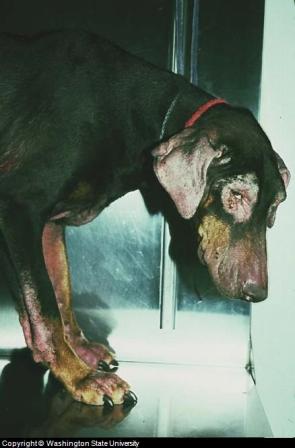
Dog food allergies result in generalized itch, which means the itch is all over the body. Dog itch is often most pronounced on the anus. Along with itch, ear infections are also common. Certain breeds have an increased risk of canine food allergy including German Shepherds and Boxers.
Dog Food Allergy Treatment
To treat food allergy in dogs, a hypoallergenic or elimination diet is required. In an elimination diet the food is reduced to one carb such as rice and one protein such as chicken. After improvement is seen, ingredients are slowly added back into the diet until the problem ingredient is identified. You should see canine skin allergy symptoms start to heal in the first few weeks.
Senior Veterinary Specialist, Veterinary Specialist Team
Pfizer Animal Health, Washington State University
Allergy Dog Testing and Diagnosis
Diagnosing dog skin allergies often requires the investigative skills of Sherlock Holmes. Any examination will start with the taking of a thorough medical history regarding your dog's symptoms. Some veterinarian's will ask you to complete an online dog skin history that can be filled out before your visit. Typical questions include when the symptoms first began, whether any siblings have similar dog skin problems, and how has the skin reaction changed over time. They will also ask about any products used to care for your dog such as flea care and the diet. Often the questionnaire is more important that the physical exam, since symptoms are often non-specific to any particular underlying cause.
Next, the veterinarian will do a physical exam. A vet will evaluate the entire dog, not just the area showing canine skin allergy symptoms. At this point, for most dog skin disorders, a vet will have some indication or suspicion of what is causing the problem, including dog flea allergy, atopy (environmental allergies), contact allergy (to a chemical or other substance), or if the cause is unrelated to allergy (see below).
Since it is sometimes difficult to tell the difference between skin allergies caused by fleas and allergy caused by something in your dog’s environment, your vet may take an ear swab and a superficial dog skin sample to determine if the problem is caused by an infection (bacterial) or yeast. All are examined using a microscope.
In an approach that is similar to the one used for people, your Veterinarian may give your dog a skin test (IST) where different causes of allergy are placed on the skin. If your dog reacts to a small amount, it means they are allergic. Some Veterinarians may opt to do a blood test called ELISA.
Dog Skin Problems with Symptoms that are Similar to Canine Skin Allergy
Several types of canine skin conditions are often confused with canine skin allergy. When reaching a specific diagnosis, the veterinarian will eliminate these causes before determining that allergy is the cause of the dog skin condition.
- Mange: There are two different types of dog mange,
demodectic and sarcoptic, that can mimic the signs of canine skin
allergy. Both are caused by mites which burrow under the skin and are
treated with a lime-sulfur dip such as Naturasil.
-- Demodectic Dog Mange is commonly seen in young puppies, larger breed dogs such as Great Danes and other breeds such as Boxers, and Pit Bulls. Symptoms includes patchy hair loss around the head and face, but can occur in any area of the body. Diagnosis is based on a skin scraping and the discovery of mites.
-- Sarcoptic Dog Mange or Scabies is also caused by mites and can be passed between people and dogs. Symptoms usually appear at the ear margins, will appear crusty and in most cases cause extreme itch. A dog scabies diagnosis is based on a skin scraping.
- Dog Ringworm results in symptoms such
as skin crusting, patchy hair loss and itch. The symptoms usually
do not look similar to the circular ring seen on human skin. Dog
ringworm diagnosis is based on a test using a "woods lamp" which causes
the fungus to fluoresce. Treatment involves the weekly use of a dip
such as Naturasil
for Ringworm.
- Immune Mediated Dog Skin Disease can affect dogs of any age, but is most frequently diagnosed in middle age females. In these types of conditions, the dogs immune system attacks its' own body, causing conditions such as pemphigus foliaceus or lupus. Symptoms includes raw dog skin and painful skin at the margins of the ears, dog lips and nose. The condition is diagnosed with a skin biopsy test.
Treatment of Dogs with a Canine Skin Allergy
Many Vets will prescribe an antihistamine (hydrocortisone or Pramoxine) to help with any dog skin itching. Popular types of antihistamine include Dipehnhydramine (Benadryl), hydroxyzine (Atarax), clemastine (Tavist) and cetirizine (Zyrtec); 40% of dogs respond to this type of treatment.
Other treatment options includes oral or topical antibiotics and anti-fungals. Shampoos and sprays may also be of help. If dog food allergy is the cause, then a hypoallergenic food trial is used to identify the problem ingredients. For seasonal allergy (canine atopy), then medication which are immune modulating such as cyclosporine are prescribed.
If your dog does not respond to any of the canine skin allergy treatments suggested above, then a series of allergy shots can be used to reduce sensitivity to the allergens (called hyposensitization therapy). This course of treatment takes as few as 9 and as many as 12 months.
During recovery, dietary supplements might help to restore skin condition, such as the omega fatty acids found in fish oil. Shampoos can also be tried to ease skin inflammation and itch such as a product that contains colloidal oatmeal (Groomers Blend). Homeopathics that combine ingredients associated with skin and coat health such as Skin and Coat Tonic may also be of help.
It is common for a vet to request a return visit after several weeks to check on your dog's progress.
Ask Our Vet A Question or Share Your Story
Have A Dog Allergy Question For Our Editors or Story For Our Readers?
Do you have a Dog Allergy related Question for our Veterinarian? Please include information such as age, sex, breed, medical history, skin and other symptoms, medications your dog is taking, recent changes in behavior, etc. Submitting a picture of any condition will help to provide a more complete answer.
We will do our best to get back to you quickly (depends on how many questions we receive each day). If you do require an immediate response we suggest using this online dog veterinary answer service that is available now.
What Other Visitors Have Asked and Suggestions from our Vet
Click below to see contributions from other visitors to this page...

Canine Persistent Skin Issue Not rated yet
My frenchie is covered with lumps that eventually dry and can be scraped off.He had these many years ago and vet couldn’t determine cause(not bacterial)so …
Hair Loss on Puppy Not rated yet
My 6 month old puppy started scratching his side and hind leg area about 2 weeks ago. When I took him for a walk he would start rolling around in leaves. …
References for Skin Allergies on Dogs
Brevitz, Betsy DVM, Hound Health Handbook; "Allergies, Itching
and Other Skin Allergies"
Greek, Jean, DVM, ACIDM; New Hope Animal Hospital
“Atopic Disease and Allergy”
Beale, Karin M. DVM, Gulf Coast Veterinary Specialists – “Atopic
Dermatitis: Clinical Signs and Diagnosis”
Giffin, James M. MD & Carlson, Liisa D., DVM “Dog Owner’s Home
Veterinary Handbook”.
Lloyd, Professor David, Royal Veterinary College, Hawkshead Campus:
“Diagnosis & Management of Adverse Food Reactions in
Dogs”
Osborn, Sarah Colombini DVM, Southwest Veterinary College, Houston:
“Optimal use of Hypoallergenic Diets”
Ihrke, VMD, Professor of Dermatology, School of Veterinary Medicine,
University of California: “Flea Allergy Dermatitis”


