Table of Contents
Summary | Video Product Review | Podcast | Dog Flea Product Reviews | Dog Flea Pills | Flea Shampoo | Brochure
What To Do When Your Dog Gets Fleas:
"There are many available dog flea treatment options and the choice can be confusing. To cut to the chase, we recommend the dog flea medicine Advantage. This product has an active ingredient that keeps dogs free from fleas, eggs and larvae. It prevents eggs from hatching and larvae from becoming adult fleas. It is not toxic to any mammals such as dogs or cats (only buy products marked for dogs if using with dogs).
There are three categories of dog flea treatment options:
- Spot-ons that are applied to the skin at the back such as Advantage, Frontline and K-9 Advantix: provide lasting protection. These product have more longevity.
- Shampoos and Collars: Shampoos are good for a quick fast-acting treatment, but do not provide residual protection. We do not recommend collars since they offer protection up to 2 weeks and protection can be limited to the area around the collar.
- Oral tablets: Another good option, particularly in dogs that are suffering from a large infestation. Longevity varies between products.
We do not recommend flea bombs, foggers, or garlic for fleas. Garlic has not been proven to work and if you need a fogger, it is best to call an exterminator.
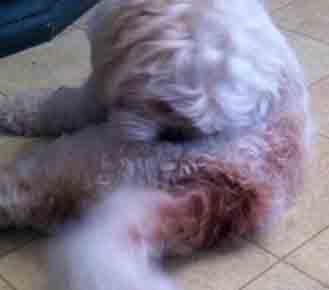
Dog flea treatment is necessary the second you suspect that your dog has fleas. Infestations are common when the weather gets warm. Fleas create discomfort for your dog and can lead to alopecia (hair loss), skin problems (dermatitis) and tapeworm. Fleas can also be harmful for people living in the home since they can spread bacteria.
Treatment for fleas on dogs is also necessary to keep them from spreading throughout your home since a flea can produce up to 50 eggs everyday and can lay 2000 during the fleas life. A veterinarian can prescribe a one time medication called oral nitempyran that can kill fleas within 15 to 30 minutes after being taken.
Symptoms such as itch can be addressed with prescription antihistamines and corticosteroids that can be taken via an injection or by mouth. If your veterinarian recommends "isoxazoline class" such as Credelio, Simparica, Nexgard and Bravecto as about rare. Adverse neurological events include muscle tremors, seizures and ataxia (loss of control of body movements.)
When you discover fleas vacuum and disinfect the home and wash the dog's belongings. Consider treating belongings with a plant based flea spray for maximum safety."
Video: Review of Dog Flea Treatment Medicines
American Veterinary Association Podcast
American Veterinary Association recommendations for dog flea treatment.
Best Dog Flea Treatment Reviews
The following dog flea medicines are commonly recommended by Veterinarians:
What Is The Best Flea Medicine for Dogs?
We believe that Advantage is the best flea medicine for most dogs. It has not toxicity in animals, is easy to apply and has a 30 day residual effect. This is the best way to get rid of fleas on your dog.
Advantage (Dogs 7 weeks and older, recommended)
Advantage is applied 1x a month along the skin located at the dog's back. In the first 12 hours it will kill 98% to 100% of all fleas that are on your dog.
Main Ingredient
The main ingredient in Advantage t is Imidaclopird, which spreads across the skin after being applied. It will also kill larval stage fleas in areas of the home that come in contact with your dog.
How it Works
Advantage paralyzes and kills fleas that come in contact with product, keeping them from laying additional eggs.
Is Advantage Toxic to Dogs?
Advantage is non-toxic to any dog or mammal making this the product of choice.
Is Advantage WaterProof?
Yes, your dog will be protected after shampoo bath or swim (within reason).
FrontLine Plus (Dogs 8 Weeks or Older)
Frontline Plus prevents fleas and ticks. It is applied to your dog 1x a month along the back. It is absorbed into the flat of the skin, making it more waterproof.
Main Ingredient
The main ingredient in Frontline Plus sis Fipronil and (s)-methoprene. This is an insect growth regulator.
How It Works
Frontline Plus kills flea eggs, adult fleas and flea larvae. It also kills the types of tick that is a carrier for Lyme Disease (Deer Tick) as well as American Dog Ticks, Lone Star Ticks, and Brown Dog Ticks.
Is Frontline Plus Water Proof?
Yes, it is effective after swimming or bathing. Do not bath 2 days before and after using this product to provide the greatest efficacy when bathing at other times.
Recommendation
For dogs that need to be protected against both ticks and fleas.
K9-Advantix (for dogs 7 weeks and older)
K9 Advantix is for the prevention of mosquitoes, ticks and fleas. It is also applied to the back 1x a month.
Main Ingredient
The main ingredient in K9 Advantix is Imidacloprid and permethrin. Not this product is toxic to cats. If you have cats in the home DO NOT use this product.
How it Works
K9 Advantix works by paralyzing fleas that come in contact with a treated dog. The permethrin is an insect repellent. Togehter it will repel and kill adult fleas, ticks and mosquitoes.
Is it Water Proof?
Yes, K9 Advantix will be effective after swimming and bathing.
Ovitrol Plus Spray (for dogs 12 weeks of age or older)
Ovitrol Plus Spray is a mosquito, tick, gnat, and flea preventative. It is applied via a spray mist.
- Apply every 2 months for flea prevention and treatment
- Apply every 10 days to repel mosquitoes
- Apply directly on a tick when treating for ticks
Main Ingredients
The main active ingredients in Ovitrol are:
- (S)-Methoprene
- Pyrethrins
- Piperonyl Buutoxide
- N-octyl Bicycloheptene Dicarboximide
Is it water proof?
Looses effectiveness after swimming or bathing.
Recommendation
Use if looking for a product that provides mosquito prevention. If using to repel mosquitoes in addition to a flea product like Frontline, apply spray 1 to 2 days after the Frontline has been applied. If only using seasonally, then no other products are required to repel mosquitoes.
Oral Dog Flea Pills
Oral dog flea pills such as Capstar are safe and they work. If a dog is severely infested with fleas, an oral medication will start killing fleas within 30 minutes and will continue working for 24 hours. Another oral medication is Sentinel which kills fleas and prevents heartworm. As an insect growth regulator it prevents the hatching of eggs and prevents larvae. Sentinel works for an entire month.
Prescription Dog Flea Medicines
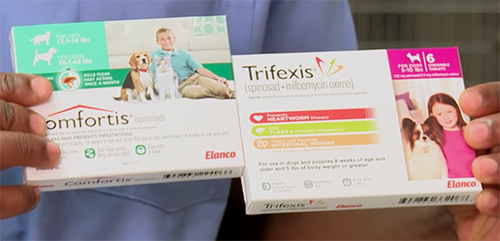 Oral Dog Flea Pills Available From Your Veterinarian. They Start Working Quickly To Kill and Prevent Fleas.

