Table of Contents
Common Eye Diseases | Eye Anatomy | Disease Details | Dry Eye | Q&A
Summary:
"Dog eye functions much like ours. Dogs also develop many of the same eye problems that people can have, like glaucoma, cataracts and others and can result in symptoms ranging from mild irritation or conjunctivitis to blindness, ocular tumors and eye loss.
The top three eye diseases in dogs are corneal abrasions, keratoconjunctivitis sicca (canine dry eye) and glaucoma. The cornea is the outermost layer of the eye, so it is subjected to injury from normal dog behaviors such as exploring when outdoors.
Bacterial infections of the conjuncytiva or cornea (conjunctivitis and keratitis respectively) will cause eye redness, and mucous eye discharge. Canine conjunctivitis will also cause swollen eyelids and excessive redness inside of the eyelid. Canine eye injuries such as corneal ulcerations or abrasions will cause excessive watering and eye pain. Dry eye in dogs causes a thick string like mucous across the eye. If not corrected, it causes melanin pigment to be deposited in the cornea causing corneal inflammation.
Each of these and other less common conditions are described and pictured below. If your dog is showing any signs of pawing at the eyes, eye pain, squinting, watery eyes, enlarged eyes or any mucous discharge, see a veterinarian as soon as possible. When it comes to the eyes, any delays could result in blindness or the need to remove the eye."
Overview
Eye problems in dogs are a common occurrence. Dog eye health issues can be suspected based on observation. Use your thumb to pull the upper eyelid so you can get a better view of the eye. The white area (sclera) should glisten white with very thin red blood vessels. Higher up on the edge of the eye is pink tissue called the conjunctiva. In a healthy dog eye, the dog conjunctiva color should match the color of the dog's gums.
Signs of dog eye problems include blood vessels that look engorged, any bruises around the eye or a sclera which is yellow (could be dog jaundice), and discharge such as mucous.
Dog eye diseases are classified by being external which affect the eyelids, conjunctiva, cornea and sclera (common) or internal such as canine uveitis, which refers to inflammation of the inner eye (less common). Similarly, dog eye problems can also arise from chronic diseases such as diabetes mellitus and Cushing's disease.
Common External Dog Eye Diseases
- Canine Conjunctivitis (Pink Eye): Conjunctivitis in dogs is caused by a bacterial infection of the conjunctiva. Symptoms include swollen eyelids, redness inside of the eyelid, mucous discharge and dog eye redness. There are other diseases such as Sub-conjuntival Hemorrhage (ruptured blood vessels) and Chemosis (swelling of conjunctival tissues), which can be primary conditions, and conjunctivitis develops as secondary problem.
- Keratitis: Caused by bacterial infection of the cornea. Symptoms include dog eye redness and mucous discharge. Keratitis can be ulcerative in nature and can develop to corneal ulcer (ulcerative keratitis). Other conditions, that of cornea may include inflammation of outer cornea and with-in cornea and corneal deterioration with age.
- Dog eye injuries (corneal ulcer, abrasion): Symptoms include excessive watering and pain such as eye squinting and rubbing with a paw.
- Dog Dry Eye: Caused by a tear gland problem or malfunction. Dry eye in dogs (also called keratoconjunctivitis sicca) results in an overabundance of thick stringy mucous across the eye. Can also cause a secondary condition where melanin pigment is deposited in the cornea.
Less Common Internal Dog Eye Diseases
These types of canine eye disorders tend to be more severe and often threaten a dog's vision and eye integrity.
- Canine Uveitis: This canine eye condition refers to inflammation of the inner eye. The dog iris or inside of the eye will have a reddish tint.
- Canine Glaucoma: Glaucoma in dogs is caused by increased eye pressure inside the eye. May have multiple underlying causes. You'll notice eye enlargement from the pressure.
- Dog Retinal Disease:
Conditions such as atrophy or a detached
retina in dogs can threaten a dog's eyesight and can cause
blindness. Symptoms include partial blindness or canine
eye removal surgery. resulting in the use of a dog
eye prosthetic. Other conditions include:
-- Progressive Retinal Atrophy in Dogs
-- Progressive Retinal Atrophy in Poodles
-- Progressive Retinal Degeneration in Dogs
-- Canine Sudden Acquired Retinal Degeneration (SARD’s)
Click on the links below for more information on other canine eye diseases and conditions not mentioned above:
Cataracts
Canine
Cherry Eye
Canine
Distichiasis
Dog
Entropion
Canine
Goniodysgenesis
Dog
Herpes
Pannus
in Dogs
Tear
Stains
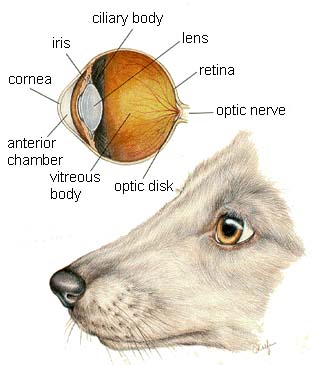
The pictures in this section are reprinted with permission by the copyright owner, Hill's Pet Nutrition, from the Atlas of Veterinary Clinical Anatomy. These illustrations should not be downloaded, printed or copied except for personal, non-commercial use.
Healthy dog eyes take care of themselves with tears which flush out the eye, and nasolacrimal ducts which help them drain. If your dog's eyes are healthy, owners only need to watch for any problems. During regularly scheduled checkups your vet will check the condition of the eyes, and use an opthalmoscope to examine the retinas. The exam will also help to detect problems early such as canine cataracts, dry eye, and eye cancer.
The eye is also a window into other diseases in the body. For example, dog diabetes is one of the causes of cataracts.
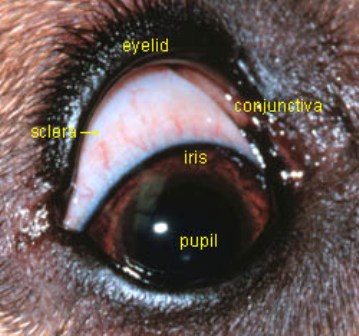
Source: Washington State University
Dog Eye Conditions and Diseases
Dog Cataracts
Dog cataracts describes a condition where the lens inside the eye is starting to become cloudy, making vision difficult for your pet.
The condition is common in certain breeds or is a result of another condition such as diabetes, eye injury or inflammation that is occurring in the eye. Treatment involves surgical removal of the cloudy lens. The prognosis for achieving better sight is excellent. You will have to administer eye drops for several weeks after the surgery.
There is some talk that eye drops can actually cure cataracts. According to the American Academy of Veterinary Ophthalmologists, there is no accepted evidence in the scientific community supporting this claim.
Dog's with cataracts are also often checked for dog diabetes, since this is a major cause of the condition. Diabetes, if left untreated, allows sugar to build up inside the eye lens, which causes water to be pulled into the lens. The lens then swells and breaks up the lens fibers, which results in cataracts.
Dog Cherry Eye
The condition known as dog cherry eye occurs when the tear glands behind your dog's third eyelid moves out of position, which is called prolapsed gland of the third eyelid. Since this gland provides your dog's tear production, it is important to ensure that the condition does not cause tear production to stop. Dog cherry eye is not painful Surgery has a high rate of success and is used to create a pocket for the gland which is then put back into position. If left untreated it can hurt your dog's eye health causing dry eye, irritation and if rubbed, bleeding, irritation and possibly infection.
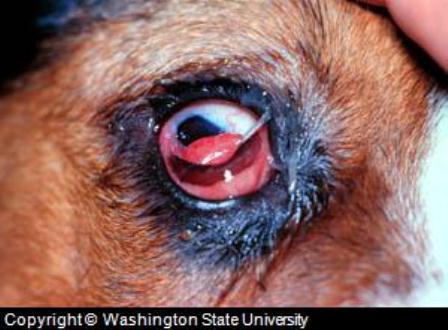
Prolapse of the gland of the third eyelid in a Beagle
Source: Washington State University
Canine Corneal Ulcer
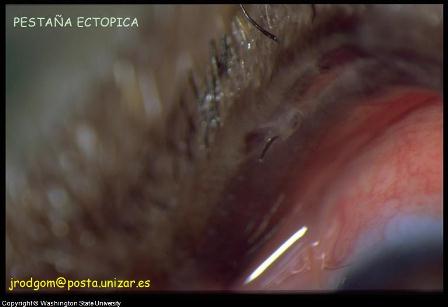
The first line of defense against injury and bacteria is the cornea, which is a transparent outer layer. Because it is the outermost surface, it is more likely to be injured than other parts of the eye from foreign objects, particularly those found outdoors or even eyelashes. the corneal ulcers and inflammation can occur on outer parts of cornea and with-in cornea.
Source: Washington State University
Dog eye scratches or corneal ulcers or abrasions can cause symptoms such as squinting, pain, watery eyes and red eyes. Minor dog eye scratches will heal on their own. Treatment for deeper abrasions or corneal ulcers are diagnosed in a veterinarian's office using a green stain named flourescein that clings to any abrasion. Treatment depends on the severity of the injury. Mild corneal abrasions are treated with topical antibiotics and if needed, pain medications. Severe cases may require surgical grafts in order to save the dog's eye.
Canine Distichiasis
Canine distichiasis is a condition where glands that do not normally grow eyelashes start to grow them. Since the eyelashes are out of position, they could irritate the eye causing irritation, inflammation and possibly a corneal ulcer (eye wound). Treatment is only necessary if it is bothering your dogs eye and could include trimming the eyelashes, plucking them, electrolysis or surgical removal of the hair follicle. Even with these techniques, new hair follicles and eyelashes could form impacting your dog health eye.
Canine Entropion
Dog entropion is a condition where the eyelid rolls back into the eye, resulting in fur and eyelashes rubbing against the eye surface. It is most common inherited condition in various breeds of dogs and or may happen due to weakening muscles in older dogs. The condition usually cause development of a scar and severe involuntary winking due to pain. The eyelashes and fur rubbing against eye surface can lead to secondary problems, such as infections. Long term entropion can cause abnormal coloring, scarring and formation of sores on cornea. These sores heal quite slowly. Treatment involves a surgical procedure, in which temporary stitches becomes necessary. These stitches can be removed in 2 - 3 weeks.
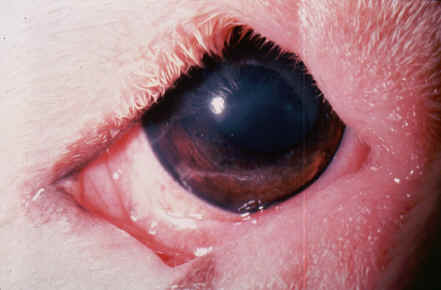
Canine Glaucoma
Dog glaucoma is a condition where fluid in the eye doesn't drain properly causing an increase in pressure. If not corrected it begins to erode cells in the retina causing increasing levels of vision loss. This condition can be painful. Other symptoms include lethargy, redness, enlarged eyes and loss of appetite.
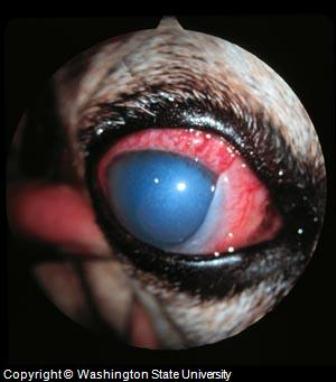
Source Dr. Anna Deykin/Washington State University
Initial treatment involves medication and topical ointments. If that doesn't control the pressure then surgery is necessary. Severe cases require emergency care to avoid vision loss. See your veterinarian or veterinary ophthalmologist if you even suspect this condition in even one eye. If the condition suddenly appears, consider the problem an emergency that requires immediate treatment in order to avoid eye loss or blindness.
Canine Keratoconjunctivitis Sicca (dog dry eye)
This dog eye condition is also referred to as dog dry eye or KCS. It is commonly caused by the immune system abnormally destroying the tear gland, causing an inadequate amount to be produced. Without a normal amount of tears being produced, the cornea becomes too dry, resulting in irritation and inflammation, which in some cases leads to the appearance of a dark pigment. Other symptoms can induce a string like mucous over the eyes.
Diagnosis of dog dry eye involves the use of a Schirmer tear test, where the veterinarian places a thin paper in the eyes for 1 minute to measure the tears absorbed by the paper. Dogs with dry eye are treated with cyclosporine, a medication that can help to increase tear production.
Dog dry eye is usually a genetic problem, passed from generation to generation. It is often seen in West Highland white terriers, Cocker Spaniels and the Shih Tsu.
Ask a Question or Share a Story
Have a Dog Eye Related Question For Our Editors or A Story to Tell About This Topic?
Do you have a dog eye related question for our Veterinarian or a helpful story to share? We'll answer it for free! Please include information such as age, sex, breed, medical history, symptoms, diet, changes in behavior and medications.
We will do our best to get back to you quickly (depends on how many questions we receive each day). If you do require an immediate response we suggest using this online dog veterinary service that is available now.
References
Washington State University


