Table of Contents
Summary:
The signs of whelping are not the same in all dogs but can include temperature change, pacing, nesting behavior, digging, hiding in the dark and milk expression from the teats. In the last 3 weeks there may be some vaginal discharge. There are medical evidences towards whelping, which includes changes in body temperature and decline in levels of serum progestrone. Similarly, there are signs and body which might not be specific but still indicative. Veterinarians recommend that whelping be done at home to avoid the chance of exposure to infection in a medical setting.
Overview
The gestation period for puppies is approximately 61 to 65 days give or take 1 day. If it's been more than 65 days and you still don't see any whelping signs in your dog, talk to your vet. Breeding to whelping takes between 55 to 70 days because male sperm can survive within the female for 7 to 9 days prior to fertilizing the egg. Similarly, an early signs of whelping should also be discussed with veterinarian, as this might be indication of complication or hormonal imbalance.
Tip: Call your veterinarian before whelping begins. Give the Vet the due date. Ask about emergency procedures if whelping occurs in the middle of the night.
There are a number of whelping signs you can notice when your female dog is close to giving birth. You may have to pay close attention to notice these signs as describe below. Some or all of these whelping signs may be present. Prepare the whelping box ahead of time (12 weeks before puppies are born - approx. 4" x 5' is ideal, with sides of approximately 2-1/2" - see how to make a dog whelping box.
Role of Body Temperature in Whelping
A normal canine temperature is 101.5 degrees. In pregnancy, a bitch will have a temperature of approximately 100 degrees. Dog whelping or labor starts within 48 hours of your bitches temperature dropping. Track the temperature day by day and you will see the drop. Start taking the temperature at day 56 and check two times, in morning and evening. The temperature will rise just before it drops.
Starting at day 56 you should be recording temperatures around 99 to 100.6. The temperature could rise to approximately 101.4 before falling to around 98 or lower. When you read 98 expect delivery within 24 hours. Other whelping signs include panting, digging behavior, hiding in the dark and dilation of the pupils.
How to Take Dog Temperature:
- Shake thermometer
- Coat with petroleum jelly
- Lay your dog down (not sitting)
- Insert the thermometer 2 inches into rectum, hold it in for 2 minutes (hold on to it tight)
- Wipe it and recored temperature
Dog Whelping Calculator
Calculate a litter due date based on the date of breeding. The calculator uses a 63 day period to determine puppy birth date:
Whelping Chart
First download this perpetual dog whelping chart. Next mark the date the female was inseminated (also referred to as being bred). The date of delivery will be approximately 61 days later as indicated on the chart. The sperm take 2 days to penetrate the egg. If your female dog ovulates on the 11th day of the cycle, then assume that she conceived on the 13th day (48 hours or 2 days later).
What to Expect During the Three Stages of Bitch Labor
- First Stage Bitch Labor: (10 to 24 hours)
- Uterine contractions begin in organized pattern, while serum progesterone levels drops to < 2 ng/mL and body temperature drops < 99°F [37.2°C]
- Bitch (Queens) behavior changes, restlessness and reclusiveness, appetite loss (not in all cases)
- Cervical dilation not noticeable unless a special scope is used
- Discharge from vagina is clear with a mucous consistency - Second Stage of Canine Labor:
- Attempt to push out puppies by abdominal muscular contractions, dog is in a lying or squatting position
- Litter delivery starts 10 to 60 minutes after muscular contractions start
- Membranes encase puppy (called chorioallantoic membrane) which ruptures. It is the equivalent of water breaking in humans
- Breeched delivery happens in 40% of cases
- The bitch or female will lick and remove the puppy or fetal membrane, and assist the pup to start breathing
- Puppies are swung to clear airways (important to avoid any brain damage)
- Stimulate puppy breathing by using a towel to dry the puppies
- Tie umbilical cord with dental floss or a suture about 1 inch from the pups abdomen. Disinfect area with iodine tincture. Encourage interaction between mother and puppy to allow for bonding. - Third Stage of Dog Labor:
- Dog placenta delivery (may or may not be attached to a puppy)
- Female bitches often attempt to ingest the placenta and sever the umbilical cords
- Place puppies after they are born into a small box for warmth (consider a Styrofoam ice chest - place a warm water bottle into the box or microwave a sock filled with uncooked rice
- Some veterinarians or breeders are using fetal monitoring to check uterine activity and fetal heart rates.
First Signs of Labor
The first signs of whelping can appear as early as 22 days. Your veterinarian may be able to see swelling of the uterus. Your veterinarian may be able to detect this via a process called palpitation, which is using the hand to judge changes in the uterus via feeling the abdomen. Ultrasound equipment may detect a heartbeat which is considered to be the most reliable indicator of pregnancy. By day 46 you should be able to detect swelling in the mammary glands. This is also the first point where x-rays can capture an image of the fetus.
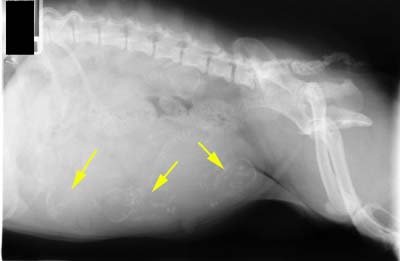
What to Watch For:
One of the key whelping signs that can predict the birth within 24 hours is a drop in body temperature. Her puppies will likely be born within 24 hours of the drop in temperature. A normal temperature is 101.8; it will usually drop to about 98 to 99. Take your dog's temperature 2x a day when the dog is calm. However, her temperature may drop, then rise again, so a decrease in temperature by itself does not always indicate puppies are on the way. Also, not all dogs see a change in temperature.
She will probably stop eating a day or so before giving birth. She may also vomit or have diarrhea. However, some dogs will eat right up until giving birth. Again, these are some whelping signs to watch for, but they won't all be present in all dogs.
Another of the whelping signs is a "glazed look" on her face. This is hard to describe but you will know it when you see it.
She will often be restless. She may pace or turn in circles, pace, pant or lie down and then get up again.
If you've prepared a whelping box for your dog, she may dig in the blankets or towels you've arranged for her. This is called "nesting". She's preparing a place for her babies. She may also take various objects that she likes to her nest.
She will look at or lick under her tail. She will probably do this the entire day of her whelping and throughout her labor.
Other whelping signs during the week before birth include:
- Changes in the abdomen - looks like it dropped
- Vulva (female genitals) enlargement
- Appetite Change/Loss
- More sleep
Her teats and mammary glands will look swollen with milk on the day of her whelping. Milk can be expressed from her teats near the time of whelping for first-time mothers, and about four days before whelping for those who have had litters before.
Once labor begins, she will pant and sometimes moan. You may notice her legs and stomach tense and then relax. As contractions progress, she will arch her back with the contractions. At this point, the pups will soon be born.
There are additional points to remember though, for example in case there are complications, a elective cesarean sections can be performed safely at >62 days of gestation. It should be remembered that a safe and predictable way to induce whelping in dogs is not yet developed. Some hormonal therapies, such as with aglepristone however has been proven promising. This should however, be administered by only professional veterinary staff.
Monitoring the Signs of Whelping
Veterinarians have many of the same monitoring devices that humans have including fetal and uterine monitors. The goal is to monitor labor to ensure that there is nothing that could prevent a successful birth.
Sources for Whelping Signs
Canine Pregnancy: Predicting Parturition and Timing Events of Gestation
P. W. Concannon
Department of Biomedical Sciences, College of Veterinary Medicine
Cornell University, Ithaca, New York, USA
Whelping 101
Piantadosi-Ward, Yvette
Canine Pregnancy: Predicting Parturition and Timing Events of Gestation
Concannon, P. W.
Normal Whelping in the Bitch
Autumn P. Davidson


