Key Takeaways
- A small amount of whitish or cream-colored material at the tip of the sheath (smegma) is normal in adult male dogs, neutered or not.
- Yellow-green, pus-like discharge is the classic sign of a penis and sheath infection, called balanoposthitis. Mild cases are common and often clear up on their own.
- See a vet if the discharge is heavy, bloody, keeps coming back, or comes with constant licking, swelling, pain or changes in peeing.
- Treatment is usually clipping the hair and flushing the sheath with a dilute antiseptic, plus fixing the underlying cause. Antibiotic pills aren't always needed.
- Don't use hydrogen peroxide, alcohol or leftover antibiotics. Peroxide damages healthy tissue, and leftover antibiotics can make infections harder to treat.
What is a dog penis infection (balanoposthitis)?
Balanoposthitis is inflammation of the penis and of the lining of the sheath (prepuce) that covers it. Balanitis means the penis is inflamed, and posthitis means the sheath lining is.[1][13] Its main sign is too much discharge from the sheath, often with some discomfort.[1] Infection of the testicles is a different condition, covered below.[3]
Mild cases are common. According to the Merck Veterinary Manual, mild balanoposthitis "is present in many sexually mature dogs and it resolves spontaneously without any treatment."[2] It is common in unneutered males,[12] and neutering reduces but does not eliminate sheath discharge.[1]
Bacteria in the sheath are normal
The sheath is never sterile. In a study of 15 healthy stud dogs sampled over 18 months, only 14.2% of sheath samples grew no (aerobic) bacteria.[14] Yeasts such as Malassezia and Candida also live there normally.[17] Most infections happen when these normal bacteria overgrow because something else is wrong, such as an injury, a grass seed or a urinary problem.[1][12] It also means a swab that "grows bacteria" doesn't by itself prove an infection.[1][15]
Dog penis discharge: a color guide
NormalA little whitish or cream-colored material
This is smegma: oily debris made of shed skin cells and gland secretions that forms inside the sheath, even in neutered dogs. Licking to clean it away is normal.[13] Merck calls a slight discharge like this "of little clinical importance."[1]
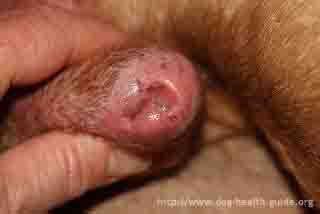
Watch or see a vetYellow or green, pus-like
Yellow-green discharge at the tip of the penis or sheath is the most common sign of balanoposthitis.[2] A small amount in a dog who is otherwise fine may settle on its own within a few days. See a vet if it is heavy, increasing, staining his legs or bedding, or comes with licking or soreness,[1] or if it smells bad.
See a vetBloody or blood-tinged
Blood suggests something more than a simple sheath infection, such as prostate disease in unneutered males, an injury, bladder stones, a urinary infection or a tumor.[1][8][26] See our guide to bleeding from the penis.
DependsClear or watery
A clear, watery discharge can be urine dribbling, or it can appear briefly with canine herpesvirus, which caused watery discharge for about 3 to 7 days in an infection study.[18] Constant dripping or wetness is worth a vet check.
Other signs of a penis or sheath infection
- Licking the sheath far more than usual[2]
- Redness of the penis or of the lining of the sheath, sometimes with small raised red bumps[1]
- Discharge collecting on the fur, back legs or bedding[1]
- Signs of discomfort[1]
The lining of the penis and sheath contains many tiny lymph follicles.[13] When the area is inflamed, these can show up as small raised red bumps.[1] Ask your vet if you notice bumps you're unsure about.
When to see a vet
Go to a vet or emergency clinic now if:
- The penis is stuck outside the sheath and won't go back in. This is paraphimosis, a medical emergency.[2]
- He strains to pee and little or no urine comes out. A blocked urethra can be life-threatening.
- The sheath is suddenly swollen and painful. Merck notes that painful swelling is rare with ordinary balanoposthitis and points instead to an injury, a bite (including snakebite) or a foreign body.[1]
- A testicle or the scrotum is swollen and painful. Twisting of a testicle (torsion) can cause permanent damage within hours.[3]
- He has a fever, vomits, stops eating or seems very unwell. Merck notes that when a dog with balanoposthitis shows signs of illness elsewhere in the body, a more serious problem may be present alongside it.[1]
See a vet within a few days if:
- The yellow-green discharge is heavy, increasing, smelly or lasts more than a few days.
- He keeps licking or chewing at the area.
- There is blood in the discharge or urine, or he pees more often or has accidents.[7]
- You see a sore, lump, blister or wart-like growth on the penis or sheath.[8]
- The problem keeps coming back.
What causes a dog penis infection?
Balanoposthitis is usually secondary: something else lets the normal bacteria overgrow.[1] Finding and fixing that cause is the key to stopping it coming back. Causes include:
Overgrowth of normal bacteria
The bacteria involved are usually ones that normally live in the sheath, such as E. coli and streptococci.[12] Long hair and moisture at the opening can trap discharge.[1]
Grass seeds and other foreign bodies
Grass awns can work their way into the sheath and hide under the lining. Suspect one especially if the sheath is painful and swollen or the discharge is bloody.[1]
Injury
Trauma to the penis, including a fractured penis bone, can lead to secondary infection.[1]
Urinary infections, stones and prostate disease
Urinary infections and bladder stones are recognized causes.[1] In unneutered males, prostate disease is a common cause of bloody discharge.[26]
A penis that can't come out, or can't go back in
A narrow sheath opening (phimosis) traps urine and discharge. A penis that stays out (paraphimosis) quickly becomes swollen, dry and painful, and can become inflamed.[1][2]
Allergies and skin irritation
Allergies are a recognized cause.[2] In 13 dogs with contact dermatitis of the nearby scrotal skin, all improved once they avoided products such as floor cleaners, bleach, cement, laundry detergent and plastic fabric.[25]
Canine herpesvirus
Herpesvirus can cause small blisters, red bumps or roughened red patches at the base of the penis, with a watery discharge.[4][18] In a 1975 report based on one vet's clinical observations, lesions of a mucous-membrane condition probably caused by canine herpesvirus were found in over 60% of the male dogs examined, often with no symptoms at all.[19] In adult dogs it is usually mild and clears up on its own, although the virus stays dormant in the body.[4] The real danger is to newborn puppies, so tell your vet if your dog is used for breeding. There is no canine herpesvirus vaccine in the US.[4] In Europe and the UK, a vaccine (Eurican Herpes 205) is licensed for pregnant females to protect their puppies, though supply has been patchy at times. It is not a treatment for male dogs.[27]
Tumors
Less often, a growth causes the discharge. Transmissible venereal tumor (TVT) looks like a cauliflower-like mass that bleeds easily.[8] In one dog shown in the Merck Veterinary Manual, a lymphoma (lymphosarcoma) of the sheath showed up as persistent licking of the sheath and penis tip.[1]
What about yeast? Yeasts live in a healthy dog's sheath,[17] and yeast overgrowth on the skin is usually a sign of an underlying problem such as allergies.[29] There's little research on yeast infections of the sheath itself, so a vet should confirm it with a smear (cytology) before treating.
How vets diagnose and treat it
Diagnosis
Your vet will examine the penis and the inside of the sheath, sometimes under sedation, and may flush it with saline to look for a grass seed, injury or growth.[1] A smear (cytology) of the discharge, a urine test and, in unneutered males, a check of the prostate are common next steps.[1][9] A culture can help with stubborn cases, but because healthy sheaths carry bacteria, results have to be interpreted carefully.[1] Ultrasound can find foreign-body tracts, injuries or masses.[1]
Treatment
- Fix the cause: remove a grass seed, treat a urinary infection or stones, manage allergies, or treat the prostate.[1]
- Clip the hair around the sheath opening so it stays clean and dry.[1]
- Flush the sheath with a mild, dilute antiseptic such as dilute chlorhexidine or povidone-iodine, or sterile saline.[1] In a trial of 60 healthy dogs being prepared for surgery, a 2-minute flush with 0.05% chlorhexidine left fewer positive cultures than 1% povidone-iodine and caused fewer reactions.[16] Your vet will show you how and how often, if it needs to be done at home.
- Antibiotics if needed: if bacterial infection is suspected, an antibiotic ointment placed inside the sheath, and antibiotic tablets only "if indicated by severity."[1] Veterinary reviewers warn against unnecessary antibiotics because they breed resistant bacteria.[12]
- Comfort: a short course of an anti-inflammatory pain reliever prescribed by your vet (never give human painkillers), and a cone (Elizabethan collar) to stop licking.[1]
Will neutering cure it? No. Neutering may reduce the discharge, but Merck says it "will not eliminate" it.[1] Neutering is, however, often recommended for unneutered dogs with prostate infection or testicle infection when they aren't needed for breeding.[3][10] See spaying and neutering.
Home care: what helps and what to avoid
DoKeep it clean and dry
Gently wipe away discharge from the outside with a soft cloth and lukewarm water or saline. Saline is the gentlest rinse for tissue.[6] Keep the hair at the opening trimmed short.[1]
DoStop the licking
Constant licking keeps the area wet and irritated. A cone can help while it heals.[1]
Don'tUse hydrogen peroxide
According to the Merck Veterinary Manual, hydrogen peroxide "is toxic to healthy tissue and should not be used for lavage of wounds."[6] In a lab study on cultured cells, it proved more toxic to tissue cells than to bacteria.[23] Rubbing alcohol, vinegar, surgical scrubs and household disinfectants are also too harsh for the delicate lining.[6][23] Strong cleaners can cause contact dermatitis.[25]
Don'tUse leftover antibiotics
Leftover pills may be the wrong drug or the wrong dose, may not be needed at all, and can encourage resistant bacteria. The AVMA advises pet owners not to save antibiotics for later or use ones prescribed for another person or pet.[11] If antibiotics are prescribed, give them exactly as directed, for the full time your vet recommends.[28]
Ask firstOver-the-counter antibiotic ointment
Triple-antibiotic ointment smeared on the outside won't reach an infection inside the sheath, and dogs lick it off. Swallowing a small amount usually causes nothing worse than mild vomiting or diarrhea,[24] but treating without a diagnosis can delay finding the real cause. When ointment is needed, your vet places it inside the sheath.[1]
Is it a urinary tract infection or a sheath infection?
They can look similar, and a urinary infection can trigger a sheath infection.[1] Signs that point more to the bladder include peeing more often, straining, accidents in the house and bloody urine.[7] A few things to know about male dogs:
- UTIs are less common in male dogs than in females.[7] In unneutered males, the international ISCAID guidelines say the prostate should be checked whenever bacteria are found in the urine.[9]
- Drinking and peeing more needs a vet check. It can come from a kidney infection,[7] but it is also a classic sign of diabetes and other conditions, so tell your vet if your dog is suddenly thirstier.
- Some dogs show no signs. In one study of dogs with diabetes or Cushing's disease, 37% of the diabetic dogs had a positive urine culture, yet fewer than 5% of the dogs with a positive culture showed straining, frequent peeing or discolored urine.[21] A newer study found positive cultures in 14% of diabetic dogs, and only about a quarter of those had urinary signs.[22]
- A urine sample, ideally collected by needle (cystocentesis), and a culture are the standard way to confirm a UTI before treating it.[10]
Testicle infection (orchitis and epididymitis)
Infection of the testicle (orchitis) and of the coiled tube behind it (epididymitis) often happen together.[3] Causes include bacteria spreading from the bladder or prostate or through the bloodstream, bites (including snakebite) and other injuries, and Brucella canis, a bacterial infection spread through mating and contact with infected fluids, which can rarely infect people.[3][5][30]
Signs include a painful, enlarged testicle, swelling, sores or scraped skin on the scrotum, poor semen quality and low interest in mating. Long-standing cases may show only shrunken or soft testicles and infertility.[2][3] A painful, swollen testicle always needs a vet the same day, partly to rule out torsion.[3]
Every dog with a testicle or epididymis infection should be tested for Brucella canis.[3] In one study of 8 dogs diagnosed with orchitis, 4 tested positive for it.[20] There's no reliably effective treatment for brucellosis, and infected dogs must not be bred.[3][30]
Treatment is antibiotics chosen by culture, usually for 3 to 4 weeks. If he isn't needed for breeding, neutering is the treatment of choice. If only one side is affected, removing that testicle may preserve fertility.[3] Cool packs may reduce damage from inflammation.[2] Even with good treatment, the outlook for fertility is guarded, and damage can show up months later.[3] A simple sheath infection is a different matter: none of the veterinary sources we reviewed link it to infertility, and in healthy stud dogs the normal sheath bacteria passed during mating did not affect fertility.[14]
What the Research Shows
- Bacteria in the sheath are normal. In 15 healthy stud dogs followed for 18 months, only 14.2% of sheath samples grew no (aerobic) bacteria, and the bacteria passed during mating didn't affect fertility.[14] In 20 stud dogs, bacterial counts didn't differ between dogs with and without discharge.[15]
- Dilute chlorhexidine is a better flush. In a randomized trial of 60 healthy dogs being prepped for surgery, 0.05% chlorhexidine reduced positive sheath cultures more than 1% povidone-iodine, which did no better than saline. Adverse reactions were 5% versus 25%.[16]
- Herpes-type lesions may be common and often silent. A 1975 report by one UK vet found the lesions of an eruptive mucous-membrane condition, probably caused by canine herpesvirus, in over 60% of the male dogs examined, often with no symptoms.[19]
- "Orchitis" can be Brucella. In 8 dogs diagnosed with orchitis, all 8 had epididymitis, only 3 had orchitis, and 4 were PCR-positive for Brucella canis.[20]
- Diabetic dogs can have hidden urinary infections. In one study, 37% of diabetic dogs had a positive urine culture, yet fewer than 5% of the dogs with a positive culture (diabetic or Cushing's) had the usual urinary signs.[21]
Frequently Asked Questions
Is discharge from a dog's penis normal?
A small amount of whitish or cream-colored discharge (smegma) is normal in adult male dogs, even neutered ones. Yellow-green pus, blood, or heavy or smelly discharge is not normal.
Can balanoposthitis in dogs heal on its own?
Mild cases often do. Merck notes that mild balanoposthitis is common in mature dogs and often resolves without treatment. If the discharge is heavy, lasts more than a few days or keeps coming back, see a vet to find the cause.
How is balanoposthitis treated in dogs?
By fixing the underlying cause, clipping the hair at the sheath opening and flushing the sheath with a dilute antiseptic. Antibiotic ointment, tablets and a short course of anti-inflammatory medicine are used when needed. A cone stops licking while it heals.
What does green discharge from a dog's penis mean?
Green or yellow-green, pus-like discharge is the most common sign of balanoposthitis, an inflammation of the penis and sheath lining. A little may clear on its own, but heavy discharge or discharge with licking or discomfort should be checked.
How do you know if a male dog has a yeast infection?
You can't tell by looking. Yeast normally lives in the sheath, so a vet needs to look at a sample under the microscope. Yeast overgrowth usually means an underlying problem such as allergies.
Can I put hydrogen peroxide on my dog's penis?
No. Hydrogen peroxide damages healthy tissue, and veterinary guidance says not to use it for cleaning wounds. Use lukewarm water or saline on the outside and ask your vet about a proper flush.
Can I give my dog leftover antibiotics for a penis infection?
No. Many cases don't need antibiotic tablets at all, and the wrong drug or dose can fail and encourage resistant bacteria. Ask your vet first.
Can a male dog's UTI go away on its own?
Don't count on it. UTIs are uncommon in male dogs, and in unneutered males they are often linked to the prostate, which needs proper diagnosis and longer treatment.
Does neutering stop penis infections?
Not reliably. Neutering may reduce discharge but doesn't stop it. It is often recommended for prostate or testicle infections in dogs not used for breeding.
Want a vet's opinion tonight?
If your vet is closed and you're unsure whether the discharge or swelling can wait, you can chat with a licensed veterinarian online through JustAnswer. For an emergency, go to an emergency clinic. (We may earn a commission if you use this service.)
Recurring infections, prostate problems and surgery can add up. Haven Pet Insurance can help with accident and illness costs. Check what a policy covers, because conditions your dog already has are usually excluded. (We may earn a referral fee.)
Related pages: Dog penis problems (overview) · Bleeding from the penis · Dog penis discharge: reader question · Prostate problems · Dogs stuck together after mating · Spay and neuter
Sources
- Davidson AP. Balanoposthitis in Dogs and Cats. Merck Veterinary Manual, 2025.
- Davidson AP. Reproductive Disorders of Male Dogs. Merck Veterinary Manual (pet owner version), updated 2024.
- Davidson AP. Orchitis and Epididymitis in Dogs and Cats. Merck Veterinary Manual, 2025.
- Creevy KE, Evans JB. Canine Herpesvirus Infection. Merck Veterinary Manual, updated 2026.
- Burns G. Brucellosis in Dogs. Merck Veterinary Manual, updated 2026.
- Winkler KP. Initial Wound Management in Small Animals. Merck Veterinary Manual, updated 2024.
- Roman N. Infectious Diseases of the Urinary System in Dogs. Merck Veterinary Manual (pet owner version), 2026.
- Kutzler M. Transmissible Venereal Tumor in Dogs. Merck Veterinary Manual (pet owner version), updated 2024.
- Weese JS, et al. International Society for Companion Animal Infectious Diseases (ISCAID) guidelines for the diagnosis and management of bacterial urinary tract infections in dogs and cats. Vet J. 2019.
- University of Melbourne. Australian Veterinary Prescribing Guidelines: Urinary tract. Updated 2025.
- American Veterinary Medical Association. Antimicrobial use and antimicrobial resistance: FAQs for pet owners.
- Turkmen A, et al. Comprehensive Insight into the Male Dog Reproductive System in Health and Diseases. Vet Sci. 2026.
- Elsevier. Prepuce: an overview (veterinary textbook excerpts). ScienceDirect Topics.
- Bjurström L, Linde-Forsberg C. Long-term study of aerobic bacteria of the genital tract in stud dogs. Am J Vet Res. 1992.
- Kühn K, et al. Flushing the canine prepuce before mating, useful or not? Tierarztl Prax Ausg K. 2024.
- Neihaus SA, et al. Presurgical antiseptic efficacy of chlorhexidine diacetate and povidone-iodine in the canine preputial cavity. J Am Anim Hosp Assoc. 2011.
- Brito EH, et al. The anatomical distribution and antimicrobial susceptibility of yeast species isolated from healthy dogs. Vet J. 2009.
- Hill H, Maré CJ. Genital disease in dogs caused by canine herpesvirus. Am J Vet Res. 1974.
- Joshua JO. "Dog pox": some clinical aspects of an eruptive condition of certain mucous surfaces in dogs. Vet Rec. 1975.
- Camargo-Castañeda AM, et al. Characterization of epididymal and testicular histologic lesions and use of immunohistochemistry and PCR on formalin-fixed tissues to detect Brucella canis in male dogs. J Vet Diagn Invest. 2021.
- Forrester SD, et al. Retrospective evaluation of urinary tract infection in 42 dogs with hyperadrenocorticism or diabetes mellitus or both. J Vet Intern Med. 1999.
- Nelson V, et al. Prevalence of signs of lower urinary tract disease and positive urine culture in dogs with diabetes mellitus. J Vet Intern Med. 2023.
- Lineaweaver W, et al. Topical antimicrobial toxicity. Arch Surg. 1985.
- Lee JA. Topical toxins: one tube can kill. CVC proceedings, 2014.
- Trenti D, et al. Suspected contact scrotal dermatitis in the dog: 13 cases (1987 to 2003). J Small Anim Pract. 2011.
- Kutzler M. Benign Prostatic Hyperplasia in Dogs. Merck Veterinary Manual, 2025.
- UK Veterinary Medicines Directorate. Eurican Herpes 205: Summary of Product Characteristics. 2026.
- American Veterinary Medical Association. Understanding the problem of antibiotic resistance.
- Guillot J, Bond R. Malassezia Yeasts in Veterinary Dermatology: An Updated Overview. Front Cell Infect Microbiol. 2020.
- Merck Veterinary Manual. Brucellosis in Dogs (pet owner version). Updated 2024.
Ask Our Editors a Question About Your Dog's Penis or Sheath
Have a Canine Penis related Question For the Dog Health Guide Team?
Tell us about your dog: breed, age, sex, the part of the body affected, what you are seeing, and any medical history. Our editorial team answers a selection of reader questions for free. We can't reply to every question, and an answer may take several days. Answers are general information, not veterinary advice.
If you need help right away, you can ask a veterinarian online at JustAnswer (a paid service; we may earn a commission if you use it). In an emergency, call your vet or the nearest emergency clinic.
Other Dog Penis Related Reader Questions and Answers
Click below to see contributions from other visitors to this page...
Reader Question: Dog’s Penis and Testicles Dark in Color – Should I Be Concerned? Not rated yet
My dog has a dark penis color and ball color trying to find out what's the cause
Reader Question: Dog’s Penis and Testicles Dark in Color – Should …

Infections Around Dog Penis and Testicle Not rated yet
What can I use for my dog for an infection in his penis and testicle?
Editor Suggestion Infection Around Dog Penis and Testicle
Hi Denyse,
An …

Puppy Penis Ulceration Not rated yet
My 7 week old puppy had 7 littermates nursing on his penis. It is now swollen with scabbing and slight scab discharge. I have separated the pups but his …


