Key Takeaways
- The four common intestinal worms in dogs are roundworms, hookworms, whipworms and tapeworms. Heartworm is a different kind of worm that lives in the heart and lungs and is spread by mosquitoes.
- You can usually only see two of them: roundworms (long, pale, noodle-like worms) and tapeworm segments (small, flat, white pieces like grains of rice). Hookworms, whipworms and heartworms are found with tests, not by looking. Found something in the poop? Use our worm checker and pictures.
- Normal-looking poop does not mean a dog is worm-free. Eggs are microscopic, which is why vets recommend regular stool tests.
- Puppies are hit hardest. A puppy with pale gums, weakness, or black or bloody diarrhea needs a vet right away.
- Some worms can spread to people, especially children. Pick up poop promptly, wash hands, and keep your dog on a year-round parasite preventive.
Signs your dog may have worms
Many dogs with worms show no signs at all. When signs appear, they can include:
- Worms or rice-like segments in poop, vomit or on the fur under the tail
- Diarrhea, sometimes with mucus or blood, or black, tarry stool
- Vomiting
- Weight loss or poor growth despite a normal appetite
- A pot belly, especially in puppies
- A dull, rough coat
- Pale gums, weakness or low energy (anemia)
- Coughing (roundworm larvae in young puppies, or heartworm)
- Scooting or licking under the tail (sometimes tapeworm, but more often anal gland problems)
When to see a vet
Emergency: go now
A puppy with pale or white gums, weakness or collapse, or black, tarry or bloody diarrhea (possible severe hookworm anemia). A dog with sudden labored breathing, pale gums or dark coffee-colored urine (possible heartworm crisis).[2][11]
See a vet today
Vomiting worms; a pot-bellied puppy that is not thriving; bloody or mucus-filled diarrhea with lethargy, dehydration or weight loss.[1][3] Also any young puppy with diarrhea plus vomiting, low energy or not eating, especially if its vaccines are not complete: puppies dehydrate quickly.
Book an appointment this week
Worms or tapeworm segments in otherwise normal poop; a persistent mild cough or tiring easily on walks; worms that come back after deworming (ask for a recheck stool test).[2][12]
Routine
A new puppy or newly adopted dog; yearly heartworm test; regular stool tests (see the schedule).
Can't reach your vet?
You can ask a licensed veterinarian online now through JustAnswer (a paid service; we may earn a commission). Have a photo of what you found ready. In an emergency, go to your nearest emergency clinic.
Seeing worms in your dog's poop?
Only two common dog worms are easy to see. Most dogs with worms have normal-looking poop, so a stool test is still the only way to know for sure.
- Long, round, cream or tan worms, several inches long: usually roundworms.
- Small, flat, white pieces like grains of rice, sometimes moving: usually tapeworm segments, from fleas.
- Tiny white wriggling worms in poop that has sat outside: often fly larvae, not a parasite.
- Black, tarry poop or slimy poop with fresh blood: possible hookworms or whipworms, which you won't see. Call your vet.
Not sure what you found? Our worms in dog poop guide has a two-question worm checker, more pictures, look-alikes and step-by-step advice on what to do now.
Types of worms in dogs, with pictures
Dogs get four common intestinal worms, plus heartworm, which lives in the heart and lungs. Here is how they differ.
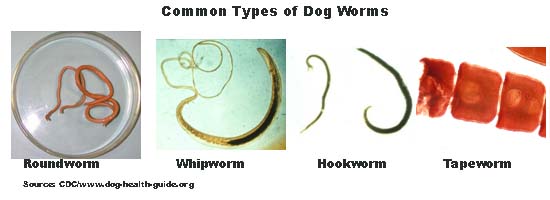
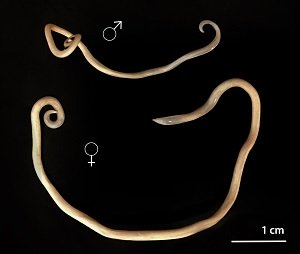
Roundworms
Can you see it? Yes, sometimes, in poop or vomit
How dogs get it: From their mother before birth or through milk; swallowing eggs from soil; eating rodents or other small animals
Main signs: Pot belly, poor growth and dull coat in puppies; often none in adults
Spreads to people? Yes (toxocariasis)
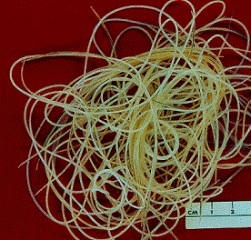
Roundworms (mainly Toxocara canis) are the most common worms in puppies. Adults are pale, round worms that can reach several inches long.[28] More than 30% of U.S. puppies under 6 months old pass roundworm eggs.[1] Larvae lie dormant in the mother's body and reactivate late in pregnancy, so puppies can be infected before they are born and through nursing. Deworming the mother does not clear the dormant larvae in her tissues, which is why she can infect one litter after another.[29] Heavily infected puppies grow poorly, have a dull coat and a pot belly, may cough or have mucus in their diarrhea, and sometimes vomit worms. Very heavy infections can kill young puppies or block the intestine.[1][7][9] Adult dogs often carry them without any signs. Read more in our guide to roundworms.
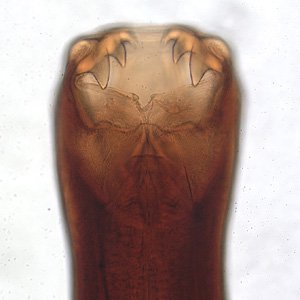
Hookworms
Can you see it? Rarely; found by stool test
How dogs get it: Larvae in soil swallowed or burrowing through skin; through mother's milk
Main signs: Anemia, pale gums, weakness, black tarry diarrhea, sore feet
Spreads to people? Yes (itchy skin tracks)
Hookworms are small (about 1 to 2 centimeters) and attach to the wall of the intestine to feed on blood.[2] That makes them the most dangerous intestinal worm for puppies: they can cause severe anemia, pale gums, weakness and dark, tarry diarrhea, and a puppy can become seriously ill before eggs even show up in a stool test.[2][7] Dogs pick them up from contaminated soil, by swallowing larvae or through the skin of their feet, and puppies get them through their mother's milk. Hookworms that resist several dewormers are now found in pet dogs across the U.S. (see What the research shows). Many of the first resistant cases were in greyhounds, and the resistant worms appear to have come from racing greyhound farms, so if you adopt a retired racer, ask your vet about a follow-up stool test after deworming.[33] Read more about treating hookworms.
Whipworms
Can you see it? Rarely; found by stool test
How dogs get it: Swallowing eggs from soil, which can stay infective for years
Main signs: Mucus and fresh blood in stool, straining, weight loss
Spreads to people? Not considered a risk
Whipworms live in the large intestine. Dogs get them by swallowing eggs from soil, where the eggs can survive for years.[3] Many infected dogs have no signs; others have recurring large-bowel diarrhea with mucus and fresh blood, straining and weight loss. Because whipworms take about three months to start producing eggs and shed them on and off, a single stool test can miss them, and treatment is usually repeated monthly for three months.[3][10] See our whipworm treatment page.
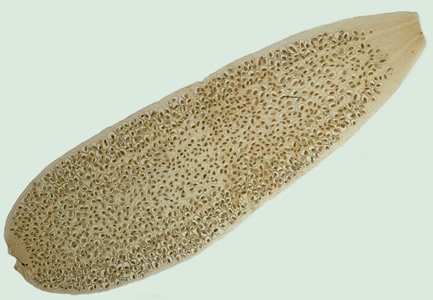
Tapeworms
Can you see it? Yes, the segments
How dogs get it: Swallowing an infected flea while grooming; eating rabbits, rodents or raw meat
Main signs: Usually none; segments under the tail, licking or scooting
Spreads to people? Rarely (swallowing a flea); some types are serious
The most common tapeworm in dogs, Dipylidium caninum, comes from swallowing infected fleas. Its segments are what owners notice: flat, white pieces about the size of a grain of rice that may wriggle in fresh poop or around the anus, then dry into hard, yellowish specks.[4][13] It rarely makes dogs sick, but it keeps coming back unless fleas are controlled. Other tapeworms (Taenia and Echinococcus) come from eating rabbits, rodents, raw meat or offal; Echinococcus can cause serious disease in people.[5][8] Routine stool tests often miss tapeworms, so tell your vet if you have seen segments. More in our guide to tapeworms.
Heartworm
Can you see it? No; found by blood test
How dogs get it: Mosquito bites
Main signs: Cough, tiring on walks, weight loss, swollen belly
Spreads to people? Not from dogs
Heartworms are spread only by mosquitoes, so even indoor dogs are at risk. Adult worms can grow to about a foot long, live for 5 to 7 years in the heart, lungs and nearby blood vessels, and damage them over time.[11] Early infections usually cause no signs; later come a mild persistent cough, tiring easily, weight loss and a swollen belly. Heartworms are never seen in poop: they are found with a yearly blood test. Treatment is long and costly, which is why year-round prevention matters. See our heartworm guide.
Not worms: Giardia and coccidia are microscopic single-celled parasites that also cause diarrhea. Ringworm is a fungal skin infection, not a worm at all.
How do dogs get worms?
- From their mother: roundworms before birth and through milk; hookworms through milk.[1][2]
- From contaminated soil, grass or sand: swallowing roundworm or whipworm eggs while sniffing, licking paws or eating dirt, or hookworm larvae burrowing through the skin.[1][2][3]
- From fleas: swallowing an infected flea while grooming (tapeworm).[4]
- From hunting or raw food: eating rodents, rabbits, birds, raw meat or offal (roundworm, tapeworm).[1][8]
- From mosquitoes: heartworm.[11]
Dog parks are a common source. In a study of 288 U.S. dog parks, 85% had at least one sample containing intestinal parasites.[16]
How vets diagnose worms
- Stool (fecal) test: a small sample is mixed with a solution that floats worm eggs so they can be seen under a microscope. Newer antigen and PCR stool tests can find infections earlier.[1][2] Tapeworms are the exception: they rarely release eggs into the stool and shed whole egg-filled segments instead, which is why a routine test often misses them.[29]
- Looking at what you bring in: your vet can usually identify roundworms and tapeworm segments on sight.
- Heartworm blood test: recommended every year for all dogs.[12]
A negative stool test does not always mean no worms: whipworms and tapeworms are easy to miss, so your vet may repeat the test or treat based on what you have seen.[3][4]
How worms are treated
Worms are treated with dewormers. Each drug covers some worms and not others, which is why knowing the type matters.[1][2][3][8]
Pyrantel
What it treats: Roundworms, hookworms
Notes: Common in puppy dewormers; does not treat tapeworms or whipworms
Fenbendazole
What it treats: Roundworms, hookworms, whipworms, some tapeworms (Taenia)
Notes: Given for 3 days in a row; is not reliable against the flea tapeworm
Praziquantel or epsiprantel
What it treats: Tapeworms
Notes: Treat fleas at the same time or tapeworms will return
Milbemycin, moxidectin, ivermectin
What it treats: Prevent heartworm; most combination products also control roundworms and hookworms, and products with milbemycin or topical moxidectin also control whipworms
Notes: Monthly preventives; prescription only
Melarsomine
What it treats: Adult heartworms
Notes: The only drug that kills adult heartworms; given by your vet as a series of injections with strict rest
What to expect after deworming: many dewormers paralyze or kill the worms so your dog passes them in the stool, so seeing dead or dying worms in the stool after treatment is normal.[14] Many treatments need a second dose: roundworms often need a repeat after two weeks, and whipworms need monthly treatment for three months.[9][10] For hookworms, ask for a recheck stool test 10 to 14 days after treatment to make sure it worked.[17] If your dog has diarrhea after deworming, see diarrhea after deworming.
Over-the-counter dewormers can treat some worms, but no single one covers them all, none prevents heartworm, and they cannot tell you which worm your dog has. Have a stool test first, and ask your vet before using any product, especially in puppies, pregnant dogs or dogs on other medicines.[15]
"Natural" dewormers are not proven. There is no good evidence that pumpkin seeds, diatomaceous earth or herbal products clear worms in dogs. Garlic, often suggested online, is toxic to dogs and can cause anemia.[18][19]
Products with evidence behind them
- Fenbendazole granules for dogs: roundworms, hookworms, whipworms and Taenia tapeworms, once your vet has identified them. Fenbendazole dewormers on Amazon.
- Praziquantel tapeworm tablets for dogs: tapeworm segments you have seen. Praziquantel tablets on Amazon.
- Monthly heartworm and intestinal worm preventive: year-round prevention. Prescription only: ask your vet.
The Amazon links above are affiliate links. If you buy through them we may earn a commission at no extra cost to you. Follow the label dose for your dog's weight.
Planning for the cost of treatment
Routine deworming is inexpensive, but heartworm treatment and care for a puppy with severe hookworm anemia can cost far more. Pet insurance can help, but only with problems that start after your policy does, so it pays to insure early.
One option to compare is Haven Pet Insurance. Haven says it reimburses up to 90% of covered vet bills, has no lifetime caps, and lets you use any licensed vet in the U.S. Read the sample policy and get at least one other quote before you decide. See our guide to pet insurance for dogs.
This is a referral link. We may be compensated if you get a quote or buy a policy through it.
Deworming and testing schedule
These are the Companion Animal Parasite Council's recommendations. Your vet may adjust them for your dog and where you live.[6][1][12]
Puppies
Deworming: At 2, 4, 6 and 8 weeks of age, then a monthly broad-spectrum preventive
Testing: Stool tests at least 4 times in the first year; heartworm test 6 months after starting a preventive, again 6 months later, then yearly
Pregnant and nursing dogs
Deworming: Stay on parasite control; treat the mother at the same time as her puppies. Your vet may recommend daily fenbendazole from about day 40 of pregnancy until 2 days after the puppies are born: in one study this cut roundworm numbers in the puppies by more than 98%. Use it only under your vet's direction.[30]
Testing: As advised by your vet; see pregnant dogs with worms
Adult dogs
Deworming: A monthly year-round preventive that covers heartworm and intestinal worms; if not on one, deworm at least 4 times a year
Testing: Stool tests at least twice a year; heartworm test every year
New or adopted dogs
Deworming: Deworm and start a preventive as your vet advises
Testing: Stool and heartworm tests at the first visit
For puppies specifically, see our guide to worms in puppies.
Can people get worms from dogs?
Some dog worms can infect people, though serious illness is uncommon:
- Roundworms: people, usually young children, can swallow eggs from soil or sand contaminated with dog poop. Most infections cause no symptoms or only vague ones; rarely, larvae damage the eyes or other organs. People can also swallow eggs on unwashed vegetables or fruit grown in soil that dogs use, so wash garden produce well.[31][32] About 5% of Americans aged 6 and older have been exposed.[20][21]
- Hookworms: larvae in contaminated soil or sand can burrow into bare skin and cause itchy, winding red tracks, usually on the feet.[22]
- Tapeworms: people, mostly children, get the flea tapeworm only by swallowing an infected flea. Echinococcus tapeworms, picked up by dogs that eat wild rodents or offal, are rare but serious.[13][5]
Petting and cuddling your dog is considered low risk. Roundworm eggs generally need two to four weeks in the environment before they can infect anyone, so the main risk comes from contaminated soil and sand. Eggs can occasionally be found on a dog's fur, though researchers say infective eggs are rare there, especially on well-cared-for dogs.[31][32] Still, wash your hands after handling your dog. The exception is Echinococcus tapeworm, whose eggs can infect people as soon as they are passed; dogs that eat wild rodents or offal need extra care.[1][5] To protect your family:[6][23]
- Pick up poop right away in public and at least daily in your yard.
- Wash hands with soap and water after handling your dog, its bowls or its poop, and supervise young children.
- Cover sandboxes, and wear shoes on soil or sand that dogs use.
- Keep your dog on year-round flea and worm prevention.
- See your doctor if you notice itchy skin tracks, segments in your own stool, or eye problems.
What the research shows
- Hookworm is rising. Across more than 39 million U.S. stool tests, hookworm rose from 2.02% of dogs in 2012 to 2.96% in 2018, a 47% increase.[24]
- Drug-resistant hookworms are widespread. In samples from 685 hookworm-positive pet dogs across the U.S., about half carried a gene change linked to resistance to a common class of dewormers.[25] Researchers have also found U.S. hookworms resistant to all three drug classes used against them.[26]
- Dog parks carry parasites. In 288 parks in 30 U.S. cities, about one in five samples contained intestinal parasites, and 85% of parks had at least one positive sample.[16]
- Roundworm exposure is common in people. About 5% of Americans aged 6 and older have antibodies to dog and cat roundworms.[21]
- Prevention is not foolproof. Heartworms resistant to standard preventives have been confirmed in Mississippi and Louisiana, one reason yearly testing is still recommended for dogs on preventives.[27][12]
Frequently Asked Questions
What do worms in dog poop look like?
Roundworms look like long, pale, round noodles several inches long. Tapeworm segments look like small, flat, white pieces the size of a grain of rice, which may move when fresh. Hookworms, whipworms and heartworms are not normally visible; they are found with stool or blood tests. See our worms in dog poop guide for pictures and a worm checker.
What are the little white worms in my dog's poop?
Small, flat, white pieces are usually tapeworm segments, which come from fleas. Longer, thin white or tan worms are usually roundworms. Tiny wriggling worms in poop that has been sitting outside are often fly larvae. Take a sample to your vet to be sure.
Can I touch or cuddle my dog if it has worms?
Yes, it is considered low risk, because most worm eggs need time in soil before they can infect anyone. Wash your hands after handling your dog or its poop, pick up poop promptly, and get your dog treated. Take extra care if your dog may have Echinococcus tapeworm from eating wild rodents or offal.
Do I need to deworm myself if my dog has worms?
Routine deworming of people is not recommended. If you develop symptoms such as itchy skin tracks, segments in your stool or eye problems, see your doctor.
Will worms go away on their own?
No. Worms usually persist or reinfect from the environment or fleas, and in puppies they can be life-threatening. They need the right dewormer.
How long after deworming will my dog pass worms?
You may see dead or dying worms in the stool for a few days after treatment. That is normal. Many treatments need a second dose, so follow your vet's schedule.
Can I treat worms without going to the vet?
Over-the-counter dewormers treat some worms, but none covers every type or prevents heartworm. A stool test tells you which drug your dog needs. Puppies and dogs with signs of illness should see a vet.
Can you see heartworms in dog poop?
No. Heartworms live in the heart and lung blood vessels, not the intestines, and are found with a blood test.
Can a dog die from worms?
Yes, though it is preventable. Hookworms can cause fatal anemia in puppies, heavy roundworm infections can kill young puppies or block the intestine, and untreated heartworm disease can be fatal.
Related guides: Worms in dog poop · Roundworms · Tapeworms · Hookworms · Whipworms · Heartworm · Worms in puppies
Sources
- Companion Animal Parasite Council. Ascarid (Toxocara, Toxascaris). Updated February 2025.
- Companion Animal Parasite Council. Hookworms. Updated November 2026.
- Companion Animal Parasite Council. Trichuris vulpis (whipworm). Updated February 2025.
- Companion Animal Parasite Council. Dipylidium caninum. Updated February 2025.
- Companion Animal Parasite Council. Echinococcus spp. Updated November 2026.
- Companion Animal Parasite Council. General Guidelines for Dogs and Cats. Updated April 2025.
- Peregrine AS. Gastrointestinal Parasites of Dogs. Merck Veterinary Manual. Updated May 2026.
- Peregrine AS. Tapeworms in Dogs and Cats. Merck Veterinary Manual. Updated August 2026.
- Cornell University College of Veterinary Medicine, Riney Canine Health Center. Roundworms.
- Cornell University College of Veterinary Medicine, Riney Canine Health Center. Whipworms in Dogs. Updated August 2024.
- American Heartworm Society. Heartworms in Dogs.
- American Heartworm Society. 2024 Canine Heartworm Guidelines update. April 2024.
- Centers for Disease Control and Prevention. About Dog or Cat Tapeworm Infection. May 2026.
- Merck Veterinary Manual. Mechanisms of Action of Anthelmintics. April 2025.
- American Veterinary Medical Association. Prescriptions and pharmacies: FAQs for pet owners.
- Stafford K, et al. Detection of gastrointestinal parasitism at recreational canine sites in the USA: the DOGPARCS study. Parasites & Vectors. 2020;13:275.
- Cima G. Drug-resistant hookworms spreading in dogs, parasitologists warn. JAVMA News. 2021.
- Merck Veterinary Manual. Garlic and Onion (Allium spp) Toxicosis in Animals. September 2024.
- Fernandez MI, Woodward BW, Stromberg BE. Effect of diatomaceous earth as an anthelmintic treatment on internal parasites and feedlot performance of beef steers. Animal Science. 1998;66(3):635-641.
- Centers for Disease Control and Prevention. About Toxocariasis. September 2024.
- Farmer A, Beltran T, Choi YS. Prevalence of Toxocara species infection in the U.S.: results from the National Health and Nutrition Examination Survey, 2011-2014. PLoS Neglected Tropical Diseases. 2017;11(7):e0005818.
- Centers for Disease Control and Prevention. About Zoonotic Hookworm. May 2026.
- Centers for Disease Control and Prevention. Healthy Pets: Dogs. June 2026.
- Drake J, Carey T. Seasonality and changing prevalence of common canine gastrointestinal nematodes in the USA. Parasites & Vectors. 2019;12:430.
- Venkatesan A, et al. Molecular evidence of widespread benzimidazole drug resistance in Ancylostoma caninum from domestic dogs throughout the USA and discovery of a novel beta-tubulin benzimidazole resistance mutation. PLoS Pathogens. 2023;19(3):e1011146.
- Jimenez Castro PD, et al. Multiple drug resistance in the canine hookworm Ancylostoma caninum: an emerging threat? Parasites & Vectors. 2019;12:576.
- Pulaski CN, et al. Establishment of macrocyclic lactone resistant Dirofilaria immitis isolates in experimentally infected laboratory dogs. Parasites & Vectors. 2014;7:494.
- University of Saskatchewan Western College of Veterinary Medicine. Toxocara canis. Learn About Parasites.
- Payne PA, Carter GR. Internal parasitic diseases of dogs and cats. In: A Concise Guide to Infectious and Parasitic Diseases of Dogs and Cats. IVIS, 2005.
- Lucio-Forster A, Bowman DD, Barr SC. Fenbendazole: a time-tested broad-spectrum antiparasitic. In: Bowman DD, ed. Companion and Exotic Animal Parasitology. IVIS, 2007.
- Holland C. The significance of Toxocara eggs on the hair of dogs and cats. EVC Voorjaarsdagen, Amsterdam, 2015. International Veterinary Information Service (IVIS).
- Holland C. Toxocara, the enigmatic parasite: the challenges remain. EVC Voorjaarsdagen, Amsterdam, 2015. IVIS.
- IVIS Veterinary News. Multiple-drug resistance in canine hookworm: an emerging problem (summary of Jimenez Castro et al., 2019). IVIS, 2020.
This article is general information, not veterinary advice. Dog Health Guide is owned and operated by Web Ventures of New York, Inc.
Ask Our Editors a Question or Share Your Story
Have A Dog Worm or Parasite Question For Our Editors? We Will Answer It For Free!
Tell us about your dog: breed, age, sex, the part of the body affected, what you are seeing, and any medical history. Our editorial team answers a selection of reader questions for free. We can't reply to every question, and an answer may take several days. Answers are general information, not veterinary advice.
If you need help right away, you can ask a veterinarian online at JustAnswer (a paid service; we may earn a commission if you use it). In an emergency, call your vet or the nearest emergency clinic.
What Other Visitors Have Asked and Suggestions from Our Editors
Click below to see contributions from other visitors to this page...
Worms In Dog Feces 
Reader Question: How do I Treat Worms In Dog Stool?
I found some very small, thread-like worms in one of my dog's poop. I am familiar with tapeworms …
Worm Exiting Dog Penis - Reader Question, Causes and Treatment Options Not rated yet
So my dog, a year-old pitbull, came in from using the restroom and when he laid down I happened to notice something pink sticking out of his penis. Upon …
Reduce Worm Risk in Beagles Not rated yet
What should we treat the ground with inside our lots to help prevent worms in our beagles?
Editor Suggestion - Treating a Dog's Environment to Protect …
Worms and Dog Hip Infection Not rated yet
Can worms cause an infection in my dogs hip? How bad are the worms if its gotten to that point? What can I do to treat them? The worm is short and white …
RoundWorms in Dogs and Kids Not rated yet
We are fostering 2 puppies (6 months and 9 months) from our local shelter who both have round worm. I have found them in their stool as they both are not …
Tapeworms in Puppy Came in Contact With Older Dog - Should We Treat Not rated yet
Our sons new puppy has worms, the little rice looking ones and played with our 8 year old dog, should we treat him for worms now?
Editor Suggestion …
How to Treat Dog Roundworms Not rated yet
Reader Question: How to Treat Dog Roundworms
We have a six week old puppy we took today and had its first shots and wormed. Tonight she has a bit …
Dog Tapeworm Home Treatment Not rated yet
After reading information on this site I am convinced my dog has tapeworm. Can I buy something at the Pet Supply place to get rid of these?
Veterinarian …
Dog Diarrhea After Being Dewormed Not rated yet
Reader Question: What is the Cause of a Watery Pinkish Dog Stool
My 9 week old Cocker Spaniel puppy has been having diarrhea for 2 days after giving …
Something Like a Maggot Near My Dog's Anus Not rated yet
Reader Question My dog has something near her anus that looks like a maggot. What could it be? Answer from Our Team The most likely answer is a …
Best Treatment for Roundworms in Shih Tzus, and Where Do They Come From? Not rated yet
Reader Question What medicine is best for roundworms? They say dogs get roundworms from eating other dogs' contaminated poop, but how does the first …
Tiny White Moving Worms in Normal-Looking Dog Poop Not rated yet
Reader Question This morning on our walk my dog's poop looked normal, but it had tiny white, moving, live worms in it. What do you recommend? Answer …
Puppy Worms Treatment Not rated yet
Reader Question: My daughter has a puppy. He is about two months old. She just noticed a worm come out of his anus. I'm worried. It's late on Friday and …
Causes For Dog Licking Rear End Not rated yet
We just received a rescue dog 4 days ago. Yesterday she started licking her butt a lot. We had her groomed as soon as we got her. I just got back from …
Dog With Worm In Anus Not rated yet
Today while at my boyfriends, I noticed a white (bright white) thing coming out of his husky's anus....it had a pointy tail it wiggled a few seconds on …
Cleaning Yard of Worms From Dogs Not rated yet
Reader Question: How to Clean Dog Worms from Backyard?
Is there something that I can use in my yard to clean any remaining worms or eggs?
Vet …
Can a Cat's Tapeworms Spread to My Dog? Not rated yet
Reader Question Can tapeworms in cats be passed to dogs in the same household? Answer from Our Team Not directly, but often indirectly. The most …
Dog Vomiting Caused By Parasites Not rated yet
Reader Question: What Types Of Parasites Cause Dog's To Vomit?
What kind of parasite would cause a 6 month old puppy to vomit after drinking or eating? …
Live White Worms on a Dog Taking Trifexis: Why? Not rated yet
Reader Question Our dogs take Trifexis, but this morning we found 3 or 4 small live white worms on their back ends. We'll take them to the vet, but …
Pregnant Dog With Worms Not rated yet
Reader Question: Do you deworm a pregnant dog before giving birth to puppies?
I have a big dog with worms that is about two weeks away from having …
Both My Dogs Are Dragging Their Butts: Is It Worms? Not rated yet
Reader Question I'm not sure whether my dogs have worms. Both of them keep dragging their bottoms across the ground and floor. Answer from Our Team …
White Worms in Dog Poop After Deworming: Is That Normal? Not rated yet
Reader Question Our vet gave our two-year-old Chow mix medicine for worms. Since then I've seen small white worms in her poop. Does that mean the medicine …

Worms Under Dog Skin Not rated yet
Is there a worm that is just under the surface of a dogs skin? My puppy has a few raised spots all over his back that look like worms.
Vet Suggestion …


