Key Takeaways
- A pink-red penis that pokes out briefly ("red rocket"), two round swellings at its base, and a small amount of whitish-yellow discharge are all normal, even in neutered dogs.
- A penis that stays out and won't go back into the sheath (paraphimosis) is an emergency. It swells and dries quickly, and within 12 to 24 hours the tissue is very likely to be damaged, so don't wait.
- A male dog straining to pee with little or no urine coming out may have a stone stuck in the urethra. That is a same-day emergency.
- Mild sheath infection (balanoposthitis) is very common. Heavy yellow-green, smelly or bloody discharge, swelling or pain needs a vet visit.
- Lumps, bleeding and blood in the urine have many causes, including prostate enlargement in unneutered dogs, stones and tumors. Most are treatable when found early.
What's normal: a quick guide to the dog penis and sheath
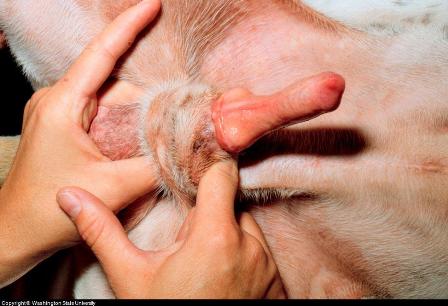
A dog's penis normally sits inside a furry sheath on the belly called the prepuce. The penis has a bone inside it (the os penis), with the urethra, the tube that carries urine, running along a groove in that bone. At the base of the penis is the bulbus glandis, a ring of erectile tissue that swells during arousal.[12][14][16]
"Red rocket": a penis that pokes out
A pink or red penis that slides out of the sheath when a dog is excited, relaxed, rolling over or being petted is normal. It should go back in on its own. Even neutered dogs sometimes get erections.[15] The penis is normally light pink and moist.
Two "lumps" at the base: the bulbus glandis
Owners often notice two round swellings on either side of the base of the penis, through the sheath, and worry they are extra testicles or tumors. This is the bulbus glandis, which can swell to 2 to 3 times the width of the shaft.[14] It swells with excitement, sometimes when a dog wakes up or is handled, and shrinks again as the arousal passes. Neutered dogs have one too: it is part of the penis, not the testicles.[16] See a vet if a swelling stays, is hard and painful, or the penis doesn't go back in.
A little discharge (smegma)
A small amount of whitish to yellowish discharge at the tip of the sheath is common in adult male dogs and is "of little clinical importance."[3] Neutering reduces it but doesn't stop it.[5] It is different from yellow-green pus or blood, which are signs of a problem.[5][17]
Some licking
Dogs lick the sheath to keep it clean. Licking that becomes frequent or constant, or comes with discharge, blood, odor, swelling or a penis that stays out, is a reason to see a vet.[3][5][15]
After neutering: only the testicles are removed. The penis, sheath and bulbus glandis stay the same, so erections, bulbus swelling and a little discharge can still happen. Swelling, bruising and soreness of the scrotum are common for the first several days after surgery.[28]
When to see a vet
Go to a vet or emergency clinic now if:
- The penis has been out of the sheath and won't go back in, especially if it looks swollen, dry, cracked, dark red, purple or black, or feels cold.[1][13][15]
- Your dog strains to pee with only drips or no urine, cries while trying, or is vomiting and lethargic. A blocked urethra can be fatal within days.[9][10][12]
- There is a painful erection that won't go down, or one that lasts more than a few hours.[2][18]
- There is heavy bleeding, an injury, or a testicle that is suddenly swollen and very painful.[11]
See a vet within a day or two if:
Penis stuck out of the sheath (paraphimosis)
Paraphimosis means the penis can't go all the way back into the sheath.[1] It usually happens after an erection, mating or semen collection, when the skin at the opening of the sheath rolls inward and traps the penis.[1][5] Other causes include a ring of hair wrapped around the penis, a sheath opening that is too small or too short, weak sheath muscles, injury, priapism, and nerve problems. In many long-running cases no cause is found.[1][13][15][21]
Why it's an emergency. The trapped penis can't drain blood, so it quickly swells, dries out and becomes painful, and the dog may lick and damage it.[1][5] If it continues, blood flow is cut off and the tissue can die. A board-certified veterinary reproduction specialist notes that the tissue is very likely to be damaged after 12 to 24 hours.[13] Severe swelling can also block the urethra.[15] Left untreated, it gets worse with time and can lead to blood clots inside the penis.[35]
What you can do on the way to the vet
- Call your vet or an emergency clinic. If the penis has turned dark, dry, cracked or cold, or your dog can't pee, go now.[15]
- Keep it moist and clean. Rinse gently with clean, lukewarm water and apply plenty of a water-based lubricant, such as K-Y jelly.[1]
- Reduce swelling. A cool, damp compress, not ice directly on the tissue, can help. Veterinary sources also describe sprinkling ordinary table sugar on the swollen penis: it draws fluid out of the tissue and can shrink it enough to slide back in.[1][13][15]
- Check for hair. In long-haired dogs, look for a band of matted hair around the penis. Don't cut near the tissue yourself; let your vet remove it.[15]
- Try once, gently. With the penis well lubricated, gently slide the sheath back over it. If it doesn't go back easily, stop and get to the vet.[1]
- Stop licking. Use a cone (Elizabethan collar) if you have one.
What the vet does
Most cases caught early are fixed by cleaning, lubricating and replacing the penis, sometimes under sedation, and the swelling goes down once circulation returns.[1][5] A temporary stitch can keep the penis inside the sheath while it heals.[1] Dogs whose penis keeps coming out may need surgery to lengthen the sheath or anchor the penis. In a 2026 study of 16 dogs treated with both procedures, 14 improved.[20] If tissue has died, part of the penis may need to be removed.[13][15] Neutering hasn't been shown to fix long-running paraphimosis with no known cause.[21]
Prevention: in long-haired dogs, keep the hair at the sheath opening trimmed, and check that the penis has gone back in after mating or excitement.[15]
An erection that won't go away (priapism)
Priapism is a persistent erection without sexual stimulation, usually defined as lasting more than 4 hours.[2][19] It is rare in dogs: a 2022 case report found only 14 earlier reports in the veterinary literature.[18] It can be linked to spinal cord disease, some drugs, blood vessel problems, tumors or injury, and sometimes no cause is found.[2] If blood flow is blocked, it is an emergency: a rigid, dark or cold penis needs care right away.[5][18] Some dogs respond to medication; dogs whose tissue has been damaged may need surgery.[2] Neutering does not help, because priapism isn't driven by testosterone.[2]
Priapism and paraphimosis can look alike, because a trapped penis swells and can look erect.[18] Your vet can tell them apart.
Penis can't come out (phimosis and persistent frenulum)
Phimosis means the opening of the sheath is too small for the penis to come out. Some dogs are born with it; others develop it after injury, infection, inflammation or a tumor. It often goes unnoticed until a dog tries to mate.[4] Many pet dogs need no treatment, but surgery to widen the opening is advised for breeding dogs, dogs with repeated sheath infections, or dogs that have trouble peeing. Urine can pool inside the sheath and cause infection.[4][5] A dog that dribbles urine or strains needs to be seen.
A persistent penile frenulum is a band of tissue joining the penis to the sheath that normally separates within a few months of birth. When it persists, it can stop the penis from coming out fully, and it can be released surgically.[30] Signs include pain during erection, trouble mating, inflammation of the penis and sheath, and difficulty peeing, though dogs not used for breeding may show none. Cutting the band is curative and the outlook is excellent.[35]
Discharge and infection (balanoposthitis)
Inflammation of the penis and sheath, called balanoposthitis, is very common in adult male dogs. Mild cases are present in many sexually mature dogs and clear up on their own.[5] The usual sign is yellow-green discharge at the tip of the sheath, often with licking.[5] Causes include bacterial overgrowth, grass seeds or other foreign bodies in the sheath, injury, urinary infection, stones and, less often, tumors.[3]
Treatment usually means clipping the hair, flushing the sheath with a mild antiseptic your vet recommends, and treating the cause. Antibiotic pills are only needed in more severe cases.[3][17] Healthy sheaths normally carry bacteria, including Mycoplasma, so a positive swab alone doesn't prove infection.[3][26] Don't put vinegar, peroxide or human creams into the sheath unless your vet advises it. For pictures and home care, see our guide to dog penis infections.
Trouble peeing: urethral stones and blockage
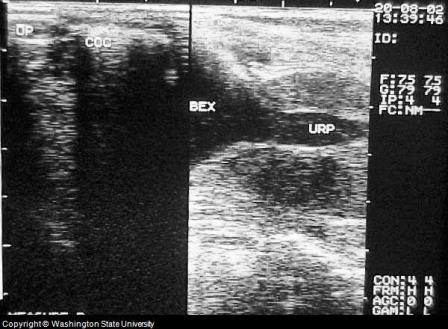
In male dogs, bladder stones often pass into the urethra and get stuck just behind the bone in the penis.[12] Signs are straining with little or no urine, many attempts to pee, dribbling, blood in the urine, and crying while urinating.[10][12] A complete blockage is an emergency: waste builds up in the blood within 36 to 48 hours, and without treatment a dog can die in about 3 days. The bladder can also rupture.[9][12]
Vets usually flush the stones back into the bladder and then remove or dissolve them. In a study of 83 male dogs with urethral stones, this worked in 77 (92.7%).[27] Dogs that can't be unblocked or keep forming stones may need surgery to create a new urine opening.[12] The outlook is excellent if the kidneys haven't been damaged by a long blockage.[12]
Bleeding from the penis
Common causes of blood dripping from the penis or in the urine include an enlarged or infected prostate in unneutered dogs, a urinary infection, stones, injury and tumors.[5][6][7] In unneutered males, signs may appear or get worse around females in heat.[6] See our full guide to dog bleeding from the penis.
Lumps, sores and tumors
Transmissible venereal tumor (TVT)
A tumor passed between dogs during mating. It forms cauliflower-like masses on the penis or sheath that often bleed easily.[8] It has nearly disappeared in regions with strict control of dog populations but is still common in many lower-income countries.[33] It responds very well to the chemotherapy drug vincristine: a 2025 review of 42 studies found complete remission in 93.1% of dogs after 4 to 6 weekly treatments.[22]
Other tumors
Squamous cell carcinoma and mast cell tumors can affect the penis or sheath, usually in middle-aged and older dogs, and are usually treated with surgery.[31][32] Lymphoma of the sheath can also occur, and persistent licking can be the first sign.[3] Any new lump, ulcer or sore that doesn't heal within a week or two should be checked.
Sores and blisters
A bumpy, "cobblestone" lining inside the sheath can be a sign of long-running inflammation.[17] Bumps, ulcers, scabs, dark spots or blisters can come from infection, injury, licking or skin disease and need a vet's look.
Injuries, hair rings and foreign bodies
- Broken penis bone: the os penis can fracture from trauma. It is very painful and can block urine flow, so see a vet right away.[3][12]
- Hair rings: matted hair can wrap around the penis or pack the sheath opening, causing soreness and paraphimosis. Soften mats with warm water and have your vet remove them if the skin is raw.[13][15]
- Grass seeds and other foreign bodies can get into the sheath, causing discharge, licking and swelling.[3]
Birth defects
Undescended testicles (cryptorchidism)
One or both testicles fail to drop into the scrotum by about 6 months of age.[11] It affects up to about 10% of dogs and is around 2.7 times more common in small breeds.[24] Retained testicles are about 9 times more likely to develop tumors and can twist painfully.[11][25] Vets recommend removing both testicles and not breeding affected dogs.[11]
Hypospadias
The urethra opens on the underside of the penis instead of the tip, often with an incompletely closed sheath, so urine soils the belly and legs. Mild cases need no treatment; severe cases need surgery.[17] In a North American study of 66 affected dogs, 15 were Boston Terriers, and German Shepherds may also be prone.[34][29]
Prostate problems in unneutered dogs
Benign enlargement of the prostate (benign prostatic hyperplasia, or BPH) is caused by hormones, not infection, and is found in almost all unneutered dogs over 6. In one study, half of beagles had it by age 4 to 5.[5][23] Many dogs have no signs; others have bloody discharge from the penis, blood in the urine or straining.[6] After neutering, the prostate visibly shrinks within a few weeks and finishes shrinking over several months.[6] Prostate infection (prostatitis) is less common, is usually bacterial and needs at least 4 weeks of antibiotics.[7] Neutering does not protect against prostate cancer.[5]
Not sure if it's normal?
If you can't reach your vet, you can ask a licensed veterinarian online now through JustAnswer (a paid service; we may earn a commission). A penis stuck out of the sheath or a dog straining to pee needs in-person care, so don't wait for an online answer.
Planning for emergency and surgical costs
Emergencies such as paraphimosis or a urinary blockage, and surgery for stones or tumors, can be expensive. Pet insurance generally doesn't cover problems that started before your policy, so it pays to insure early.
One option to compare is Haven Pet Insurance. Haven says it reimburses up to 90% of covered vet bills, has no lifetime caps, and lets you use any licensed vet in the U.S. Read the sample policy and get at least one other quote before you decide. See our guide to pet insurance for dogs.
This is a referral link. We may be compensated if you get a quote or buy a policy through it.
What the research shows
- Paraphimosis is time-critical. A veterinary reproduction specialist warns that loss of blood flow is very likely to damage the penis after 12 to 24 hours.[13]
- Surgery helps dogs whose penis keeps coming out. Combining two procedures to lengthen the sheath and anchor the penis improved 14 of 16 dogs in a 2026 study.[20]
- Urethral stones can usually be flushed back. All urethral stones were moved back into the bladder in 77 of 83 male dogs (92.7%).[27]
- TVT responds well to chemotherapy. Weekly vincristine for 4 to 6 sessions led to complete remission in 93.1% of dogs across 42 studies.[22]
- Prostate enlargement starts young. 16% of beagles had BPH by age 2 and 50% by age 4 to 5.[23]
- Retained testicles raise cancer risk. In a study of 2,912 cryptorchid dogs, the risk of testicular tumors was about 9 times higher.[25]
Frequently Asked Questions
What should a normal dog penis look like?
Light pink and moist, sitting inside the furry sheath and only coming out briefly with excitement. A small amount of whitish-yellow discharge at the sheath opening is normal. Dark, dry, swollen or bleeding tissue is not.
Why is my dog's penis sticking out?
Brief exposure with excitement or relaxation is normal and should go back in on its own. If it stays out, looks swollen or dry, or won't go back in, it may be paraphimosis, which needs prompt veterinary care.
How do I get my dog's penis back in?
Rinse it gently, apply plenty of water-based lubricant and a cool, damp compress, then gently slide the sheath forward over it. If it doesn't go back easily, or the tissue looks dark or dry, go to a vet right away.
Can sugar be used to treat paraphimosis in dogs?
Veterinary sources describe sprinkling table sugar on the swollen penis to draw out fluid and shrink it so it can slide back in. Use it only as first aid on the way to the vet, together with lubrication.
What are the two lumps at the base of my dog's penis?
That is the bulbus glandis, normal erectile tissue that swells with excitement, sometimes after waking or when handled, and goes down again. Neutered dogs have it too. See a vet if a lump stays swollen, is hard and painful, or the penis stays out.
Do neutered dogs still get erections?
Yes. Neutering removes the testicles but not the penis or the bulbus glandis, so neutered dogs can still have erections and swelling at the base of the penis.
Is discharge from my dog's penis normal?
A small amount of whitish to yellowish discharge (smegma) is normal, even in neutered dogs. Heavy, yellow-green, smelly or bloody discharge, or constant licking, needs a vet visit.
Why does my dog keep licking his penis?
Some licking keeps the area clean. Frequent or constant licking, especially with discharge, blood, odor, swelling or a penis that stays out, can signal infection, a foreign body, a stone or a tumor.
Why is my male dog straining to pee?
It may be a urethral stone, prostate disease or a urinary infection. If little or no urine comes out, treat it as an emergency: a complete blockage can be fatal within days.
Related guides: Dog penis infection · Bleeding from the penis · Dog knot stuck after mating · Spaying and neutering
Sources
- Davidson AP. Paraphimosis in Dogs and Cats. Merck Veterinary Manual. 2025.
- Davidson AP. Priapism in Dogs and Cats. Merck Veterinary Manual. 2025.
- Davidson AP. Balanoposthitis in Dogs and Cats. Merck Veterinary Manual. 2025.
- Davidson AP. Phimosis in Dogs and Cats. Merck Veterinary Manual. 2025.
- Davidson AP. Reproductive Disorders of Male Dogs. Merck Veterinary Manual, owner version. Updated 2024.
- Kutzler M. Benign Prostatic Hyperplasia in Dogs. Merck Veterinary Manual. 2025.
- Kutzler M. Prostatitis in Dogs. Merck Veterinary Manual. 2025.
- Kutzler M. Transmissible Venereal Tumor in Dogs. Merck Veterinary Manual, owner version. Updated 2024.
- Van Vertloo L. Urethral Obstruction in Small Animals. Merck Veterinary Manual. 2025.
- Roman N. Urinary Emergencies in Dogs. Merck Veterinary Manual, owner version. 2026.
- Cornell University College of Veterinary Medicine, Riney Canine Health Center. Cryptorchidism in dogs (retained testicle). 2026.
- American College of Veterinary Surgeons. Urinary Obstruction in Dogs.
- Runcan EE. Podcast: Prolapsed penis in a French Bulldog with Dr. Runcan. Clinician's Brief. February 2026.
- Louisiana State University School of Veterinary Medicine, Theriogenology. Male reproductive physiology (lecture notes).
- Oursler TA. Paraphimosis and phimosis in dogs and cats. Veterinary Partner (VIN). 2022.
- Goericke-Pesch S, Hölscher C, Failing K, Wehrend A. Functional anatomy and ultrasound examination of the canine penis. Theriogenology. 2013;80:24-33.
- Turkmen A, Lonc G, Yurdakok-Dikmen B, et al. Comprehensive insight into the male dog reproductive system in health and diseases: developmental, genetic, and environmental factors. Veterinary Sciences. 2026;13(5):464.
- Roux FA, Le Breuil F, Branchereau J, Deschamps JY. Stuttering priapism in a dog: first report. Veterinary Sciences. 2022.
- Lavely JA. Priapism in dogs. Topics in Companion Animal Medicine. 2009;24(2):49-54.
- Badham H, Cathrall G, Cockburn E, Das S. Combined phallopexy and preputial advancement for the treatment of paraphimosis of unknown aetiology in 16 dogs. Journal of Small Animal Practice. 2026.
- Thyriakis IP, Ververidis C, Pavlidis L, et al. Modified preputial elevation and cranial translation of the prepuce for the treatment of chronic idiopathic paraphimosis in dogs: six cases (2021-2024). Journal of Small Animal Practice. 2026.
- Pimentel PAB, Giuliano A, Odatzoglou P, et al. Clinical guidelines for canine transmissible venereal tumour treatment: systematic review and meta-analysis. Veterinary and Comparative Oncology. 2025.
- Berry SJ, Strandberg JD, Saunders WJ, Coffey DS. Development of canine benign prostatic hyperplasia with age. The Prostate. 1986.
- Blades M, Freyer J, Donner J, et al. Large scale across-breed genome-wide association study reveals a variant in HMGA2 associated with inguinal cryptorchidism risk in dogs. PLoS One. 2022.
- Hayes HM, Wilson GP, Pendergrass TW, Cox VS. Canine cryptorchism and subsequent testicular neoplasia: case-control study with epidemiologic update. Teratology. 1985.
- Doig PA, Ruhnke HL, Bosu WT. The genital Mycoplasma and Ureaplasma flora of healthy and diseased dogs. Canadian Journal of Comparative Medicine. 1981.
- Thiel C, Häußler TC, Kramer M, Tacke S. Urethrolithiasis in the dog: a retrospective evaluation of 83 male dogs. Tierärztliche Praxis Ausgabe K. 2019.
- Hamilton KH, Henderson ER, Toscano M, Chanoit GP. Comparison of postoperative complications in healthy dogs undergoing open and closed orchidectomy. Journal of Small Animal Practice. 2014.
- Switonski M, Dzimira S, Aleksiewicz R, et al. Hypospadias is not rare in dogs: five new cases, a retrospective study, and a review of the literature. Sexual Development. 2018.
- Elsevier veterinary textbook excerpts. Prepuce: an overview. ScienceDirect Topics.
- Natsios P, Chatzimisios K, Tsioli V, et al. Surgical management of squamous cell carcinoma of the canine male external genitalia: 15 cases (1994-2020). Topics in Companion Animal Medicine. 2024.
- Ritson K, Bird F, Stefanidis G, Brissot H. The indications, complications and outcomes of dogs undergoing partial penile amputation: 10 cases (2014-2021). Journal of Small Animal Practice. 2023;64:103-110.
- Pimentel PAB, Maia LDMS, Oliveira IMS, et al. Canine transmissible venereal tumor: anatomical locations, chemotherapy response, and epidemiological aspects in Brazil (2012-2022). Animals. 2025;15:1675.
- Hayes HM, Wilson GP. Hospital incidence of hypospadias in dogs in North America. Veterinary Record. 1986;118:605-607.
- Kutzler MA. Pathophysiology of the Penis. In: Bojrab MJ, Monnet E, eds. Mechanisms of Disease in Small Animal Surgery, 3rd ed., via IVIS, 2014.
This article is general information, not veterinary advice. Dog Health Guide is owned and operated by Web Ventures of New York, Inc.
Ask Our Editors a Question About Your Dog's Penis or Sheath
Have a Canine Penis related Question For the Dog Health Guide Team?
Tell us about your dog: breed, age, sex, the part of the body affected, what you are seeing, and any medical history. Our editorial team answers a selection of reader questions for free. We can't reply to every question, and an answer may take several days. Answers are general information, not veterinary advice.
If you need help right away, you can ask a veterinarian online at JustAnswer (a paid service; we may earn a commission if you use it). In an emergency, call your vet or the nearest emergency clinic.
Other Dog Penis Related Reader Questions and Answers
Click below to see contributions from other visitors to this page...
Bleeding dogs penis 
My two year old unneutered Great Pyrenees started bleeding from his penis yesterday. He was losing large amounts of blood. I took him to our local vet …
Dog Penis Bleeding Causes and Treatment
Reader Question: Why Is My Canine's Penis Bleeding?
Please look at these pictures A vet here in East London has not explanation for my dogs behaviour. …
Dog Penis Infection Q&A
Reader Question: Which Canine Penis Problem Is My Dog Suffering From?
I have a Hungarian Viszla dog (not neutered) who is a normally very healthy, …
Dog Penis Discharge
Ever since my Dog, a Great Dane, Male, 4 year old, Coda, was neutered he has occasionally had a yellow brown discharge drip from the tip of his penis. …
Reader Question: Puppy with Exposed Penis After Rear Leg Amputation – What Can Help? Not rated yet
Reader's Question: Our small dog (5 lbs, 6 1/2 months) was injured and subsequently had an amputation of his right rear leg. His penis was x-rayed and …
What are the two lumps between my dog's penis and testicles? Not rated yet
My Staffordshire Terrier is 1 year 1 month old. Very smart energetic and loves to eat whatever we're eating. So much so he'll walk away from his food until …
Dog Penis Foreskin Swelling With Blisters at the Tip Not rated yet
Penis foreskin swelling, red, and looks to have blisters on the tip only? He is a 9 month old Pit bull that has been exposed to the plant poison ivy. Could …
Does my Dog have a Urinary Tract Infection? Not rated yet
My dog is not even one year old and I noticed the tip of his penis has turned red and there is a green thick substance coming out of it.
His energy …
Hard Swollen Lumps on Side of Dogs Penis Not rated yet
I have staff shire terrier about 1 1/2 years old. I've noticed he has red swollen lumps on both sides of his penis. Where is balls would be. But he's been …
Causes of Dog Penis Irritation Not rated yet
Reader Question: Causes of Dog Penis Irritation or Dryness
Hi Jennifer,
I have a year old french poodle. He was already neutered when we got him. …
Bored Dog Licking Penis or Health Issue Not rated yet
Reader Question: Dog Cleaning Penis and Anus
Hank is a German short-haired pointed, neutered and approximately 5+ year old (rescued). Within the …
Can a Bee Sting in or Around a Dog's Penis Cause Problems Not rated yet
Our dog was attacked by ground bees and stung. There were so many bees on him that we don't know where or how many times he was stung. Since this incident, …
Why Puppy Rubs Penis On Floor: Reader Question and Vet Response Not rated yet
My 5-month-old puppy has been rubbing his penis on the grass and carpet a lot. Just yesterday I noticed there's redness around his stomach (close to the …
Red penis head, Slightly Protruding Not rated yet
On arriving home from work I noticed that my dog's penis is slightly protruding and red on the tip - what should i do?
Editor Suggestion Red Protruding …


