Key Takeaways
- Skin problems are among the most common reasons dogs see a vet. In a study of more than 22,000 dogs, skin disorders were the second most common group of diagnoses, and skin allergies have topped Nationwide's dog insurance claims for 15 straight years.[1][2]
- Itch usually means allergy or parasites. Flea allergy, environmental allergies (atopic dermatitis), food allergy, and mites (mange) explain most itchy dogs.
- Infections are usually a symptom, not the cause. Bacterial and yeast infections typically set in on top of allergy or another skin problem, so they come back unless the underlying cause is treated.
- Get any new lump checked. A lump the size of a pea that is still there after a month should be sampled with a needle. Mast cell tumors, the most common canine skin cancer, can look like a harmless bump.[12][13]
- Diagnosis takes a few simple tests. Skin scrapings, tape or swab cytology, a fungal culture, a needle sample of lumps, and an 8-week diet trial for suspected food allergy answer most cases.
When to see a vet right away
Most skin problems can wait for a regular appointment. These cannot:
- Facial swelling or sudden hives with vomiting, weakness, pale gums, or trouble breathing (possible anaphylaxis, an emergency).
- A wound or swelling that is hot, oozing, or spreading fast, or any skin problem with fever, lethargy, or loss of appetite.
- Large raw, red, weeping patches that appear within hours (hot spots can spread quickly and are very painful).
- A lump that grows quickly, changes size from day to day, bleeds, or ulcerates.
- Any skin problem in a young puppy, especially sores and swelling on the face and muzzle (juvenile cellulitis, or "puppy strangles").
Dog Skin Problem Checker
Answer a few questions to see what's most likely going on, how soon to see a vet, and what to read next. This is not a diagnosis.
Match your dog's symptom to the likely cause
Vets narrow down skin problems by what the skin looks like, where on the body it is, whether it itches, and the dog's age and breed. Use this table to see what is most likely, then follow the link for the full guide on that condition.
| What you see | Most likely causes | Next step |
|---|---|---|
| Itching and scratching, little to see on the skin | Fleas or flea allergy, environmental allergy, early scabies | Comb for fleas and flea dirt; start vet-recommended flea control for every pet in the home |
| Itchy rear half: lower back, base of tail, back of thighs | Flea allergy dermatitis[3] | Year-round flea control for all pets; vet for itch relief and any infection |
| Licking paws, rubbing face, scratching armpits and belly, often seasonal | Atopic dermatitis (environmental allergy) or food allergy | Vet visit; ask about itch medication and an 8-week diet trial |
| Red bumps, pimples, and circular crusts with peeling edges | Bacterial skin infection (pyoderma), often on top of an allergy | Vet exam and cytology; medicated shampoo is often enough for mild cases |
| Greasy, smelly skin, darkened or thickened skin, itchy ears | Yeast (Malassezia) infection, usually with allergy underneath | Vet cytology; antifungal shampoo or medication; treat the allergy |
| Patchy hair loss around the eyes, mouth, or front legs, especially in puppies | Demodectic mange | Deep skin scrapings at the vet |
| Intense itch on ear edges, elbows, hocks, and belly; people in the house itch too | Sarcoptic mange (scabies)[10] | Vet visit; treat all dogs in the home; it can spread to people |
| Round patches of hair loss with scaling, often on the face, ears, or legs | Ringworm (a fungus), demodex, or bacterial infection | Vet tests (Wood's lamp, culture, PCR); ringworm spreads to people |
| Sudden raw, wet, painful patch | Hot spot (acute moist dermatitis), usually set off by itch | Vet visit for clipping, cleaning, and pain and itch relief |
| Raised welts or puffy face appearing within minutes to hours | Hives from an allergic reaction (insect sting, vaccine, drug) | Same-day vet call; emergency if breathing is affected |
| A lump on or under the skin | Fatty tumor (lipoma), cyst, wart, or a tumor such as a mast cell tumor | Needle sample if it is pea-sized and still there after a month[13] |
| Even hair loss on both sides of the body, no itch, thin skin, pot belly, drinking more | Hormonal disease: hypothyroidism or Cushing's disease | Vet blood work |
| Crusts on the nose, ear tips, or footpads | Autoimmune skin disease such as pemphigus foliaceus, or sun damage | Vet biopsy |
| Gray, thick, hairless patch on an elbow or hock | Pressure callus from lying on hard floors | Padded bedding; vet if it cracks or oozes |
| Flaky skin or dandruff | Dry skin, seborrhea, Cheyletiella mites ("walking dandruff"), or a sign of allergy or hormonal disease | See dry skin causes; vet if it persists or itches |
Pictures of common dog skin conditions
These photos show what common conditions look like. Many skin problems look alike, and a dog can have more than one at a time, so a picture can point you in the right direction but cannot replace an exam.

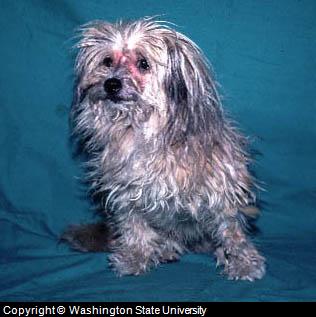

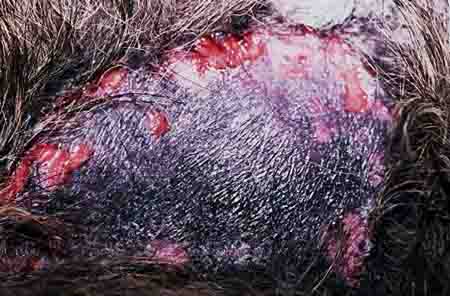
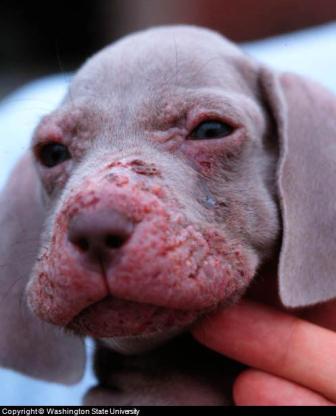


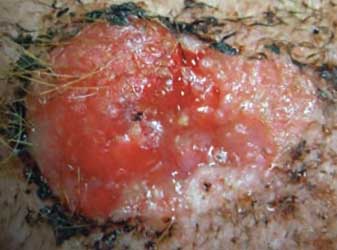


Allergies: the most common cause of itchy skin
Allergies are the leading reason dogs itch. There are three main types, and many dogs have more than one.
Flea allergy dermatitis
Some dogs are allergic to flea saliva, so a few bites can set off weeks of itch. The Merck Veterinary Manual calls flea allergy the most common skin disease of dogs in the southern United States. The itch and hair loss center on the lower back, tail base, and back of the thighs.[3] You may never see a flea, because allergic dogs chew them off. Vets often confirm the diagnosis simply by seeing the itch improve on strict flea control. That means treating every dog and cat in the home, every month, all year, and cleaning the environment.[3] See our guide to flea medicine.
Atopic dermatitis (environmental allergies)
Atopic dermatitis is an inherited allergy to things in the environment such as dust mites, pollen, and mold. Signs usually start between 6 months and 3 years of age. Dogs lick their paws, rub their faces, and scratch their ears, armpits, belly, and groin, and many get repeated ear and skin infections. Breeds prone to it include West Highland White Terriers, Labrador and Golden Retrievers, German Shepherds, French and English Bulldogs, Boxers, Shih Tzus, and Shar-Peis. There is no cure, but it can usually be controlled well with a combination of treatments (see Treatment).[4] Read more about seasonal allergies and atopy and skin allergy remedies.
Food allergy
Food allergy causes year-round itch, often on the face, feet, ears, and rear end, and sometimes soft stools or more frequent bowel movements. In a review of 297 food-allergic dogs, the most common culprits were beef (34%), dairy (17%), chicken (15%), and wheat (13%). Soy, lamb, corn, and egg were each 6% or less.[5] Blood and saliva allergy tests are not reliable for food allergy. The only accurate test is an elimination diet: a prescription hydrolyzed diet or a single novel protein, with no treats or flavored medications, for 8 weeks. More than 85% of food-allergic dogs improve within 5 weeks and more than 95% within 8.[6] If the itch returns when the old food is reintroduced, the diagnosis is confirmed. See food allergies and intolerance.
Parasites: fleas, mites, and lice
Demodectic mange
Demodex mites live in small numbers on all dogs. Mange develops when the immune system can't keep them in check, most often in puppies, or in adult dogs with an underlying illness or on immune-suppressing drugs. It causes patchy hair loss, often around the eyes, mouth, and front legs, and may itch only when a bacterial infection sets in. Small patches in puppies often clear on their own. Widespread cases need treatment. Modern isoxazoline flea and tick drugs work well, and vets recheck monthly until two skin scrapings in a row are negative.[9] Demodex is not contagious to people. See demodectic mange and signs of mange.
Sarcoptic mange (scabies)
Sarcoptic mites cause intense itch that starts on the ear edges, elbows, hocks, and belly. Rubbing the ear edge often makes the dog kick a hind leg (the "pinnal-pedal reflex"). The mites are hard to find, and skin scrapings miss about half of cases, so vets often treat based on the signs.[10] Scabies spreads easily between dogs and can cause itchy red bumps in people that go away once the dog is treated. All dogs in the home need treatment. Some older treatments such as ivermectin can be dangerous for Collies, Shelties, Australian Shepherds, and related breeds with the MDR1 (ABCB1) gene mutation.[10] See dog scabies.
Other parasites
Cheyletiella mites cause "walking dandruff" along the back. Lice cause itch and a dull coat. Ticks cause local bumps and can carry diseases such as Lyme disease.
Bacterial, yeast, and fungal skin infections
Bacterial skin infection (pyoderma)
Most dog skin infections are caused by Staphylococcus pseudintermedius, a bacterium that normally lives on dog skin and takes over when the skin barrier is damaged.[7] Allergy is the most common trigger, and others include parasites and hormonal disease. Signs include red bumps, pustules, crusts, and round scaly rings with a peeling edge (epidermal collarettes).
Veterinary guidelines now favor medicated shampoos, sprays, and wipes (such as chlorhexidine) as the first treatment for surface infections, because they work well and reduce the use of antibiotics. When antibiotic pills are needed, they are usually given for at least 3 weeks and continued for a week after the skin looks normal.[7][8] Antibiotic-resistant staph (MRSP) is becoming more common, so dogs that don't improve, or keep getting infections, should have a bacterial culture.[7][8] See pyoderma, skin infection, and skin pimples.
Yeast infection (Malassezia dermatitis)
Malassezia yeast also lives on normal skin and overgrows when allergies or other problems disturb it. Infected skin is red, greasy, itchy, and has a musty smell. Over time it can turn dark and thick. Yeast commonly affects the ears, paws, lips, armpits, and neck. Vets confirm it by looking at a tape or swab sample under a microscope. See dog yeast infection.
Ringworm (dermatophytosis)
Ringworm is a fungus, not a worm. It usually causes round patches of hair loss with scaling and crusting, often on the face, ears, and paws, and it is usually not very itchy. The species Microsporum canis glows apple-green under a Wood's lamp in most untreated cases, and vets confirm it with a fungal culture or PCR test.[11] Treatment combines oral antifungal medication with medicated rinses or shampoo and thorough cleaning of the home. It can spread to people, so wash your hands after handling an infected dog.[11] See ringworm in dogs and fungal skin infections.
Lumps, bumps, and skin tumors
Most lumps in dogs are harmless, such as fatty lipomas, cysts, warts, or skin tags. But you can't tell a benign lump from a cancerous one by looking at or feeling it. Mast cell tumors are the most common skin tumor in dogs, making up 7% to 21% of them. They can look like anything from a soft fatty lump to a red, itchy bump that swells and shrinks.[12] Boxers, Boston Terriers, Pugs, Golden and Labrador Retrievers, and Bulldogs are at higher risk.[12]
Veterinary oncologists recommend a simple rule called "See Something, Do Something": any lump the size of a pea (about 1 cm) or larger that has been there for a month should be sampled with a fine needle.[13] The test is quick, usually needs no sedation, and often gives an answer in the same visit. See dog lumps on skin, skin cysts, skin warts, and skin cancer symptoms.
Hormonal, autoimmune, and other causes
- Hormonal (endocrine) disease: Hypothyroidism and Cushing's disease cause even, non-itchy hair loss on both sides of the body, thin or darkened skin, and repeated skin infections. Cushing's also causes increased thirst, appetite, and a pot belly. Both are diagnosed with blood tests.
- Autoimmune disease: Pemphigus foliaceus, the most common autoimmune skin disease in dogs, causes pustules and crusts on the bridge of the nose, around the eyes, on the ear flaps, and on the footpads. It is diagnosed by biopsy and treated with immune-suppressing medication.
- Sun damage: Dogs with white or thin coats who sunbathe can get red, thickened skin on the belly and nose that can turn into squamous cell carcinoma.
- Calluses and pressure sores: Large dogs that lie on hard floors develop thick gray calluses on the elbows and hocks.
- Hot spots: Hot spots are painful, wet patches that dogs create by licking and chewing, usually because of an allergy or flea bites.
How vets diagnose skin problems
A vet starts with a history (age at onset, season, diet, flea control, other pets, and itch level) and a full exam. Then a few inexpensive tests answer most questions:
| Test | What it looks for |
|---|---|
| Flea comb | Fleas and flea dirt |
| Skin scrapings and hair plucks | Demodex and sarcoptic mites[9][10] |
| Tape or swab cytology | Bacteria and yeast under the microscope |
| Bacterial culture | Which antibiotic will work, including for resistant staph (MRSP)[7] |
| Wood's lamp, fungal culture, PCR | Ringworm[11] |
| Fine needle aspirate | What a lump is made of[12][13] |
| Elimination diet trial (8 weeks) | Food allergy[6] |
| Blood work and hormone tests | Hypothyroidism and Cushing's disease |
| Skin biopsy | Autoimmune disease, unusual tumors, and cases that don't respond to treatment |
| Allergy testing (skin or blood) | Which environmental allergens to include in allergy shots or drops. It confirms the triggers once atopic dermatitis has been diagnosed, but it can't diagnose it on its own.[4] |
Treatment: what works
Treatment depends on the cause, and many dogs need several approaches at once. A typical plan:
- Treat the trigger. Use year-round flea control for every pet, mite treatment if mange is found, or a diet trial if food allergy is suspected.
- Treat any infection. Medicated shampoos, sprays, or mousses come first, and antibiotic or antifungal pills are added when needed.[7][8]
- Control the itch. For allergic itch, international guidelines support short courses of steroids and oclacitinib (Apoquel).[4] Newer options include lokivetmab (Cytopoint), an injection that blocks an itch-signaling protein for 4 to 8 weeks,[15] and ilunocitinib (Zenrelia), approved in 2024 for dogs at least 12 months old. Zenrelia carries an FDA warning about vaccines, so ask your vet about vaccine timing.[16] Cyclosporine is used for long-term control. Antihistamines help only a minority of dogs.[4]
- Protect the skin barrier. Regular baths with a gentle or prescribed shampoo remove allergens and bacteria. Omega-3 fatty acids may help the skin, but they rarely control itch on their own.[4]
- Prevent flares. Allergen-specific immunotherapy (allergy shots or drops) is the only treatment that targets the allergy itself instead of the itch.[4]
Never give your dog human medicines without your vet's advice. Doses differ, and some ingredients, such as decongestants added to antihistamines and xylitol in some liquid medicines, are toxic to dogs.
What the Research Shows
- Skin disease is a top reason for vet visits. Among 22,333 dogs in UK primary care, skin disorders affected 12.6% in a single year, second only to dental disease. Ear infections (otitis externa) alone affected 7.3%.[1]
- Beef, dairy, and chicken are the top food allergens. They account for most reported food allergies in dogs. Grains are less common triggers than many owners assume.[5]
- Diet trials need patience. More than 95% of food-allergic dogs improve by week 8, but more than 1 in 10 are not better by week 5.[6]
- Steroids may be unnecessary for mild allergic reactions. In 880 dogs treated for hives or facial swelling, adding a steroid injection to an antihistamine did not improve recovery.[14]
- Topical therapy is now preferred for surface skin infections to slow the rise of antibiotic-resistant staph.[7][8]
What you can do at home
- Check for fleas first. Part the fur at the base of the tail and use a flea comb. Specks that turn red on a wet paper towel are flea dirt.
- Keep every pet on flea prevention year-round, not just in summer.[3]
- Bathe gently. Use a mild, soap-free dog shampoo (oatmeal-based shampoos soothe mild itch) and rinse thoroughly. Avoid human shampoos and harsh scented products.
- Stop the licking. A cone or a soft T-shirt can protect a sore spot while you wait for the vet.
- Take photos and notes. Track when the itch started, where it is, food changes, and new products. Your vet will find this useful.
- Skip unproven remedies on broken skin. Coconut oil may soften dry skin but does not treat infection or allergy. Vinegar, tea tree oil, and alcohol can sting or harm damaged skin, and tea tree oil is toxic to dogs if licked.
Can't get in to see your vet?
If you're worried and your vet isn't available, you can ask a licensed veterinarian online now and send photos of your dog's skin. In an emergency, go to the nearest emergency animal hospital.
We may earn a commission if you use this service, at no extra cost to you.
Have A Question about Your Dog's Skin Condition? Our Team Will Answer It for Free!
Do you have a question or comment? Share it!
Our editors will pick 1 question to answer each week. Please include your dog's age, breed, medical history, medications and if possible, a picture of the condition.
We will do our best to get back to you quickly (it depends on how many questions we receive each day). If you do require an immediate response we suggest using this online dog veterinary service that is available now.
Other Reader Dog Skin Related Questions and Vet Suggestions
Click below to see contributions from other visitors to this page...

My Dog Has A Rash 
We went to the veterinarian last week worried about this dog skin rash. They gave us a cream for it but it seemed to work for a little while but then …

Puppy Losing Hair and Scabs On Head
I have a month and a half old German shepherd/miniature husky mix. The first picture is of her about two or three weeks ago and the second is of her today. …
Dog Skin Problem
Reader Question: Dog Has Ongoing Skin Problem Under Tail
Breed: Rough Collie
Age: 4 years old
Medical History: Colitis controlled by high fiber …
Dog Nose Color Change
Spayed one and a half year old 110 pound Great Pyrenees/Akbash mix with no health problems at all. Her nose seems to be changing from that typical solid …

My American Eskimo has developed Red Round Bumps with Scabs over Bumps
Reader Question: What has caused my American Eskimo to have developed red round bumps with scabs?
My 10 year old American Eskimo just developed red …
Dog Skin Problem Gone Unanswered
I have a 9 year old Pit Bull mix and he has had issues with skin problems for almost 4 years. I adopted him from the pound when he was about a year old. …

Red Itchy Dog Rash
My pit bull is about 8 months old, male. He has this horrible worsening rash on his underside- irritated, but not dry or greasy, with continuous licking …

Dog Skin Rash Around Mouth and Lips
Hi,
My female Labrador is just under 2 years old. She has developed a strange rash around her lips and mouth. She has been chewing a lot lately, but …
Dog Sprayed by Skunk
My dog was sprayed by a skunk in the middle of the night. I think he was directly hit in the mouth and nose as he did not smell anywhere else but in that …
Peeling Dog Skin
Reader Question: What Is Causing My Dog's Skin To Peel?
I noticed a few weeks ago that my family dog had a strange, raw patch of skin right between …
Canine Skin Rash After Giving Birth
I have a french bulldog that just gave birth in December. Everything went great, but now she is having dog skin problems. She has a canine skin rash that's …
Dog Raw Skin and Hairless at Tail Base
My dog has a raw area on her back where the tail meets her back. Hair is missing and she's constantly at it. Can you shed some light on the problem?
…
Smelly Dogs
My treeing walker Coon Hound has a very red underbelly and red areas between the pads on his paws. His is not experiencing any itching.
He is an extremely …

Dog Ear Skin Problem
Dog Ear Skin Problem Reader Question: I suddenly noticed many round patches of white scaly greasy feeling mater under the very long hair of my Porty's …
Infected Dog Wound
Infected Dog Wound Reader Question: About a week ago my dog was out playing and scratched herself. (something she does all the time)I cleaned the scratch …
Red to Purple Color Skin Underarm Area
Dog Skin Condition Reader Question: My 2 year old pit bull has red to purple skin color under his arms. There is no itching. The skin actually looks …

Spot on penis Not rated yet
Reader Question My 10.5 year-old lab/pointer cross has a single spot on penis also has what could either be related or non-related site on upper lip. …

What are These Red Spots on my Dog's Leg Not rated yet
My dog keeps on itching and licking and biting his back leg I want to know what he has .....I am having trouble identifying what it could be ....
Editor …

Mystery Severe Dog Skin Infection Not rated yet
we think it started as a spider bite after a night eating out. He’s been to the vet and the ER. No one has ever seen anything like it, so it's still undiagnosed. …

Leg Skin Hardening in Senior Dog Not rated yet
My dog's skin is getting worse. it started on one leg now it spreading fast. She is 20 years old other wise in good health. Her one leg is hard the whole …

Calluses on Leg Due to Chronic Pressure Not rated yet
Nikki-Our blue beagle has had a scabby patch on her leg for a few years. The vet said it is common and is caused by her lying down and putting pressure …
Hole on My Dog's Back Not rated yet
my pekennesse maltese had a bump on her back and white stuff came out of it and now their is a hole on her back and losing hair around it.
Any suggestions? …
Puppy Bump Not rated yet
My 9 week old puppy has a scabbed bump on the end of his shaft on the left side. The scab came off but did not bleed so I put hydrogen Peroxide and Neosporin …
Pit Bull with Weird Lumps on Skin Not rated yet
These lumps change in placement size and amount, often. Sometimes it is worse than others. We brought her to our vet and were told to watch diet for process …
Dog Skin Scabs around Eyes and Mouth Not rated yet
Reader Question: What is cause of dog skin scabs around eyes and mouth?
My dog is perfectly healthy 1 and a half-year-old husky black lab border collie …
Causes of Dog Hair Loss Not rated yet
Reader Question on Possible Causes of Dog Hair Loss
Hi, my name is Francesca. My dog is a 7-year-old Pointer. When she was a puppy we treated her …
How to Treat a Recurrent Dog Skin Infection Not rated yet
Reader Question: Symptoms Returned After Treating a Dog Bacterial Skin Infection
My 9 year old Westie has had a skin problem develop over the last …

Lump on Dog Hip Not rated yet
Reader Question: Treatment for Lump on Dog Hip
My dog Bella (Bermise, border collie, 110 lbs, 9 years old) has had a hard lump the size of a plum …

Treatment for Dog Skin Pimples and Irritation Not rated yet
Reader Question: When I first bought my Shihtzu 4 months old, he was just cured from ear mites but had some red bumps like pimples on his tummy. …
How To Diagnose A Dog Skin Rash Not rated yet
Reader Question: Causes of Dog Skin Rash
My White German Shepard has a pinkish (might be from loss of hair, skin is pink/spotted), puffy, itchy area …
Skin Rash on Female Dog Not rated yet
I have a 5 month old St. Bernard pup. I just recently noticed she had brown scaly flakes on the insides of her hind legs. I washed it off and realized …

Puppy Hair Loss on Head Not rated yet
I have a month and a half old German Shepard/miniature husky mix. She was always normal and healthy until about a week ago or two ago. She started losing …
Canine Squatting Down Not rated yet
Reader Question: What Causes Dogs To Squat Down?
Our Irish Terrier has started squatting down as if scooting but receives regular de-worming treatment …
Dog Skin Irritation and Hair Loss Not rated yet
Reader Question: Canine is suffering from skin irritation and hair loss
Hello,
My daughter has a 6 year old Sheltie. In early September we noticed …
Causes of Chalky Dog Skin Growths Not rated yet
Reader Question: What could cause a chalky dog skin growth that snaps off.
Question: Hi, my male King Charles Cavelier aged 7 has something growing …
Yeast Infection on Dog Jaw Not rated yet
My 6 year old Golden Retriever has a wide, flat, leathery, sometimes raw patch underneath her jaw downwards for about six inches.
She frequently rubs …
Prednisone Did Not Help Dog Skin Problem Not rated yet
Reader Question Followed by Suggestions From Our Vet: How to Diagnose Dog Skin Problems?
My dog has dry scab like patches on his back and is always …

My Dog has Fleas Not rated yet
My sister has a white Lhasa Apso. Ever since he was a puppy his hair on his lower back is discolored. The color of his lower back is brownish pink. He …
Dog Stiff Skin Problem Not rated yet
My bluenose pittbull has a patch of stiff skin and the fur on it is lighter than the rest of his fur. He has skin allergies in the summer, but dosent seem …
Dgo Skin Tags Not rated yet
My almost 15 year old beagle mix, has developed several, what appear to be dog skin tags on her legs, and body. There are a few that she is now licking, …

Dog Red Itchy Rash on Underside Not rated yet
Reader Question: Dog Itchy Rash Treatment
My pit bull is about 8 months old, male. He has this horrible worsening dog rash on his underside- irritated, …

Diagnosis and Treatment of a Recurrent Dog Skin Infection Not rated yet
Reader Question: How do I treat and cure a recurrent dog skin infection?
My 3 yrs old Maltese has a recurrent dog skin infection since May this year. …
Hard Bump Under Dog Chin Not rated yet
My 11 year old white shepherd has a smooth, hard lump, about the size of a pinky fingertip, under her chin. I cannot see any discoloration.
She has …
Cyst Removal Not rated yet
Reader Question: How To Treat Dog Cyst
My 12 year old poodle has a cyst/lump on the right side of his chin. The vet noticed it but never indicated …
Cause of Dog Hair Loss Not rated yet
Reader Question: Cause of Dog Hair Loss
My dog recently had a large, but one normal wound on his rear end, near the tail. We treated the wound, but …
Doberman Losing Dog Skin Pigment Not rated yet
My dog is a white doberman, white below and fawn on top with blue eyes. He is a neutered male, approximately six years old, with a history of dog skin …
My Dog's Skin Problem Not rated yet
Reader Question on Dog Skin Problem Followed by Suggestion From Our Vet
We have a 6-year-old male Lab/Pitt Bull mix. Last year after he was at the kennel …
Raised Bumps on Dog Back Not rated yet
My dog has an area of raised bumps on his back that resemble scabs. They don't seem to bother him but I am curious as wto what they are. I don't have …
Treating Bumps On Dog Lips Not rated yet
Reader Question and Suggestions From Our Veterinarian
I have a mix pit/lab he's only 9 months old, but he has these bumps on his top and bottom lips. …
My Dog Is Losing Hair Not rated yet
Reader Question:
I just adopted a 7 month old lab. In the past few weeks I have been noticing that her hair has been thinning. She now has several …
Dog Losing Hair on Leg Not rated yet
I just got this dog from the pound and it looks like she has licked a spot under her back leg so much that her hair is gone and the skin is dark and looks …
Itchy Dog Skin Not rated yet
Our dog Bastardo is a Border Collie mix. His age is a rough estimate, we think he is around 12 or 13. The vet under estimated his age, we think, because …
Canine Dry Skin Not rated yet
My Sharpe has a canine dry skin condition. Can I treat him with Biotin, Vitamin E and Zinc?
Canine dry skin - Dog Health Guide editor suggestions …
Dog Red Skin Problem Not rated yet
Dog Red Skin Reader Question: I do not have any idea the dog type. He was given to us last week. He was very red on the underside of his body. Itching …
Dog Muzzle Scab Not rated yet
Dog Muzzle Scab Reader Question: My dog has sore skin on the underside of his muzzle. This keeps scabbing over then the process starts over again. He …
Frequently Asked Questions
What is the most common skin problem in dogs?
Allergic skin disease is the most common skin problem in dogs. It includes flea allergy, environmental allergies (atopic dermatitis), and food allergy. Skin allergies have been the number-one dog insurance claim at Nationwide for 15 years running, and bacterial and yeast infections that follow allergies are close behind.[2]
Why does my dog keep getting skin problems?
Repeated skin infections almost always have an underlying cause, most often an allergy, and less often hormonal disease such as hypothyroidism or Cushing's disease. Antibiotics clear the infection, but it returns until the trigger is found and controlled.[7]
What does a fungal skin infection look like on a dog?
Ringworm usually causes round, scaly patches of hair loss, often on the face, ears, or paws, that may not itch much. Yeast (Malassezia) infections look different: red, greasy, smelly skin that may darken and thicken, especially on the paws, ears, armpits, and lips.[11]
How can I tell if my dog's skin infection is bacterial or fungal?
You usually can't tell by looking. Bacterial infections tend to cause pimples, pustules, and ring-shaped crusts, and yeast causes greasy, smelly skin, but the two often occur together. A vet can tell in minutes by looking at a tape or swab sample under a microscope.
What does a cancerous skin lump look like on a dog?
There is no reliable look. Mast cell tumors, the most common canine skin cancer, can look like a soft fatty lump, a wart, or an itchy red bump.[12] Warning signs include fast growth, changing size, redness, ulceration, and bleeding. Have any pea-sized lump that has been there for a month checked with a needle sample.[13]
What is the most common autoimmune skin disease in dogs?
Pemphigus foliaceus is the most common one. It causes pustules and crusts on the bridge of the nose, ear flaps, around the eyes, and on the footpads, and it is diagnosed with a skin biopsy.
What dog breeds have the most skin problems?
Breeds prone to allergies and skin infections include West Highland White Terriers, French and English Bulldogs, Shar-Peis, Labrador and Golden Retrievers, German Shepherds, Boxers, and Shih Tzus. Wrinkly breeds also get infections in their skin folds.
Is coconut oil good for my dog's skin rash?
Coconut oil may soften mildly dry skin, but it doesn't treat the allergies, parasites, or infections that cause most rashes, and dogs tend to lick it off. Ask your vet about a medicated shampoo or spray instead.
What can I give my dog for itchy skin?
Start with a flea check and year-round flea control, plus a gentle oatmeal bath. For real relief, see your vet: prescription options such as Apoquel, Cytopoint, Zenrelia, and short courses of steroids are far more effective than over-the-counter antihistamines, which help only some dogs.[4][15][16] Don't give human medications without your vet's guidance.
Can dog skin conditions spread to people?
Most can't. Allergies, yeast, demodectic mange, and most bacterial infections are not contagious to people. The main exceptions are sarcoptic mange (scabies) and ringworm, which can cause itchy or scaly skin in people.[10][11] Fleas also bite people.
References
- O'Neill DG, James H, Brodbelt DC, Church DB, Pegram C. Prevalence of commonly diagnosed disorders in UK dogs under primary veterinary care: results and applications. BMC Veterinary Research. 2021;17:69.
- Nationwide. Chronic conditions dominate this year's list of most common and expensive pet health problems. March 5, 2026.
- Gentry C. Flea Allergy Dermatitis in Dogs and Cats. Merck Veterinary Manual. Reviewed April 2026.
- Olivry T, DeBoer DJ, Favrot C, et al. Treatment of canine atopic dermatitis: 2015 updated guidelines from the International Committee on Allergic Diseases of Animals (ICADA). BMC Veterinary Research. 2015;11:210.
- Mueller RS, Olivry T, Prélaud P. Critically appraised topic on adverse food reactions of companion animals (2): common food allergen sources in dogs and cats. BMC Veterinary Research. 2016;12:9.
- Olivry T, Mueller RS, Prélaud P. Critically appraised topic on adverse food reactions of companion animals (1): duration of elimination diets. BMC Veterinary Research. 2015;11:225.
- Hillier A, Lloyd DH, Weese JS, et al. Guidelines for the diagnosis and antimicrobial therapy of canine superficial bacterial folliculitis (Antimicrobial Guidelines Working Group of the International Society for Companion Animal Infectious Diseases). Veterinary Dermatology. 2014;25(3):163-e43.
- Pieper JB. Canine pyoderma: a tiered approach. Veterinary Focus. 2024;34(1). Via IVIS.
- Mueller RS, Rosenkrantz W, Bensignor E, et al. Diagnosis and treatment of demodicosis in dogs and cats: clinical consensus guidelines of the World Association for Veterinary Dermatology. Veterinary Dermatology. 2020;31(1):5-27.
- Torres SMF. Canine sarcoptic mange. In: Small and Large Animal Dermatology Handbook, Vol. 1. University of Minnesota; 2025.
- Moriello KA. Dermatophytosis in Dogs and Cats. Merck Veterinary Manual. Reviewed February 2025.
- Weir M, Williams K, Pinard C, Downing R. Mast Cell Tumors in Dogs. VCA Animal Hospitals.
- Ettinger S. Veterinary Oncology: What to Do With Lumps and Bumps on Dogs and Cats. Today's Veterinary Practice. July/August 2017.
- Helgeson ME, Pigott AM, Kierski KR. Retrospective review of diphenhydramine versus diphenhydramine plus glucocorticoid for treatment of uncomplicated allergic reaction in dogs. Journal of Veterinary Emergency and Critical Care. 2021;31(3):380-386. Summary at Clinician's Brief.
- Zoetis. Zoetis Receives USDA License for CYTOPOINT. December 21, 2016.
- Elanco. Elanco Announces FDA Approval and Launch of Zenrelia (ilunocitinib tablets). September 19, 2024.
This guide is for general information and is not a substitute for an exam by your veterinarian. Dog Health Guide is owned and operated by Web Ventures of New York, Inc.


