Key Takeaways
- Small, flat, rice-like pieces (sometimes wriggling) in poop or under the tail are usually tapeworm segments, most often from swallowing fleas.
- Long, round, cream-colored worms several inches long are usually roundworms, the most common worm in puppies.
- Tiny white wriggling worms in poop that has sat outside for hours are often fly larvae (maggots), not a parasite. Check a fresh sample.
- Hookworms and whipworms are rarely seen. The clues are black, tarry poop (hookworm) or slimy poop with fresh blood (whipworm). Both need a vet.
- Bag a fresh sample and call your vet. Go to a vet or emergency clinic now for pale or white gums or weakness, and the same day for a puppy passing many worms, black tarry poop, bloody diarrhea or repeated vomiting.
- Pick up poop daily. Most worm eggs need days to weeks in soil before they can infect dogs or people, and bleach does not reliably kill roundworm eggs.
Finding worms in your dog's poop is unpleasant, but it is common and very treatable. What you saw, where you saw it and whether your dog seems unwell tell you most of what you need to know. This page helps you work out what it probably is, what to do in the next hour, and when it can't wait. For the full picture on types of worms, symptoms, treatment and deworming schedules, see our main guide to worms in dogs.
First: is it an emergency?
Go to a vet today or an emergency clinic now if:
- Your dog has black, tarry poop, pale or white gums, or weakness, especially a puppy. Severe hookworm anemia can kill young puppies without prompt treatment.[2]
- A puppy is passing or vomiting lots of worms, has a pot belly, or isn't growing. Heavy roundworm loads can be fatal in young puppies and can block the intestine.[1]
- Your dog has a swollen belly with vomiting or no poop: a possible blockage.
- Your dog is vomiting repeatedly, won't eat, or has bloody diarrhea with weakness or dehydration.[3][6]
Book a visit in the next few days if:
- You saw worms or tapeworm segments but your dog is eating, playful and has normal gums.
- You still see worms more than a week after finishing a dewormer.
What am I looking at? Quick worm checker
Answer two questions
This is a guide to the most likely cause, not a diagnosis. Your vet can confirm it with a stool test.
Pictures of worms in dog poop
These are the worms dog owners most often see. Roundworms and tapeworm segments are the only common dog worms you are likely to spot with the naked eye.
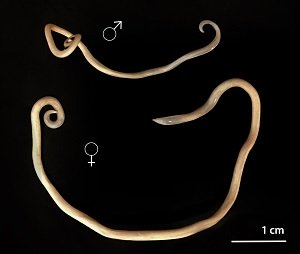
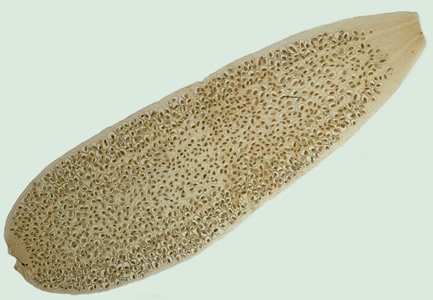
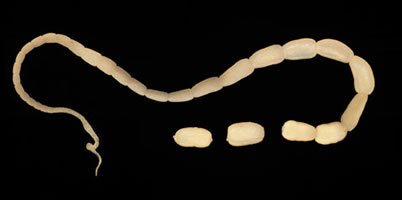
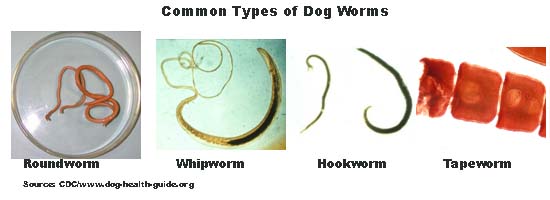
White worms in dog poop: what they mean
Most worms owners see are white or cream, and the size and shape tell you which worm it is.
Short, flat white pieces about ¼ to ½ inch, like rice or cucumber seeds; may stretch and crawl
Most likely: Tapeworm segments (Dipylidium caninum)
Details: Each segment is a packet of eggs that breaks off the end of the worm. Fresh ones are about 12 mm by 3 mm and move; dried ones shrink to about 2 mm, hard and yellowish.[11][13] You'll often see them under the tail or on bedding rather than in the poop itself.[4]
Long, round, cream or white worms an inch to several inches long, smooth, often curled
Most likely: Roundworms (Toxocara canis or Toxascaris leonina)
Details: Adults are stout and cream-colored, usually 2 to 6 inches (5 to 15 cm) long, with tapered ends.[7][12] They are often passed in poop, and sometimes vomited, particularly by puppies and after deworming.[1][7]
Tiny, thin white worms wriggling in poop that has been outside
Most likely: Fly larvae (maggots) or free-living soil worms
Details: Not a dog parasite. Flies lay eggs on feces that isn't fresh, and soil-living worms move into poop left on grass.[9][10] See look-alikes.
Thin, thread-like worms in fresh poop
Most likely: Uncommon; ask your vet
Details: Hookworms (under an inch) are very hard to see with the naked eye.[2][21] Whipworms are thin, about 1½ to 3 inches long, and are diagnosed by finding their eggs in a stool test rather than by owners spotting them.[3] Bring a sample so your vet can check.
Can you tell tapeworm types apart by eye? Not reliably. The flea tapeworm is by far the most common. Dogs that hunt or eat rabbits, rodents or raw offal can pick up Taenia tapeworms, and in some regions Echinococcus, which can be serious for people. Your vet can tell them apart, so mention if your dog hunts.[5][18]
Black, red, yellow or pink? Other colors explained
Yellow, golden or tan specks stuck to fur or bedding
What it usually means: Dried tapeworm segments[13][20]
Urgency: Routine vet visit plus flea control
Pink to tan worm in vomit
What it usually means: Roundworm, or Physaloptera stomach worm (1 to 2½ inches)[1][6]
Urgency: Call your vet today
Red streaks or fresh blood with mucus
What it usually means: Bleeding in the large intestine. Whipworms are one cause; colitis from other causes is common[3]
Urgency: Within a day; same day if weak or vomiting, and same day for any puppy
Black, tarry poop
What it usually means: Digested blood (melena), not black worms. Hookworm is one cause, especially in puppies[2]
Urgency: Same day; emergency in puppies or with pale gums
Brown or black "worms"
What it usually means: No common dog worm is brown or black. Usually plant fibers, food or debris
Urgency: Bring a sample if unsure
Things that look like worms but aren't
- Maggots (fly larvae). Flies are drawn to dog poop, and their eggs hatch within 8 to 20 hours in warm weather.[19] If the poop sat outside overnight or longer, wriggling white "worms" are usually maggots. Tapeworm segments are easy to mistake for maggots, too.[11] The test: look at a fresh poop.
- Free-living soil worms. Poop left on soil or grass can be invaded by worms that live in the environment, most too small to see, which is one reason vets want fresh samples.[9]
- Earthworms. An earthworm on or under poop in the yard isn't a dog parasite. But dogs that eat earthworms can pick up roundworm larvae from them.[1]
- Mucus strands. Clear or white slimy strings that break apart are mucus. A little is normal; a lot, especially with blood, points to colitis.
- Undigested food and plant material. Rice, noodles, bean sprouts, grass blades and fibrous fruit or vegetables can look like worms. They don't move, they break apart, and they usually match something your dog ate.
- String, hair and toy fibers. Common in dogs that chew. If your dog passes string or fabric and is vomiting or not eating, call your vet: swallowed string can cause a blockage. Never pull on string or fabric hanging from your dog's bottom; let your vet remove it.
- Pinworms. Dogs don't get pinworms. People are the only natural host of human pinworm, so your dog can't be the source if your child has them.[14]
Found worms in your dog's poop? What to do now
- Check your dog. Look at the gums (pink is good; pale or white is an emergency), energy, appetite and belly. If anything in the emergency list applies, call your vet now.
- Bag a sample. Using a poop bag or gloves, put the worm or segment and about a teaspoon of fresh poop in a sealable plastic bag or container. Fresh means just passed, not picked up off the grass hours later.[9]
- Keep it cool. If you can't get it to the vet within 2 hours, refrigerate it (away from food). A sample left at room temperature for more than 6 hours is no longer reliable.[9]
- Take a photo next to a coin or ruler, in case the sample dries out. Size and shape help your vet identify it.
- Call your vet. Different worms need different medicines: most roundworm products don't kill tapeworms, and tapeworm tablets don't kill roundworms. Identification first saves money and time.
- Start flea control for every dog and cat in the home if you saw tapeworm segments. Without it, tapeworms come straight back.[13]
- Clean up and wash hands. Pick up all poop in the yard and wash your hands well (see below).
Can't reach your vet?
You can ask a licensed veterinarian online now through JustAnswer (a paid service; we may earn a commission). Have a clear photo of what you found ready. In an emergency, go to your nearest emergency clinic.
Why a stool test still matters, even if you saw the worm
What you see and what the lab sees are different. Hookworm and whipworm infections are almost never visible to owners and are found by microscopic eggs. Tapeworms are the opposite: owners spot the segments, but routine stool tests often miss them.[4][18] That's because tapeworms don't usually release eggs into the stool; they shed whole segments packed with eggs, which crawl out and break open outside the body.[25] In a 2023 study of 877 U.S. dogs, a standard flotation test found flea tapeworm in none of the pet dogs, while a newer antigen test found it in 2.2%. (The study was funded by IDEXX, which makes that antigen test.)[17] So tell your vet exactly what you saw, and don't skip the test because you think you know the answer: dogs can carry more than one kind of worm.
Over-the-counter treatment
If your vet has confirmed tapeworms, or you are confident you saw tapeworm segments, praziquantel tapeworm tablets are sold without a prescription. For roundworms and anything else, check with your vet first, especially for puppies under 6 weeks old or very small dogs, because dosing is by weight and some products don't cover every worm. Garlic, pumpkin seeds, diatomaceous earth and other "natural dewormers" are not proven to work; see our worms guide for details.
Praziquantel tapeworm tablets for dogs
Use it for: Tapeworm segments you have seen, along with flea control
Where to get it: Praziquantel tablets on Amazon
As an Amazon Associate we earn from qualifying purchases. Follow the label dose for your dog's weight.
Worms in dog poop after deworming
Seeing worms after a dewormer is usually a good sign. Many dewormers, including pyrantel, paralyze roundworms so the gut pushes them out, often still intact.[23] They may be dead or still moving slightly. Here is what to expect:
- Roundworms: you may see worms in the poop for several days after the dose. Many dewormers only kill adult worms, so your vet will usually repeat the dose 10 to 14 days later, then recheck a stool sample 7 to 14 days after that.[7] Puppies are dewormed every 2 weeks until about 3 months old.[7]
- Tapeworms: you usually won't see them after treatment, because praziquantel causes the worm to be digested.[20] New segments a few weeks later usually mean reinfection from fleas or hunting, or occasionally that treatment didn't work; tell your vet.[4][20]
- Hookworms and whipworms: you probably won't see anything. Ask for the follow-up stool test, because some U.S. hookworms are now resistant to common dewormers. Retired racing greyhounds are especially likely to carry resistant hookworms.[2][8][29]
Call your vet if you still see live worms more than a week after finishing the full course, if your dog develops diarrhea or vomiting that lasts more than a day, or if your dog seems unwell. See our page on diarrhea after deworming.
Cleaning up: yard, house and bedding
The good news: roundworm, hookworm and whipworm eggs in fresh poop are not immediately infective. They need time in the environment first, so picking up poop promptly prevents most new infections.[2][3][15] The exception is the Echinococcus tapeworm, whose eggs are infective right away (see below).[5]
Hookworm
Time before infective: About 2 to 9 days[2]
How long they survive: A few months in warm, moist conditions; freezing usually kills them[2]
Roundworm
Time before infective: About 2 to 4 weeks[7]
How long they survive: Months to years in moist, shaded soil[1][15][28]
Whipworm
Time before infective: About 9 to 21 days, sometimes longer[3]
Flea tapeworm
Time before infective: Not spread through poop: dogs and people get it by swallowing an infected flea[13]
How long they survive: Control fleas in the home and yard
- Yard: pick up poop at least daily, and right away in public places.[1] Bag it and put it in the trash, not the compost. Keep dogs off areas where poop has built up, and cover sandboxes.
- Don't count on bleach. Roundworm eggs are very resistant to household disinfectants. In a lab study, 2.4% sodium hypochlorite (diluted bleach) for up to an hour did not stop roundworm eggs from developing.[1][16] What helps is removing poop, letting hard surfaces dry out, steam cleaning runs and kennels, and, for badly contaminated soil, replacing the top layer or paving it.[1][15]
- Inside the house: clean up any accident right away with gloves and paper towels, then wash the area with hot soapy water. You don't need to deep-clean the whole house for roundworms; eggs need weeks to mature and indoor accidents cleaned up quickly are low risk.
- Bedding: wash bedding that had poop or tapeworm segments on it in hot water. For tapeworms, vacuum carpets and furniture and treat every pet for fleas, because flea larvae live in carpets, along baseboards and in pet bedding.[24]
Can I catch worms from my dog's poop?
Some dog worms can infect people, but sensible hygiene prevents almost all of it.
- Roundworms: people are infected by swallowing eggs that have matured in soil, not usually from fresh poop. Young children who play in dirt or sandboxes are most at risk.[15]
- Hookworms: larvae in contaminated soil or sand can burrow into bare skin and cause itchy, winding tracks. Wear shoes outdoors and gloves when gardening.[2]
- Tapeworms: you can't catch the flea tapeworm from touching segments. People, almost always children, get it by swallowing an infected flea.[13]
- Echinococcus tapeworm: unlike the others, its eggs are infective as soon as they are passed. If your dog hunts or eats rodents or raw offal, wear gloves when handling poop and ask your vet about it.[5]
Can I touch, cuddle or let my dog lick me? Yes, with common sense. Petting a dog with worms is low risk. Roundworm eggs have been found on dogs' fur, but researchers say the kind that can infect people are rare there, especially on well-cared-for dogs.[26][27] Wash your hands after handling your dog and especially after picking up poop, even with a bag, and supervise children under 5 around dogs.[22] Until treatment is finished, it's also sensible to keep your dog's face away from small children's faces.
Planning for the cost of treatment
A dewormer is inexpensive, but an emergency visit for a puppy with hookworm anemia or a blockage can cost far more. Pet insurance helps only with problems that start after your policy does, so it pays to insure early.
One option to compare is Haven Pet Insurance. Haven says it reimburses up to 90% of covered vet bills, has no lifetime caps, and lets you use any licensed vet in the U.S. Read the sample policy and get at least one other quote before you decide. See our guide to pet insurance for dogs.
This is a referral link. We may be compensated if you get a quote or buy a policy through it.
What the research shows
- Stool tests miss most flea tapeworm infections. In 877 U.S. dogs, flotation found flea tapeworm in 0% of pet dogs versus 2.2% with an antigen test; in shelter dogs, 0.3% versus 12.5%. The study was funded by the antigen test's maker.[17]
- Adding an antigen test finds more hidden worms. In the same study, combining tests raised hookworm detection from 8.4% to 13.8% and whipworm from 1.4% to 2.9%.[17]
- Bleach doesn't reliably kill roundworm eggs. Six common disinfectants, including 2.4% sodium hypochlorite for up to 60 minutes, failed to stop Toxocara canis eggs from developing.[16]
- Puppies are the big source. More than 30% of U.S. dogs under 6 months old shed roundworm eggs.[1]
- Hookworms are fast. Their larvae can become infective in soil within about 2 to 9 days, much faster than roundworm eggs, which is why daily pickup matters most where hookworms are common.[2]
Frequently Asked Questions
What do white worms in dog poop mean?
Short, flat, rice-like white pieces are tapeworm segments, which dogs get from swallowing fleas. Long, round, cream-colored worms several inches long are roundworms. Tiny white wriggling worms in poop that has sat outside are usually fly larvae. Bag a fresh sample and call your vet to confirm.
What should I do if I find worms in my dog's poop?
Check your dog's gums and energy, bag about a teaspoon of fresh poop with the worm, refrigerate it if you can't get to the vet within 2 hours, and call your vet. Go to a vet or emergency clinic now for pale or white gums or weakness, and the same day for a puppy with many worms, black tarry poop, bloody diarrhea or repeated vomiting.
How long will my dog poop worms after deworming?
Usually a few days after each dose of a roundworm dewormer. Tapeworms are usually digested and not seen. If you still see live worms more than a week after finishing the full course, call your vet.
Are worms in dog poop contagious to humans?
Some are. Roundworm eggs become infective after weeks in soil, and hookworm larvae in soil can enter bare skin. People get the flea tapeworm only by swallowing an infected flea. Pick up poop promptly, wash your hands and keep children from playing where dogs defecate.
Do I need to clean my house if my dog has worms?
Not a deep clean. Clean up accidents right away and wash bedding in hot water. For tapeworms, vacuum and treat every pet for fleas. Focus most effort on picking up poop in the yard, because that is where eggs mature.
Can I touch my dog if it has worms?
Yes. Petting is low risk. Wash your hands after handling your dog or its poop, and keep its face away from small children's faces until treatment is finished.
Do worms in dog poop move?
Fresh tapeworm segments often stretch and crawl. Roundworms may be alive or dead, especially after deworming. Wriggling worms in poop that has been outside for hours are usually maggots.
Can a dog have worms without worms in its poop?
Yes, and many do. Hookworm and whipworm infections are rarely visible, and roundworm eggs are microscopic. That is why vets recommend regular stool tests and a monthly preventive that covers intestinal worms.
Can dogs get pinworms?
No. Human pinworm infects only people, so a dog can't give pinworms to your family or get them from you.
Related guides: Worms in dogs: types, signs and treatment · Roundworms · Tapeworms · Hookworms · Whipworms · Worms in puppies · Fleas · Can you see heartworms in poop? · Dog diarrhea
Sources
- Companion Animal Parasite Council. Ascarid (Toxocara, Toxascaris). Updated February 2025.
- Companion Animal Parasite Council. Hookworms. Updated November 2026.
- Companion Animal Parasite Council. Trichuris vulpis (whipworm). Updated February 2025.
- Companion Animal Parasite Council. Dipylidium caninum. Updated February 2025.
- Companion Animal Parasite Council. Echinococcus spp. Updated November 2026.
- Companion Animal Parasite Council. Physaloptera spp. (stomach worm). Updated July 2015.
- Peregrine AS. Roundworms in Small Animals. Merck Veterinary Manual. Updated July 2026.
- Merck Veterinary Manual. Hookworms in Small Animals. Updated August 2026.
- Conboy G. Parasitology in Veterinary Practice. Merck Veterinary Manual. May 2025.
- Merck Veterinary Manual. Pseudomyiasis in Animals. October 2026.
- Centers for Disease Control and Prevention, DPDx. Dipylidium caninum. 2019.
- Centers for Disease Control and Prevention, DPDx. Toxocariasis. 2019.
- Centers for Disease Control and Prevention. About Dog or Cat Tapeworm Infection. May 2026.
- Centers for Disease Control and Prevention, DPDx. Enterobiasis (pinworm). 2019.
- Center for Food Security and Public Health, Iowa State University. Toxocariasis (factsheet). 2016.
- Ursache AL, et al. Is routine disinfection efficient in preventing contamination with Toxocara canis eggs? Journal of Helminthology. 2020;94:e60.
- Little S, et al. Diagnosis of canine intestinal parasites: Improved detection of Dipylidium caninum infection through coproantigen testing. Veterinary Parasitology. 2023;324:110073. Funded by IDEXX Laboratories; several authors are IDEXX employees.
- Jesudoss Chelladurai J. Canine Tapeworms. Today's Veterinary Practice. 2021.
- University of Florida IFAS Extension. House Fly, Musca domestica (EENY-048). Revised December 2023.
- VCA Animal Hospitals. Tapeworm Infection in Dogs. January 2026.
- VCA Animal Hospitals. Hookworm Infection in Dogs. June 2025.
- Centers for Disease Control and Prevention. Healthy Pets: Dogs. June 2026.
- Merck Veterinary Manual. Mechanisms of Action of Anthelmintics. April 2025.
- Companion Animal Parasite Council. Fleas. 2017.
- Payne PA, Carter GR. Internal parasitic diseases of dogs and cats. In: A Concise Guide to Infectious and Parasitic Diseases of Dogs and Cats. IVIS, 2005.
- Holland C. The significance of Toxocara eggs on the hair of dogs and cats. EVC Voorjaarsdagen, Amsterdam, 2015. International Veterinary Information Service (IVIS).
- Holland C. Toxocara, the enigmatic parasite: the challenges remain. EVC Voorjaarsdagen, Amsterdam, 2015. IVIS.
- Little S. Customized approach to parasite control: risk assessment and routine deworming of pets. Latin American Veterinary Conference, Lima, 2010. IVIS.
- IVIS Veterinary News. Multiple-drug resistance in canine hookworm: an emerging problem (summary of Jimenez Castro et al., 2019). IVIS, 2020.
This article is general information, not veterinary advice. Dog Health Guide is owned and operated by Web Ventures of New York, Inc.


